The Completion of The Communist Manifesto (Misdated Claim)
1847 · London, United Kingdom
The first edition of The Communist Manifesto was completed by Karl Marx and Friedrich Engels.
February 21, 1848
The Communist Manifesto, written by Karl Marx and Friedrich Engels, was published in London. It became one of the world's most influential political documents.
London, United Kingdom | Communist League
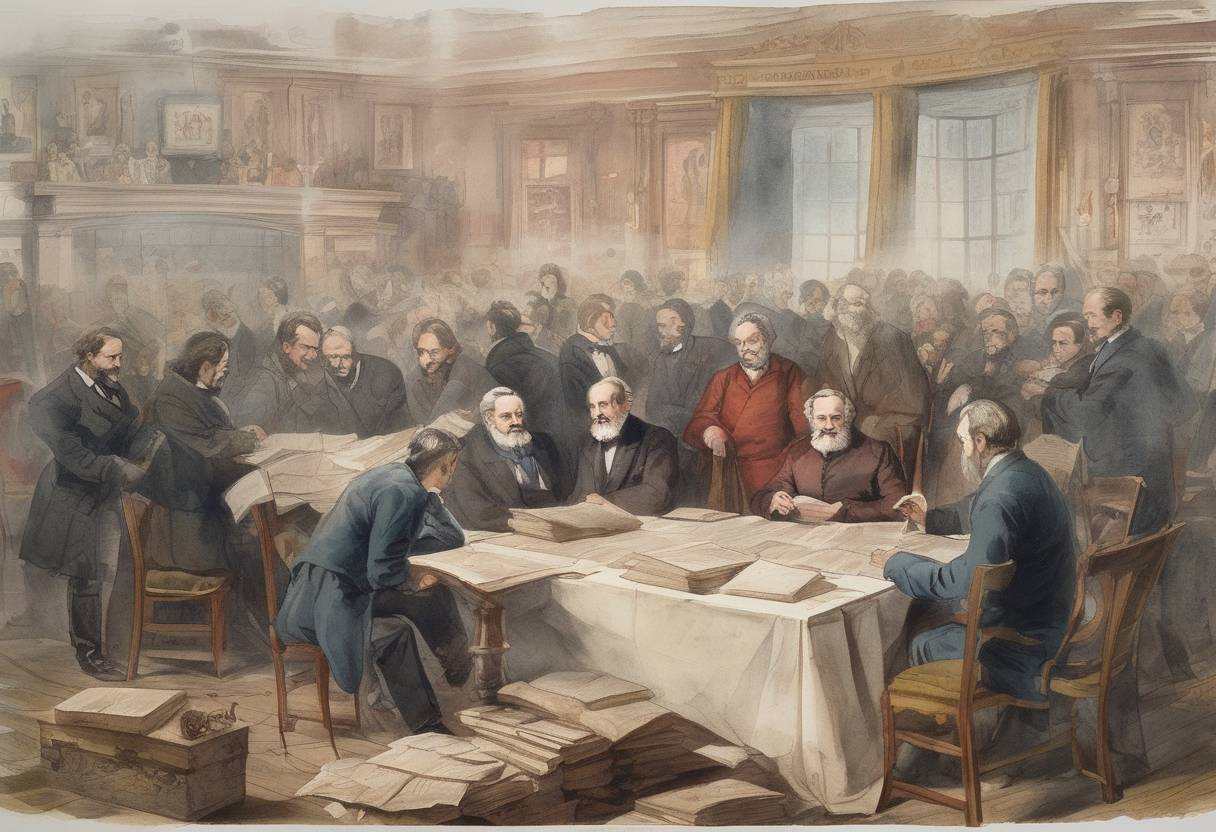
On February 21, 1848, The Communist Manifesto, authored by Karl Marx and Friedrich Engels, was published in London. This seminal document would go on to become one of the most influential political texts in history, laying the foundation for modern socialist and communist movements.
The mid-19th century was a period of significant social and economic upheaval in Europe. The Industrial Revolution had transformed economies, leading to the rise of a capitalist system characterized by stark class divisions. The working class, or proletariat, faced harsh working conditions, low wages, and limited rights, while the bourgeoisie, or capitalist class, accumulated wealth and power.
Karl Marx and Friedrich Engels, both German philosophers and social scientists, were deeply influenced by these conditions. They were members of the Communist League, an international political group that sought to address the inequalities of capitalism. The League commissioned Marx and Engels to write a manifesto that would articulate their goals and principles.
The Communist Manifesto is structured into four sections:
Bourgeois and Proletarians: This section outlines the historical development of class struggles, emphasizing the conflict between the bourgeoisie and the proletariat. It argues that capitalism inherently leads to the exploitation of the working class.
Proletarians and Communists: Here, Marx and Engels describe the role of communists as advocates for the proletariat. They call for the abolition of private property and the establishment of a classless society.
Socialist and Communist Literature: This section critiques other socialist and communist movements of the time, distinguishing the scientific socialism of Marx and Engels from other ideologies.
Position of the Communists in Relation to the Various Existing Opposition Parties: The final section discusses the relationship between communists and other political parties, emphasizing the need for international solidarity among workers.
The publication of The Communist Manifesto coincided with a wave of revolutionary movements across Europe in 1848, known as the Revolutions of 1848. Although these uprisings were largely unsuccessful in the short term, they highlighted widespread discontent with the existing social and political order.
Over time, the manifesto’s influence grew, particularly as socialist and communist movements gained traction in the late 19th and early 20th centuries. It provided a theoretical framework for understanding class struggle and inspired numerous political leaders and movements, including the Bolshevik Revolution in Russia in 1917.
The ideas presented in The Communist Manifesto have been subject to extensive debate and interpretation. While some view it as a blueprint for totalitarian regimes, others see it as a call for social justice and equality. Despite differing perspectives, its impact on political thought and history is undeniable.
Today, the manifesto remains a critical text for understanding the development of socialist and communist ideologies. It continues to be studied and referenced in discussions about economic systems, class dynamics, and social change.
In summary, the publication of The Communist Manifesto on February 21, 1848, marked a pivotal moment in political history, providing a powerful critique of capitalism and a vision for a more equitable society.
Source: en.wikipedia.org