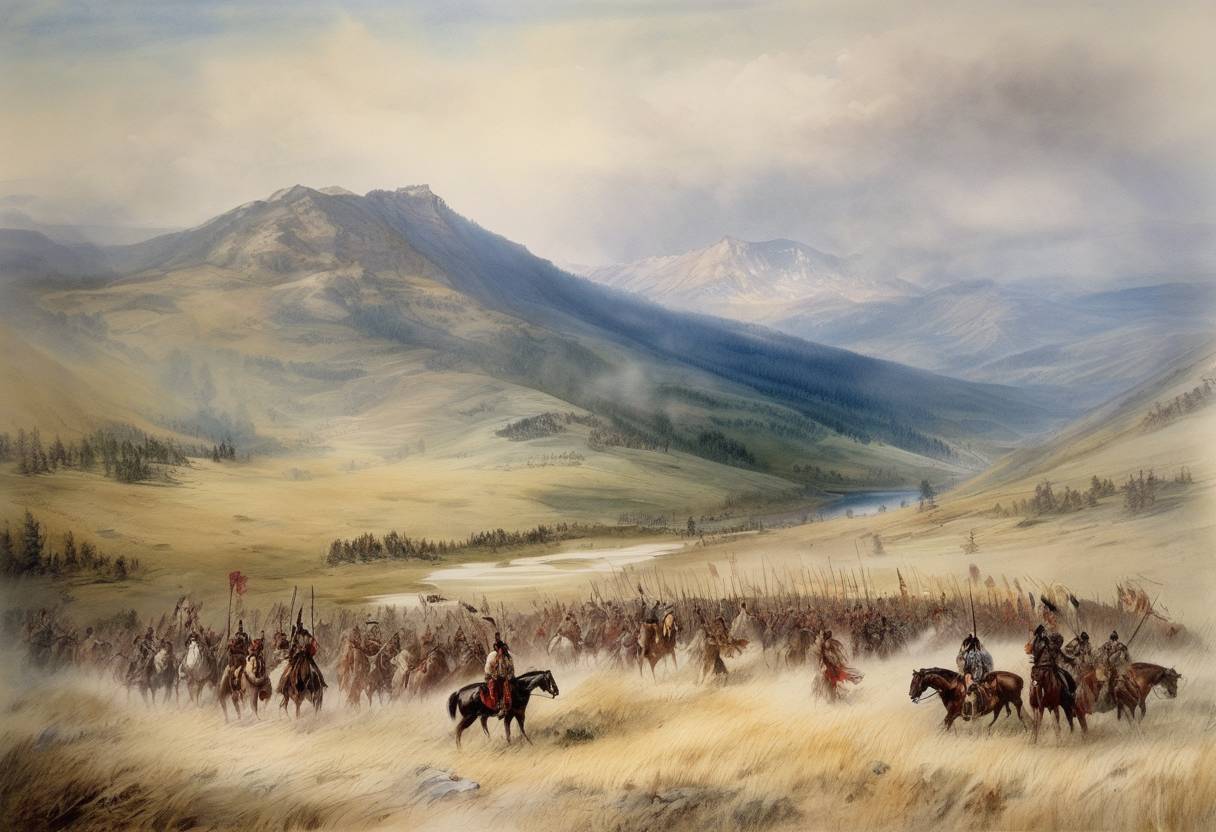
Capture of Chief Joseph and the Nez Perce at Bear Paw Mountain
On October 5, 1877, the Nez Perce War came to a crucial conclusion when U.S. Army forces captured Chief Joseph and his people at Bear Paw Mountain, Montana. This event marked the end of the Nez Perce’s arduous attempt to escape capture by fleeing towards Canada.
Background
The Nez Perce War began in June 1877, following escalating tensions between the Nez Perce tribe and the United States government. These tensions arose due to the U.S. government’s attempts to force the Nez Perce from their ancestral lands in the Wallowa Valley of northeastern Oregon onto a much smaller reservation in Idaho, as mandated by the 1863 Treaty of Lapwai. Many Nez Perce bands refused to accept these terms, leading to violent conflicts.
The Flight Towards Canada
In a remarkable display of strategic retreat, approximately 800 Nez Perce men, women, and children, many led by the tactically astute Chief Joseph, embarked on a harrowing journey of more than 1,170 miles. Despite being heavily outnumbered and pursued by U.S. troops, the Nez Perce fought several battles and skillfully evaded capture for several months.
The Stand at Bear Paw Mountain
By October 1877, the Nez Perce had hoped to find refuge in Canada, seeking asylum with the Sioux led by Sitting Bull, who had fled there earlier. However, just 40 miles short of the Canadian border, the Nez Perce were cut off by U.S. forces led by Colonel Nelson A. Miles at Bear Paw Mountain. A five-day standoff ensued, characterized by freezing temperatures and dwindling supplies among the Nez Perce.
Chief Joseph’s Surrender and Legacy
On October 5, 1877, understanding the dire situation and prioritizing the lives of his people, Chief Joseph made the decision to surrender. His speech, which has become a poignant symbol of Native American resistance and perseverance, famously concluded with the words: “From where the sun now stands, I will fight no more forever.”
Aftermath
The surrender at Bear Paw Mountain did not bring justice or immediate peace to the Nez Perce. Chief Joseph and his people were initially promised a return to their ancestral lands, but they were instead relocated to reservations in Kansas and later Oklahoma. It was not until 1885 that they were allowed to return to the Pacific Northwest, but they were not allowed to settle in their beloved Wallowa Valley.
The legacy of Chief Joseph and the Nez Perce War remains significant in American history, serving as a powerful narrative of resistance, hardship, and the enduring quest for justice among Native American tribes.