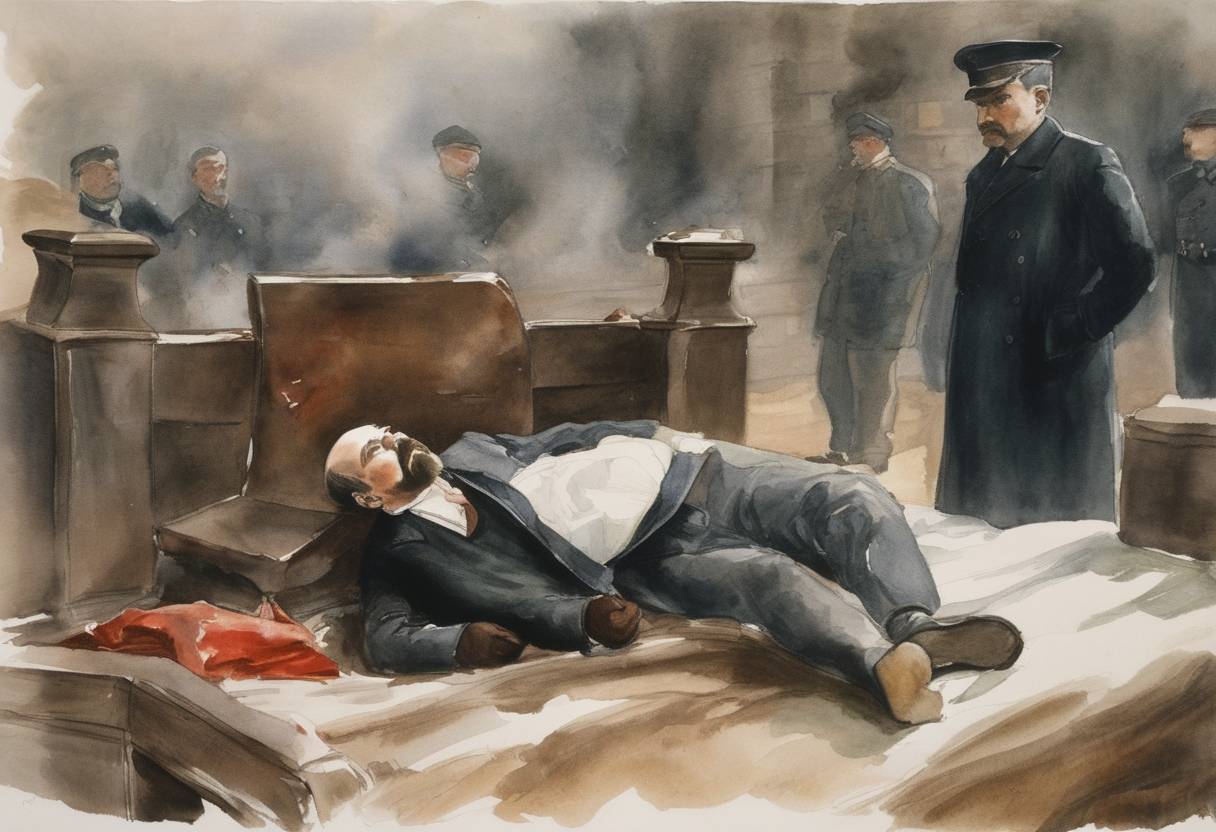
Assassination Attempt on Vladimir Lenin: August 30, 1918
On August 30, 1918, Vladimir Lenin, the leader of the Bolshevik Revolution and head of the Soviet Russian government, survived an assassination attempt by Fanny Kaplan. This pivotal event occurred in Moscow as Lenin was leaving a factory meeting at the Michelson Works.
Background of the Event
In the chaotic environment following the Russian Revolution of 1917, the new Bolshevik government faced intense opposition from various factions, including monarchists, foreign enemies, and revolutionaries disenchanted with the Bolshevik’s direction. Among the internal dissent was Fanny Kaplan, a member of the Socialist Revolutionary Party, who opposed Lenin’s policies and viewed him as a betrayer of the revolution.
The Assassination Attempt
On the aforementioned evening, Lenin delivered a speech to workers at the Michelson Arms Factory in Moscow. As Lenin exited the building and approached his car, Kaplan fired three shots at him from a close range. Lenin was struck twice, once in the shoulder and once in the neck. Despite his severe injuries, Lenin struggled inside the vehicle, preventing further immediate attack.
Aftermath and Consequences
Despite the serious nature of his injuries, Lenin avoided surgery for the removal of one of the bullets, which remained embedded close to his neck for the rest of his life. Nevertheless, he survived and quickly returned to work, becoming even more zealous in his leadership.
The assassination attempt had significant repercussions. It prompted the Bolsheviks to intensify the Red Terror, a campaign to eliminate real or perceived enemies of the Bolshevik regime. This marked a period of remarkable violence and political purges against counter-revolutionaries and political adversaries. The attempt on Lenin’s life further solidified his authority and justified stricter government measures to consolidate power.
Fanny Kaplan was apprehended shortly after the shooting. Having confessed to the crime, she expressed no remorse for her actions against Lenin. Kaplan was executed by the Bolsheviks on September 3, 1918, just a few days after the assassination attempt, without facing a formal trial.
Historical Significance
The assassination attempt on Lenin was emblematic of the tumultuous period following the Bolshevik Revolution. It highlighted the severe political tensions and conflicts that plagued the nascent Soviet state. Additionally, the event underscored Lenin’s precarious position and the substantial opposition he faced internally, even from those who had initially supported revolutionary change in Russia.