Papal Sanction of the Knights Templar: January 13, 1128
1128 · Rome, Italy
Pope Honorius II grants a papal sanction to the military order known as the Knights Templar, declaring it to be an army of God.
February 18, 1268
The Livonian Brothers of the Sword, a military order, are dissolved by Pope Clement IV.
Unknown, Modern-day Latvia and Estonia | Catholic Church
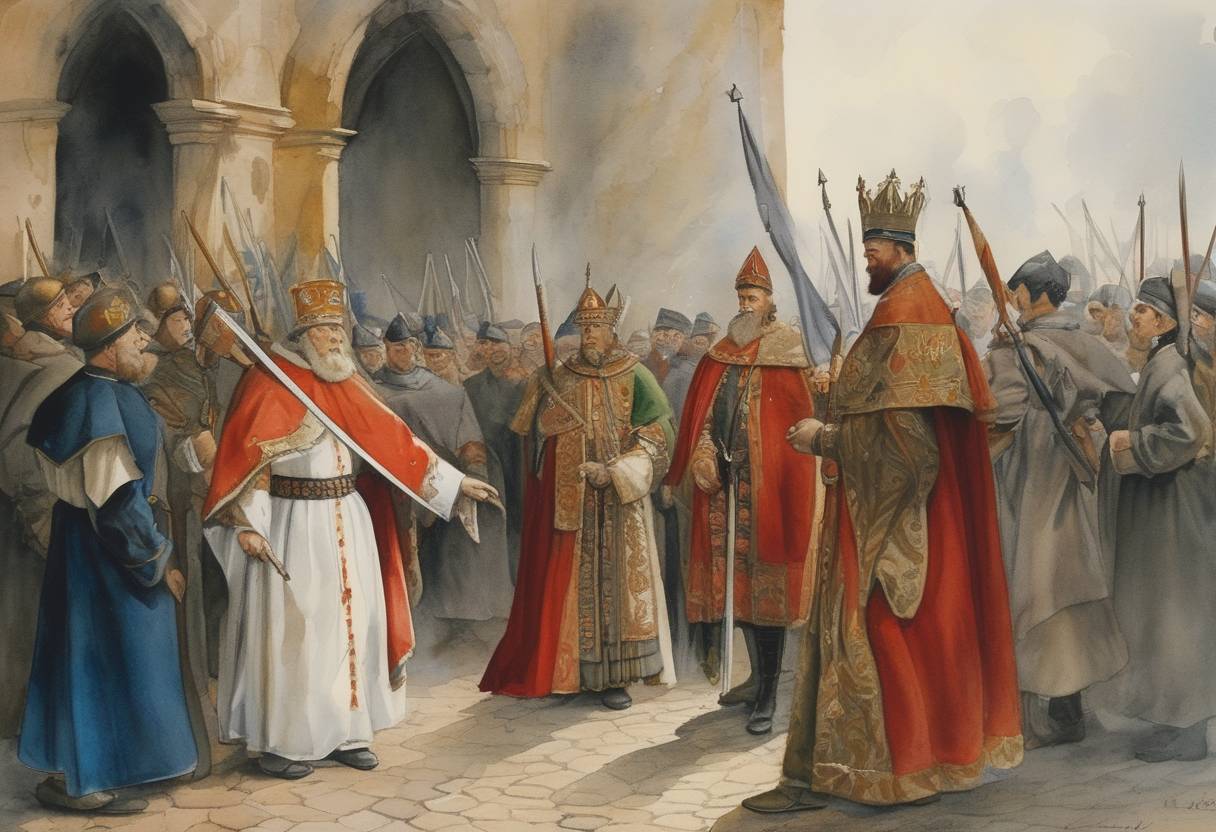
On February 18, 1268, the Pope Clement IV formally dissolved the Livonian Brothers of the Sword, also known as the Livonian Order. This military order had been established in 1202 by Albert of Riga to aid the Christianization and military conquest of the Baltic region known as Livonia, which includes modern-day Latvia and parts of Estonia.
The Livonian Brothers of the Sword were originally instituted as an autonomous crusading order akin to the Teutonic Knights, with the mission to convert the pagan tribes of the Baltic region to Christianity and extend the influence of the Church. The order had been instrumental in advancing the Northern Crusades alongside German and Danish interests in the region.
The brothers’ militaristic approach often led to conflicts not only with the indigenous peoples but also among the Christian factions themselves, including altercations with bishops in the area due to their overreaching ambition and execution of power. A notable defeat that affected their standing occurred at the Battle of Saule in 1236. This defeat significantly weakened the order and forced its merger with the Teutonic Knights soon thereafter.
Pope Clement IV’s decree to dissolve the Livonian Brothers of the Sword came after persistent internal problems and a failure to independently sustain their position. By this point, their operational integrity and military capability had diminished, overshadowed by their more robust counterparts, the Teutonic Knights.
Following the dissolution, the remnants of the Livonian Brothers were absorbed into the Teutonic Order. The integration effectively marked the end of the Livonian Order as an independent entity, reinforcing Teutonic dominance in the Baltic Crusades and the regional power dynamics.
The dissolution exemplified the challenges faced by military orders over territorial jurisdiction, religious goals versus temporal governance, and internal cohesion against a backdrop of feudal Europe’s complex political landscape. As a consequence, the Teutonic Order was empowered to further expand its influence throughout the Baltic states, significantly impacting the history and culture of the region.
This realignment under the Teutonic Knights perpetuated the decline of indigenous cultures and significantly shaped the area’s subsequent historical trajectory. The dissolution marked both an end and a transformation; while the Livonian Order ceased to exist, its aspirations and conflicts were subsumed into the larger narrative of the Teutonic pursuits in Northern Europe.
Source: en.wikipedia.org