The Killing of Johan and Cornelis de Witt - August 20, 1672
1672 · The Hague, Netherlands
Johan de Witt, a prominent Dutch statesman, and his brother Cornelis were killed by a mob in The Hague during political turmoil within the Dutch Republic.
May 13, 1619
Dutch statesman Johan van Oldenbarnevelt was executed in The Hague after being accused of treason, marking a significant political event in the Dutch Republic.
The Hague, Dutch Republic | Dutch government
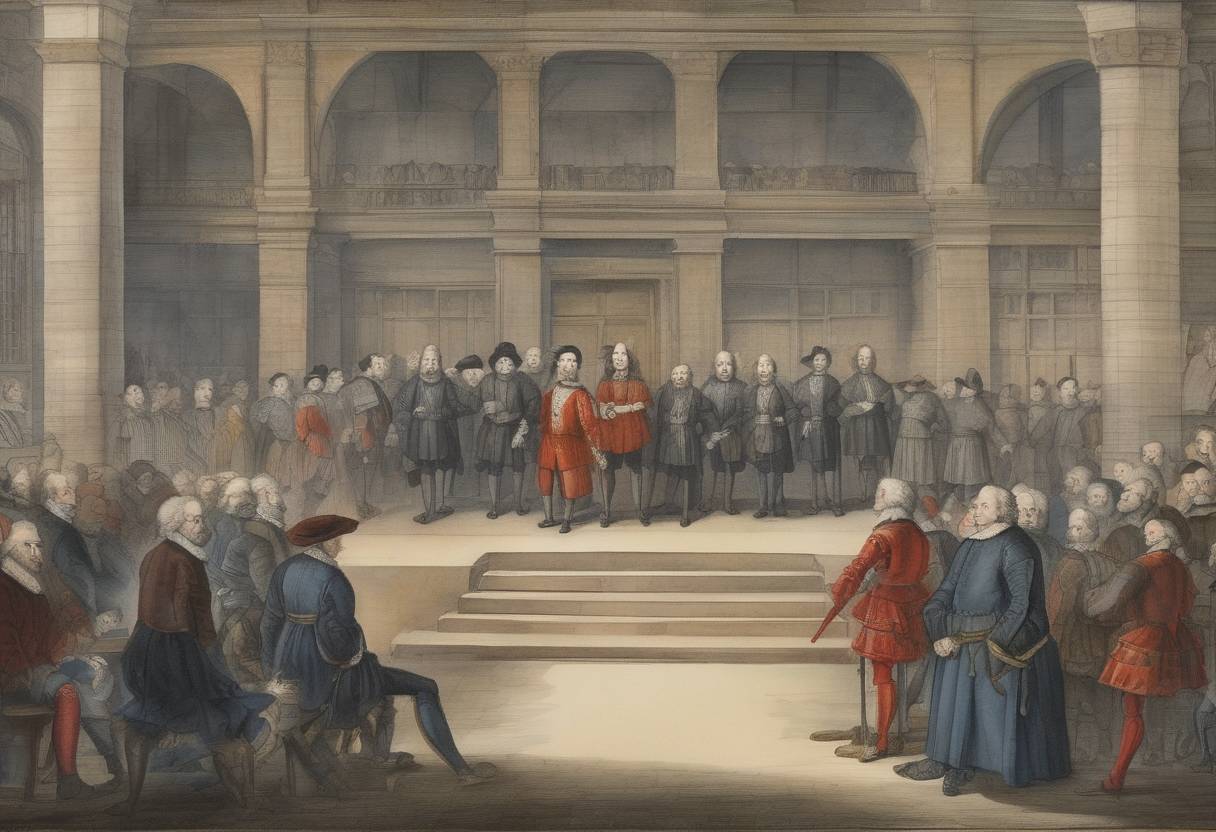
On May 13, 1619, Johan van Oldenbarnevelt, a prominent Dutch statesman, was executed in The Hague, marking a pivotal moment in the history of the Dutch Republic. His execution was the culmination of a complex political struggle that had significant implications for the young republic.
Johan van Oldenbarnevelt was born in 1547 and rose to become one of the most influential political figures in the Dutch Republic. As the Land’s Advocate of Holland, he played a crucial role in the Dutch struggle for independence from Spanish rule, known as the Eighty Years’ War. Van Oldenbarnevelt was instrumental in negotiating the Twelve Years’ Truce in 1609, which temporarily halted hostilities between the Dutch and the Spanish.
The early 17th century was a period of intense political and religious conflict within the Dutch Republic. Two main factions emerged: the Remonstrants, who supported a more lenient form of Calvinism and were led by van Oldenbarnevelt, and the Contra-Remonstrants, who adhered to a stricter interpretation of Calvinism and were supported by Maurice of Nassau, the Prince of Orange and the Republic’s military leader.
The conflict was not only religious but also political, as it involved issues of provincial autonomy versus centralized power. Van Oldenbarnevelt advocated for the rights of individual provinces to govern themselves, while Maurice favored a stronger central government.
The tensions between these factions reached a boiling point when van Oldenbarnevelt attempted to raise a local militia in Holland to counteract the influence of Maurice and his supporters. This move was perceived as a direct challenge to Maurice’s authority and led to van Oldenbarnevelt’s arrest in 1618.
Van Oldenbarnevelt was charged with treason, accused of conspiring against the state and attempting to undermine the authority of the Prince of Orange. His trial was highly controversial, as it was conducted by a special court composed of judges who were largely sympathetic to Maurice.
On May 13, 1619, Johan van Oldenbarnevelt was executed by beheading in The Hague. His death sent shockwaves through the Dutch Republic and was seen by many as a miscarriage of justice. The execution highlighted the deep divisions within the Republic and marked a shift in power towards a more centralized government under the influence of the House of Orange.
Van Oldenbarnevelt’s legacy is complex; he is remembered as a key architect of Dutch independence and a martyr for the cause of provincial rights. His execution underscored the fragile nature of the Dutch political system and the intense factionalism that characterized the early years of the Republic.
The execution of Johan van Oldenbarnevelt had lasting implications for the Dutch Republic. It solidified the power of the House of Orange and set a precedent for the centralization of authority. The event also served as a cautionary tale about the dangers of political and religious intolerance, themes that would continue to resonate throughout Dutch history.
In summary, the execution of Johan van Oldenbarnevelt on May 13, 1619, was a significant event that reflected the complex interplay of political, religious, and personal rivalries in the early Dutch Republic. It remains a poignant reminder of the challenges faced by emerging democratic systems in balancing power and justice.
Source: en.wikipedia.org