Emperor Arcadius Marries Aelia Eudoxia
395 · Constantinople, Eastern Roman Empire
Emperor Arcadius marries Aelia Eudoxia, the daughter of the Frankish general Flavius Bauto.
November 27, 0395
Rufinus, the Roman statesman and praetorian prefect of the East, was assassinated by Gothic mercenaries. His death marked a significant moment in the power struggles within the Eastern Roman Empire.
Constantinople, Eastern Roman Empire | Eastern Roman Empire
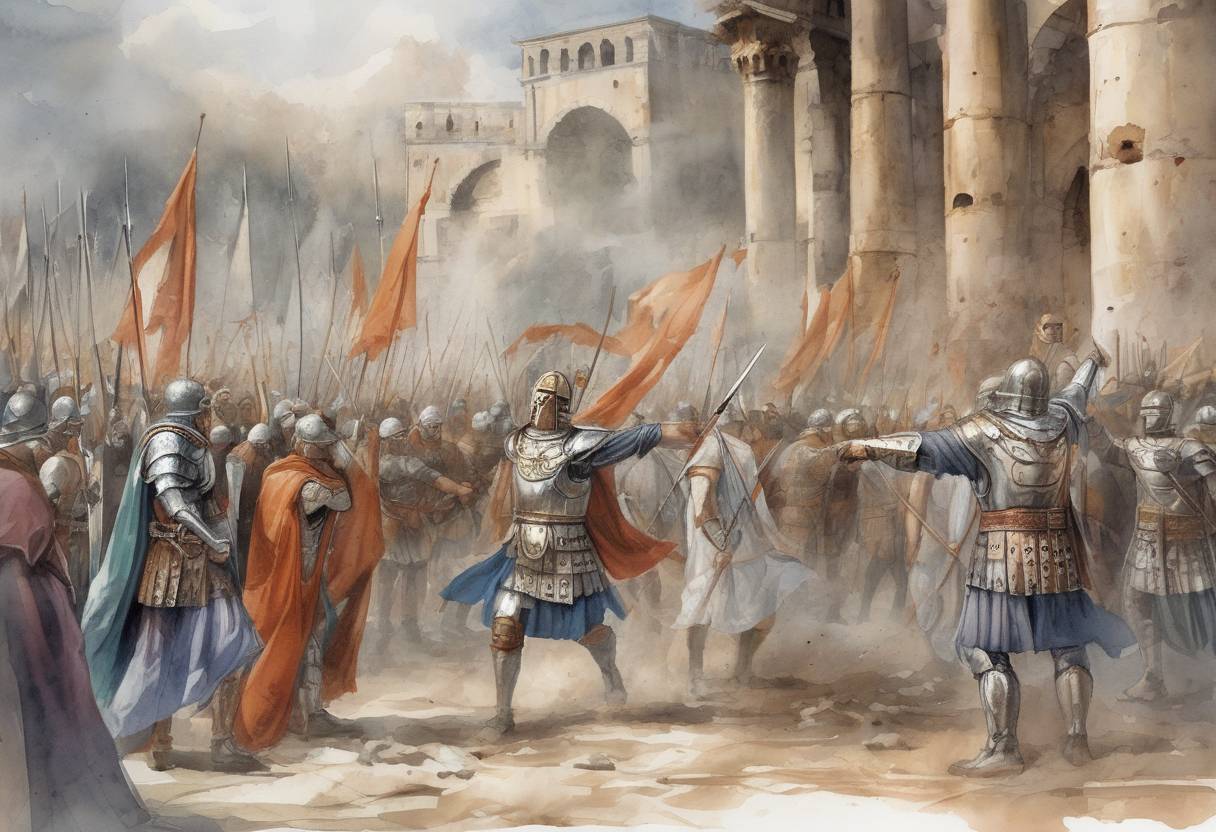
On November 27, 395, a pivotal event unfolded in the Eastern Roman Empire with the assassination of Flavius Rufinus, a prominent Roman statesman and the praetorian prefect of the East. His death marked a significant turning point in the internal power struggles of the empire during a period of considerable political instability.
Rufinus was a key political figure in the Eastern Roman Empire under Emperor Arcadius, who ascended to the throne in 395 following the death of his father, Theodosius I. As the praetorian prefect, Rufinus wielded substantial influence over the young and inexperienced emperor, effectively acting as the power behind the throne. His tenure was characterized by his ambition and the accumulation of power, which earned him numerous enemies within the imperial court.
The political landscape of the Eastern Roman Empire at the time was fraught with tension and rivalry. Rufinus’ primary adversary was Stilicho, the powerful general and regent for the Western Roman Empire under Emperor Honorius, Arcadius’ brother. The rivalry between Rufinus and Stilicho was emblematic of the broader East-West divide within the Roman Empire, with each seeking to extend their influence over both halves of the empire.
Rufinus’ assassination was orchestrated by Gothic mercenaries, who were under the command of Gainas, a Gothic general serving in the Roman army. The event took place near Constantinople, the capital of the Eastern Roman Empire. As Rufinus was addressing the troops, he was suddenly attacked and killed. The assassination was likely instigated by his political opponents, possibly with the tacit approval of Stilicho, who sought to eliminate Rufinus as a rival.
The death of Rufinus had immediate and far-reaching consequences for the Eastern Roman Empire. It temporarily destabilized the court of Arcadius, leading to a power vacuum that was quickly filled by Eutropius, another influential court official. The assassination underscored the volatile nature of Roman politics at the time, where military leaders and court officials often vied for control and influence.
In the broader context, Rufinus’ assassination highlighted the growing influence of barbarian groups, such as the Goths, within the Roman military and political spheres. This event foreshadowed the increasing reliance on and integration of barbarian forces in the Roman Empire, a trend that would have profound implications for its future stability and cohesion.
Rufinus’ death is a reminder of the complex interplay of power, politics, and military influence in the late Roman Empire, setting the stage for further conflicts and transformations in the years to come.
Source: en.wikipedia.org