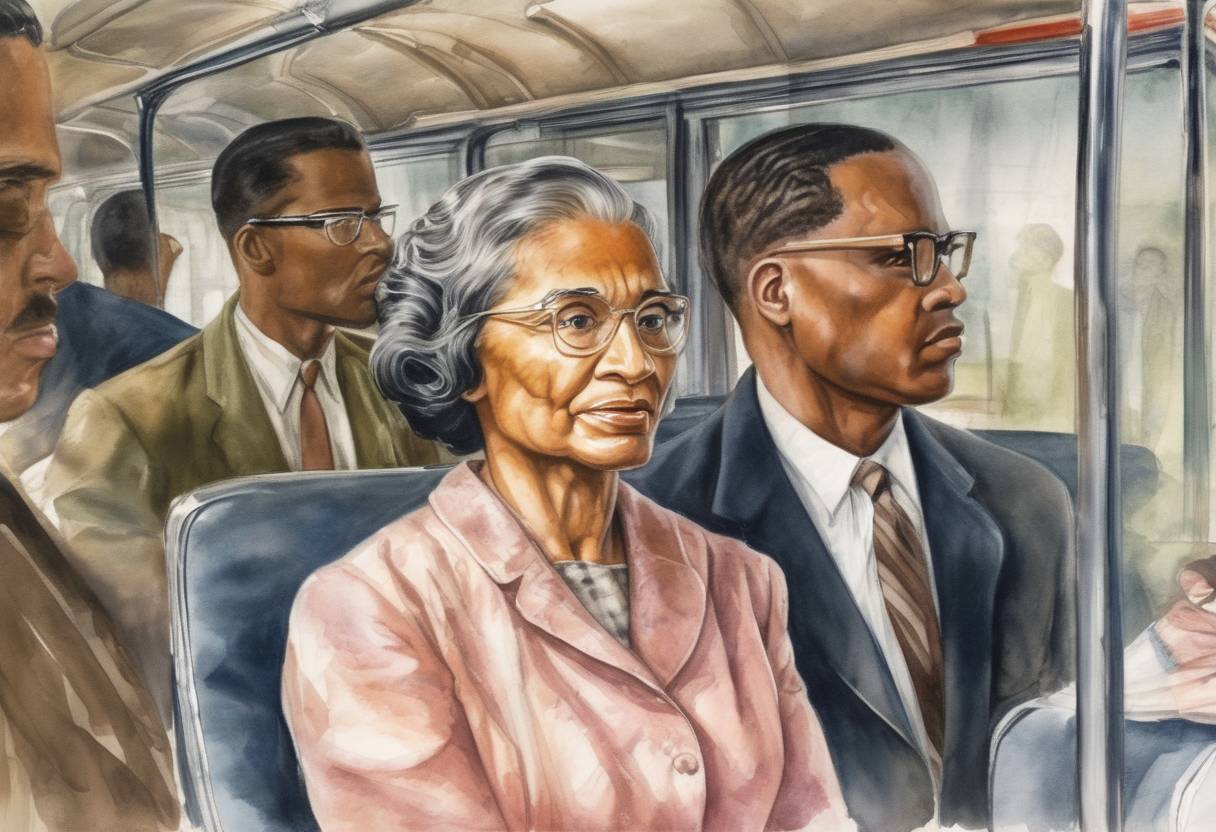
Rosa Parks and the Montgomery Bus Boycott
On December 1, 1955, Rosa Parks, an African American seamstress and civil rights activist, was arrested in Montgomery, Alabama, for refusing to give up her seat to a white passenger on a city bus. This act of defiance became a pivotal moment in the American Civil Rights Movement, leading to the Montgomery Bus Boycott.
Context and Background
Jim Crow Laws: At the time, the Southern United States was governed by Jim Crow laws, which enforced racial segregation in public facilities, including buses. African Americans were required to sit at the back of the bus and give up their seats to white passengers if the bus became full.
Civil Rights Activism: Rosa Parks was not the first to resist bus segregation, but her involvement with the NAACP (National Association for the Advancement of Colored People) and her respected status in the community made her a symbol of the struggle against racial injustice.
The Arrest
Incident: On the evening of December 1, 1955, Parks boarded a Montgomery city bus and sat in the first row of seats designated for black passengers. As the bus filled, the driver demanded that Parks and three other black passengers give up their seats for white passengers. Parks refused and was subsequently arrested for violating the city’s segregation laws.
Immediate Reaction: Parks’ arrest galvanized the African American community in Montgomery. Local civil rights leaders, including E.D. Nixon and Jo Ann Robinson, quickly organized a response.
The Montgomery Bus Boycott
Organization: The Montgomery Improvement Association (MIA) was formed to oversee the boycott, with a young pastor named Martin Luther King Jr. elected as its president.
Duration: The boycott began on December 5, 1955, and lasted for 381 days. African Americans in Montgomery refused to use the city buses, opting instead for carpools, walking, or other means of transportation.
Impact: The boycott severely impacted the finances of the bus company and drew national attention to the civil rights struggle. It also marked the rise of Martin Luther King Jr. as a prominent leader in the movement.
Legal and Social Consequences
Court Ruling: On November 13, 1956, the U.S. Supreme Court ruled in Browder v. Gayle that segregation on public buses was unconstitutional, leading to the desegregation of Montgomery’s buses on December 20, 1956.
Legacy: Rosa Parks’ courageous act and the subsequent boycott became symbols of the fight against racial segregation and injustice. The success of the boycott demonstrated the power of nonviolent protest and set the stage for future civil rights actions across the country.
Broader Historical Significance
The Montgomery Bus Boycott was a significant turning point in the Civil Rights Movement, highlighting the effectiveness of collective action and civil disobedience. It inspired other movements and protests, contributing to the eventual passage of the Civil Rights Act of 1964 and the Voting Rights Act of 1965, which dismantled legal segregation and secured voting rights for African Americans. Rosa Parks is remembered as the “mother of the civil rights movement,” and her legacy continues to inspire generations in the ongoing fight for equality and justice.