Invasion of Puerto Rico: July 25, 1898
1898 · Guánica, Puerto Rico
During the Spanish-American War, U.S. forces, led by General Nelson A. Miles, invaded Puerto Rico, beginning the island's transition from Spanish to American control.
July 1, 1898
The Battle of San Juan Hill took place in Cuba, with American forces, including future President Theodore Roosevelt, securing a crucial victory in the Spanish-American War.
Santiago de Cuba, Cuba | United States Army
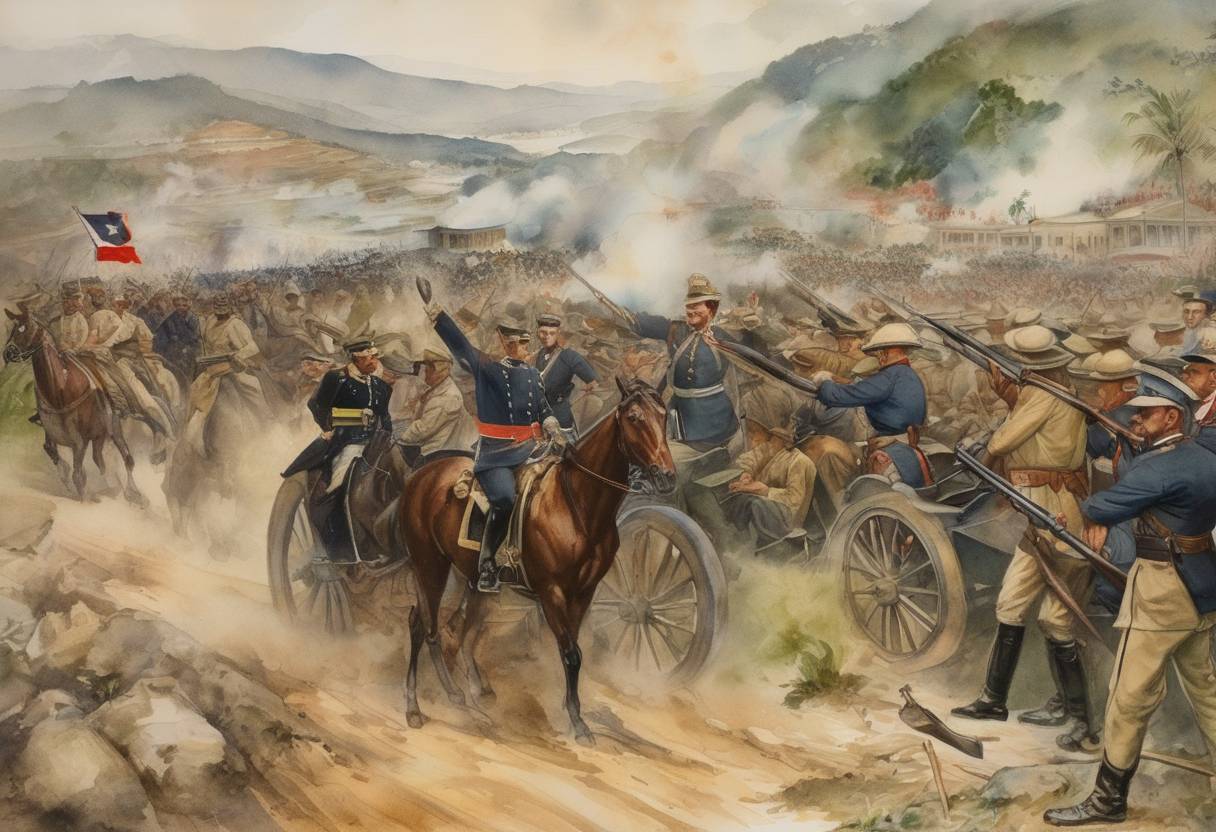
The Battle of San Juan Hill, fought on July 1, 1898, near Santiago de Cuba, was a pivotal engagement during the Spanish-American War. It involved American forces, including the famed Rough Riders under the leadership of Theodore Roosevelt, achieving a significant victory against Spanish troops.
The Spanish-American War began in April 1898, primarily over the issue of Cuban independence from Spain. The United States entered the conflict, stirred by the sinking of the USS Maine in Havana Harbor and reports of Spanish atrocities in Cuba. The war front spread from Cuba to the Philippines, with the Caribbean island being a critical battlefield.
San Juan Hill was part of a system of Spanish defenses surrounding the city of Santiago de Cuba. The capture of these heights was crucial in the American strategy to isolate and defeat Spanish forces, leading to control over Santiago and ultimately achieving victory in Cuba.
On the same day as the Battle of El Caney, American forces, comprising units of regular soldiers and volunteer regiments, such as the 1st United States Volunteer Cavalry—known as the Rough Riders—advanced on San Juan Heights. Under the overall command of Major General William Rufus Shafter, the attack consisted of multiple assaults:
Kettle Hill: This particular segment of the battle was key, where Roosevelt and his Rough Riders famously charged uphill. Despite facing intense Spanish fire, the Americans succeeded in reaching the summit.
San Juan Hill: Meanwhile, the main assault saw coordinated infantry attacks, with artillery support helping dislodge Spanish defenses. The advance resulted in the crucial capture of San Juan Hill and adjacent positions.
Theodore Roosevelt, then-Assistant Secretary of the Navy turned Rough Rider, emerged as a national hero following his actions during the battle. His leadership and the mythology surrounding his charge on Kettle Hill contributed significantly to his later political success, including eventually becoming President of the United States.
The victory at San Juan Hill was instrumental in the larger Siege of Santiago, leading to the surrender of the Spanish forces on July 17, 1898. This event further weakened Spain’s position and solidified American military superiority. The subsequent Treaty of Paris, signed in December 1898, ended the war. Through the treaty, Spain relinquished sovereignty over Cuba and ceded Guam, Puerto Rico, and the Philippines to the United States, marking a new era of American expansionism and global influence.
Source: www.britannica.com