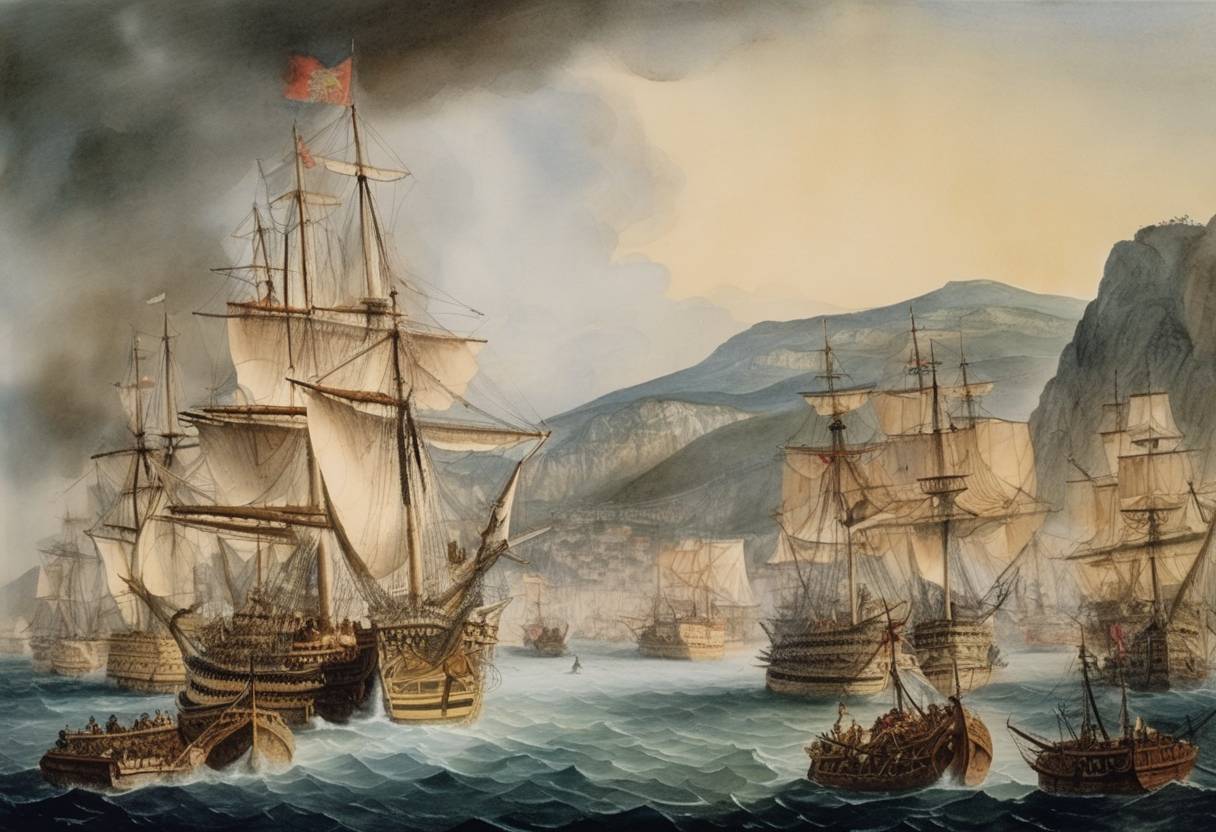
The Battle of Gibraltar: April 25, 1607
The Battle of Gibraltar, a significant naval engagement during the Eighty Years’ War, took place on April 25, 1607. This battle was a pivotal moment in the long conflict between the Dutch Republic and the Spanish Empire for control over the seas and influence in Europe.
Background
The Eighty Years’ War (1568-1648) was a prolonged struggle by the Dutch to gain independence from Spanish rule. Throughout this period, the Dutch employed their maritime prowess to challenge Spanish supremacy at sea. The tactical naval confrontation at Gibraltar was one such effort aimed at disrupting Spanish naval capabilities and supporting the broader objective of Dutch independence.
Key Events Leading to the Battle
Admiral Jacob van Heemskerk, a seasoned Dutch naval commander, devised a plan to attack the Spanish fleet anchored at the Bay of Gibraltar. His squadron consisted of 26 warships, significantly outnumbered by the decently fortified Spanish galleons under Don Juan Álvarez de Avilés. Nevertheless, Van Heemskerk was not deterred by the enemy’s numerical advantage, relying instead on superior tactics and the audacity of his fleet.
The Battle
On the morning of April 25, 1607, Van Heemskerk’s fleet approached the Spanish ships, which were caught off guard by the swift and aggressive Dutch assault. The Dutch fleet initiated the attack by maneuvering into close range, using a combination of strategic boarding actions and effective gunnery to incapacitate the Spanish vessels.
Despite a few brief successes, the Spanish fleet was overwhelmed by the disciplined coordination of the Dutch forces. The Spanish flagship, commanded by Álvarez de Avilés, was heavily damaged, leading to the admiral’s death and a collapse in Spanish command structure.
Aftermath and Consequences
The victory at Gibraltar was a morale-boosting triumph for the Dutch Republic. This decisive engagement underscored the effectiveness of Dutch naval strategy and inspired further resistance against Spanish control. On a broader scale, the success at Gibraltar demonstrated to European powers the vulnerability of Spanish maritime dominance.
Moreover, the defeat weakened Spanish naval capabilities in the region, impacting Spain’s influence and control over the Mediterranean. The battle was a crucial step in the course toward eventual Dutch independence, exemplifying the shifting balance of power during this period in European history.
Historical Significance
The Battle of Gibraltar is noteworthy for its demonstration of innovative naval tactics and the strategic foresight of Admiral Van Heemskerk. It exemplifies one of the many naval encounters that contributed to the broader geopolitical changes during the Eighty Years’ War, ultimately reshaping the political landscape of Europe.