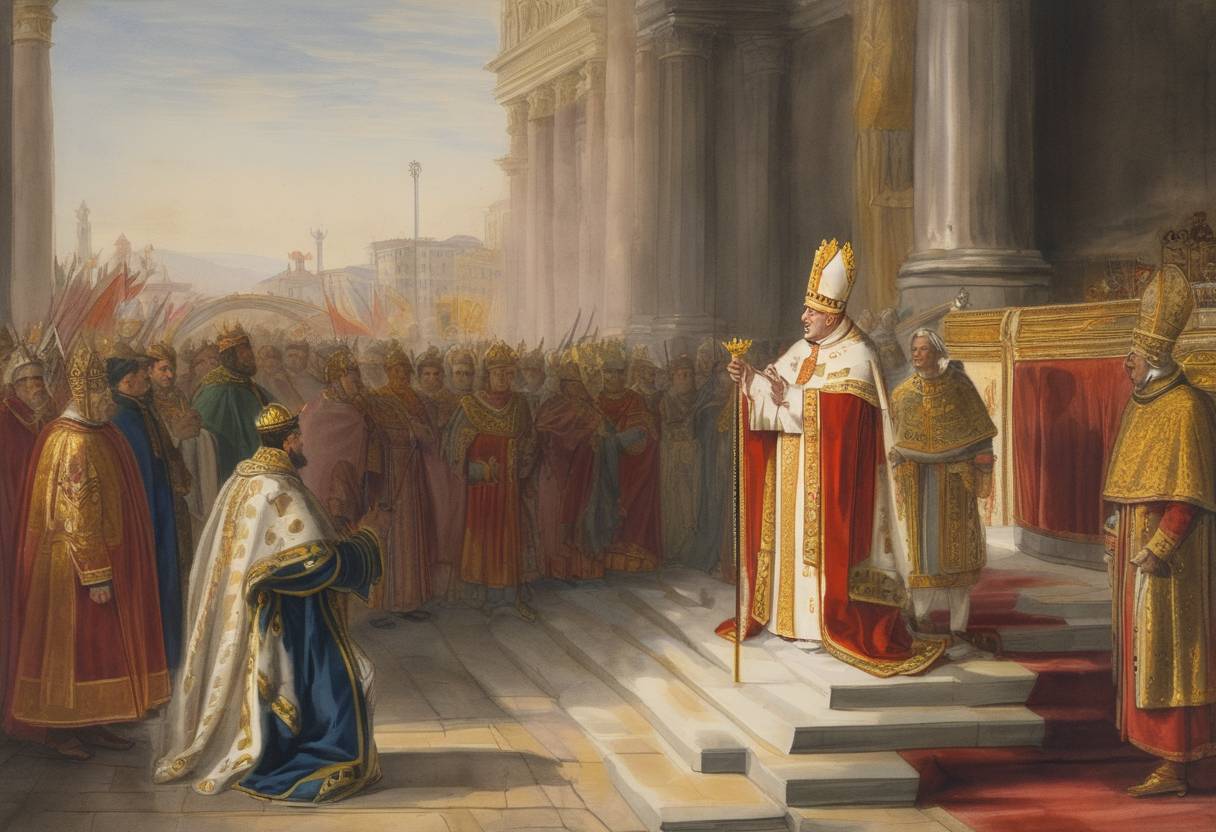
Coronation of Otto I as Holy Roman Emperor
On February 13, 962, Otto I, the king of the Germans, was crowned Holy Roman Emperor by Pope John XII in St. Peter’s Basilica in Rome. This event marked a significant turning point in European history, symbolizing the renewal of the Roman Empire in the West and cementing the concept of a unified Christendom under a single political and religious leadership.
Context and Prelude
- Background: Otto I, also known as Otto the Great, ascended to the German throne in 936. His reign was characterized by efforts to consolidate his territories and exert influence over Central Europe.
- Italian Affairs: Otto’s involvement in Italy began in the early 950s when he embarked on military campaigns against Italian rulers, culminating in his marriage to Adelaide of Italy, thereby securing a claim to the Italian throne.
- Imperial Ambitions: The coronation was a strategic move to reinforce Otto’s authority over Italy and exert influence over the papacy. Pope John XII sought Otto’s protection against Berengar II of Italy, prompting him to invite Otto to Rome.
The Coronation
- Location: The ceremony took place in the hallowed grounds of St. Peter’s Basilica, a location deeply imbued with religious significance, symbolizing the papal endorsement of Otto’s imperial rule.
- Ceremony: During the coronation, Pope John XII placed the crown upon Otto’s head and proffered him the imperial regalia, an act that signified the revival of the ancient Roman Empire’s authority in Western Europe.
Aftermath and Significance
- Holy Roman Empire: This coronation established the Holy Roman Empire, a political entity that would become a crucial power in European affairs for centuries, stretching across various territories that are part of modern-day Germany, Italy, and beyond.
- Papal-Imperial Relations: The alliance forged between the papacy and the newly crowned emperor strengthened Otto’s position in Europe but also set the stage for future conflicts over the respective powers and autonomy of church and state.
- Legacy: Otto I’s coronation laid the foundations for future rulers, marking a monumental shift towards the consolidation of political power alongside religious influence, which would shape the medieval European political landscape.
The crowning of Otto I as Holy Roman Emperor on February 13, 962, thus represents a pivotal historical event, underscoring the complexities of medieval European power dynamics and the enduring legacy of imperial authority.