The Battle of Angion - September 1, 1299
1299 · Angion, Armenia
The Battle of Angion took place, marking part of the wider conflict between the Mamluks of Egypt and the Armenians of Cilicia.
July 13, 1307
The Second Battle of Homs took place, a significant conflict of the Mamluk-Mongol Wars, where the Mamluks emerged victorious over the Ilkhanate forces, asserting their control over Syria.
Homs, Syria | Mamluk Sultanate
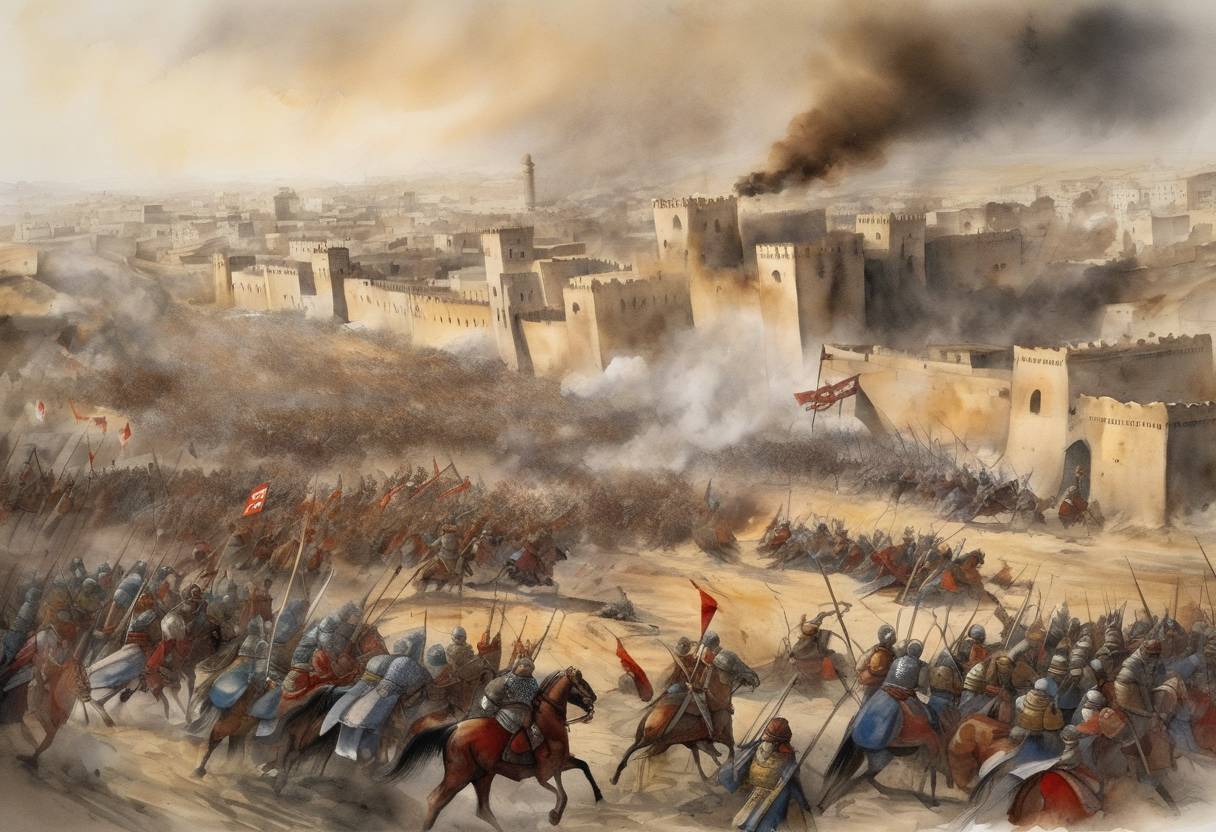
The Second Battle of Homs on July 13, 1307, was a pivotal conflict in the prolonged Mamluk-Mongol Wars, marking a decisive victory for the Mamluks over the Mongol Ilkhanate forces. This clash is crucial in understanding the power dynamics of the Middle East during this period.
The conflict arose from the broader context of the Mongol invasions and the Mamluks’ defense of the Islamic heartlands. The Ilkhanate, a division of the Mongol Empire, sought to expand its control over Syrian territories historically dominated by the Mamluks. The strategic city of Homs, located in present-day Syria, became a focal point for power struggles between these factions.
Previously, the Mamluks had experienced both victories and losses against the Mongols. The Battle of Ain Jalut in 1260 had already showcased the Mamluks’ defensive capabilities, and subsequent engagements continued their rivalry.
On July 13, 1307, the Mamluk army confronted the Ilkhanate forces near Homs. Despite the Mongols’ formidable cavalry and previous tactical innovations in warfare, the Mamluks leveraged their deep knowledge of local geography and their own military acumen to gain an upper hand.
The Mamluks effectively utilized their fast-moving cavalry units alongside skilled archers to disrupt the Mongol formations. This tactical superiority, combined with better coordination and the motivation to protect their sovereign territory, led to a crushing defeat for the Mongol forces.
The Mamluk victory at the Second Battle of Homs was significant in maintaining their dominance over Syria and countering Mongol advances in the region. The defeat hampered the Ilkhanate’s strategic aspirations and contributed to the gradual decline of their influence in the Near East.
This battle reaffirmed the Mamluks’ reputation as formidable defenders against Mongol incursions and played an essential role in ensuring the stability and longevity of their rule in Egypt and Syria. The resilience shown by the Mamluk leadership during this period highlighted their ability to adapt to evolving military challenges presented by the Mongols.
The outcome at Homs also exemplified a broader pattern of successful defense against external threats, which allowed the Islamic civilization in the region to thrive culturally and economically in the subsequent centuries.
Source: en.wikipedia.org