President Lyndon B. Johnson's 'Great Society' Plan
1965 · Washington D.C., United States
President Lyndon B. Johnson outlined his 'Great Society' plan in his State of the Union address.
May 22, 1964
U.S. President Lyndon B. Johnson announced the Great Society social reforms during a speech at the University of Michigan.
Ann Arbor, United States | University of Michigan
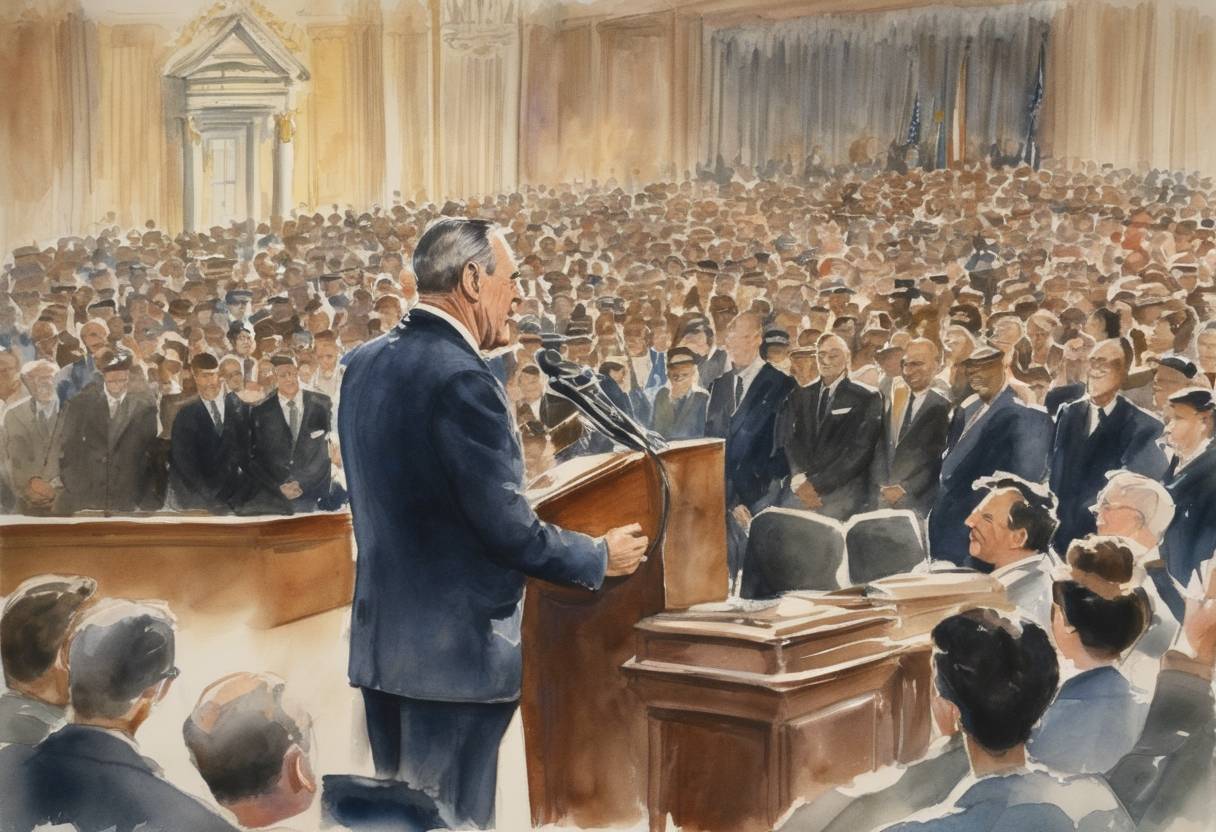
On May 22, 1964, President Lyndon B. Johnson delivered a seminal commencement address at the University of Michigan in Ann Arbor, during which he introduced the vision for his ambitious domestic policy agenda known as the “Great Society.”
After assuming the presidency in November 1963 following the assassination of John F. Kennedy, Lyndon B. Johnson sought to build on his predecessor’s New Frontier programs. He aimed to address social reforms, economic equality, and racial injustice in the United States. The period was marked by significant civil rights activism, social upheavals, and a growing consciousness about poverty and education.
In his address, President Johnson outlined his vision for the Great Society, a set of domestic programs aimed at eliminating poverty and racial injustice while improving public education and healthcare. He emphasized the need for a prosperous nation to extend its benefits to all citizens, highlighting the government’s role in creating conditions conducive for success and fulfillment. His speech called for reforms in three primary areas:
City Revitalization: Johnson proposed urban renewal efforts to combat poverty and improve living conditions in cities, emphasizing the importance of planning space creatively to improve the quality of urban life.
Countryside Enhancement: He underscored the importance of conserving natural resources and beautifying the American landscape. Johnson advocated for the revitalization of rural areas and the expansion of national parks.
Education: Johnson asserted that education was crucial in creating a great society, emphasizing the need to improve and increase access to high-quality education as a foundation for equal opportunity.
The Great Society led to the introduction and passage of landmark legislation, much of which was inspired by Johnson’s address:
President Johnson’s speech at the University of Michigan marked a pivotal moment in American social policy. The initiatives set forth under the Great Society have had lasting impacts on American society, contributing to significant reductions in poverty and improvements in education and healthcare. However, Johnson’s ambitious agenda also faced criticism, with debates persisting about the role of government in addressing societal issues and the efficiency of such programs.
The Great Society speech remains a cornerstone of Johnson’s presidency, encapsulating his commitment to the idea that a wealthy and powerful nation must strive to be socially equitable. The address continues to be referenced in discussions on social reform and governmental responsibility in providing for the welfare of its citizens.
Source: en.wikipedia.org