Simón Bolívar Named President of Peru: September 10, 1823
1823 · Lima, Peru
Simón Bolívar is named President of Peru, reinforcing his influence in South American liberation movements against Spanish control.
June 24, 1821
The Battle of Carabobo took place, resulting in a decisive victory for the revolutionary forces led by Simón Bolívar against the Spanish royalist army, securing the independence of Venezuela.
Campo de Carabobo, Venezuela | Simón Bolívar's revolutionary forces
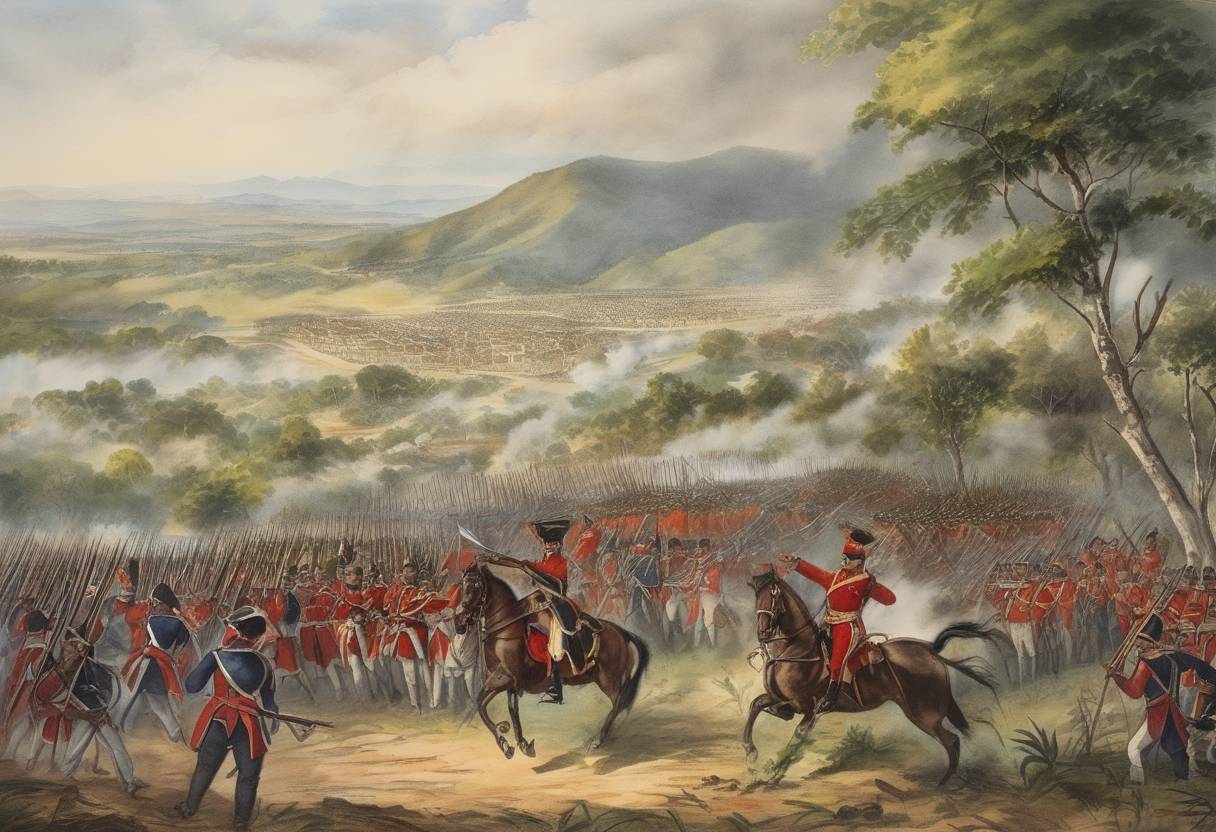
The Battle of Carabobo, a pivotal military engagement in the Venezuelan War of Independence, occurred on June 24, 1821. This battle marked a decisive victory for the revolutionary forces led by Simón Bolívar against the Spanish royalist army. It was instrumental in securing the independence of Venezuela from Spanish rule.
By the early 19th century, the Spanish American wars of independence had encompassed vast territories in South America. Simón Bolívar, a leading figure in these independence movements, sought to liberate Venezuela from Spanish control. The struggle was complex, given the regional divisions and the challenges of Spanish resistance bolstered by loyalist forces.
Prior to Carabobo, Bolívar had launched a series of military campaigns to consolidate his control over regions in northern South America. The stage for the battle was set as Bolívar’s forces aimed to advance towards Caracas, the capital of Venezuela, thereby breaking the royalists’ hold over the region.
The revolutionary forces, motivated by their push for independence and guided by effective leadership, managed to rout the royalist army, which suffered heavy casualties and was effectively dismantled as a fighting force.
The victory at the Battle of Carabobo opened the path for Bolívar’s forces to advance unopposed to Caracas, leading to the eventual annexation of the city. This facilitated the full establishment of the Republic of Gran Colombia, of which Venezuela was a part, further cementing Bolívar’s legacy as the ‘Liberator’ of South America.
The victory at Carabobo is celebrated annually in Venezuela as a symbol of national independence and unity, and it remains a testament to the determination and resilience of those who fought for freedom from colonial rule. The battle not only helped to secure Venezuela’s independence but also set a precedent for other South American regions seeking self-determination from European colonial powers.
Source: en.wikipedia.org