The Treaty of Lausanne: Ending the Italo-Turkish War
1912 · Ouchy, Switzerland
The Treaty of Lausanne was signed, officially ending the Italo-Turkish War.
August 4, 1791
The Treaty of Sistova is signed, ending the Austro-Turkish War between Austria and the Ottoman Empire, aiming to maintain the status quo ante bellum.
Sistova, Modern-day Bulgaria | Austrian Empire, Ottoman Empire
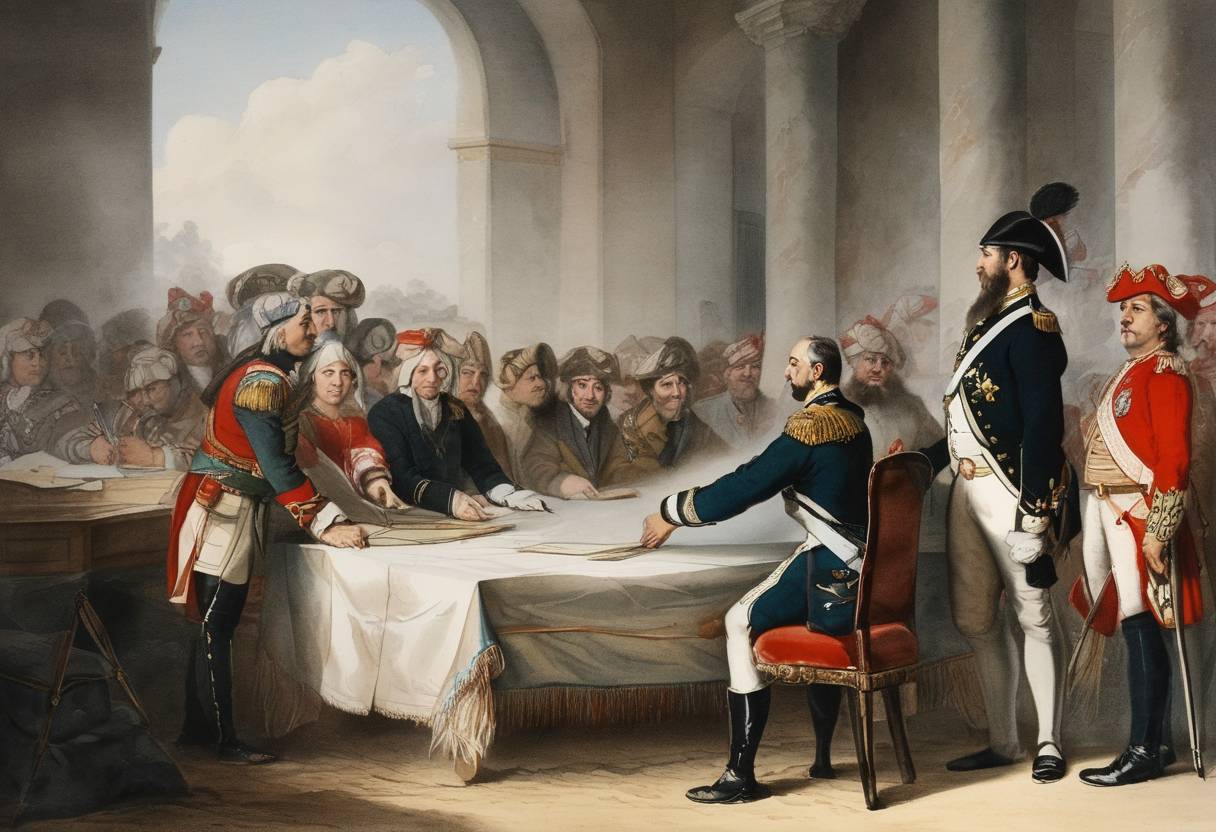
The Treaty of Sistova, signed on August 4, 1791, marked the conclusion of the Austro-Turkish War (1787–1791) between the Habsburg Monarchy of Austria and the Ottoman Empire. This treaty was crucial as it aimed to re-establish the status quo ante bellum, meaning the war ended without significant territorial changes between the two empires.
The Austro-Turkish War was part of a larger series of conflicts that involved the Ottoman Empire during the late 18th century, notably as the Ottomans battled both Russia and Austria. While the Austrians initially hoped to gain territory from the weakened Ottoman Empire, various factors led to a cessation of aggressive ambitions:
European Political Landscape: The ongoing wars placed considerable financial and military pressure on Austria. Moreover, the political situation in France and the rise of revolutionary activities consumed much of Europe’s attention.
Military Outcomes: Although Austria achieved some success on the battlefield, the victories did not translate into decisive, strategic gains necessary to secure advantageous territorial expansion.
Diplomatic Efforts: The Treaty of Sistova was heavily influenced by diplomatic pressure from other European powers seeking to maintain a balance. Particularly, Prussian diplomacy played a mediating role to prevent a complete collapse of Ottoman power, which was viewed as a buffer state against Russian expansion.
The primary principle guiding the Treaty of Sistova was to return to pre-war conditions. The main stipulations were as follows:
While the treaty itself did not result in any tangible territorial changes, its significance lay in its contribution to stabilizing the region. The Treaty of Sistova marked one of the last significant conflicts involving the Ottoman Empire and the Habsburg Monarchy in the 18th century. It underscored the shifting balance of power in Europe, where issues of sovereignty and territorial integrity were increasingly dictated by broader diplomatic considerations rather than solely military outcomes.
In summary, the Treaty of Sistova of August 4, 1791, exemplifies diplomatic maneuvering in the late 18th century, reflecting a collective European interest in maintaining a balance of power that prevented the decline of the Ottoman Empire from destabilizing the continent.
Source: www.britannica.com