Isaac Newton's Admission to Trinity College, Cambridge
1661 · Cambridge, England
Isaac Newton was admitted to Trinity College, Cambridge, marking the beginning of his formal education in mathematics and physics.
April 22, 1705
Queen Anne of England knights Isaac Newton at Trinity College, Cambridge.
Cambridge, England | Monarchy of England
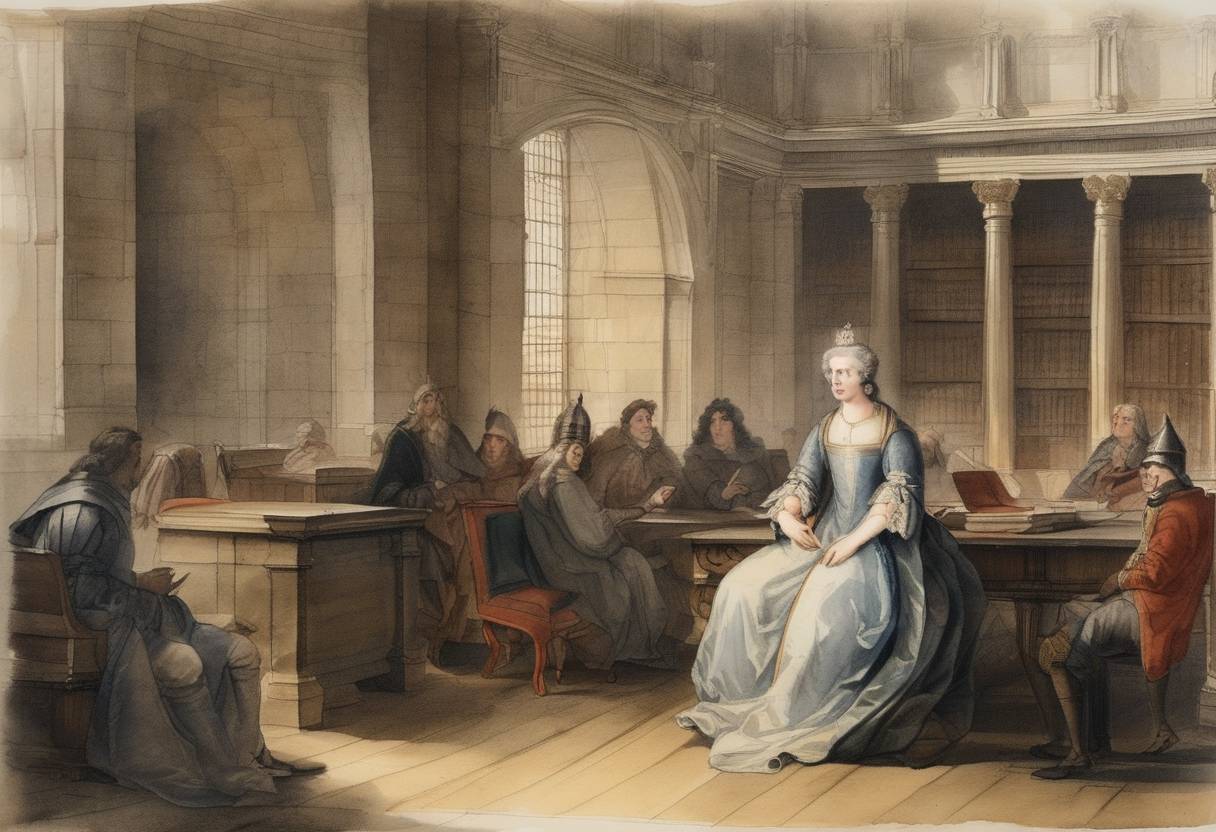
On April 22, 1705, Sir Isaac Newton was knighted by Queen Anne at Trinity College, Cambridge. This prestigious honor was conferred upon Newton in what was a significant interaction between science and the British monarchy of the time.
Isaac Newton, one of the most influential scientists in history, had already made his monumental contributions to the field of physics and mathematics by the time he was knighted. His work, Philosophiæ Naturalis Principia Mathematica, first published in 1687, had laid the foundations for classical mechanics, introducing the laws of motion and universal gravitation.
By 1705, Newton had also made significant contributions to mathematics with the development of calculus, an area in which he had a famed rivalry with the German mathematician Gottfried Wilhelm Leibniz over its invention. Beyond his scientific endeavors, Newton was appointed Warden and later Master of the Mint, playing a vital role in the reform of England’s currency.
The knighting ceremony was a notable event, taking place in the midst of Newton’s tenure as a Member of Parliament for the university. The decision to knight Newton was influenced by both his scientific achievements and his political service. Queen Anne, visiting Cambridge on a royal tour, held the knighting ceremony in the grandeur of Trinity College, underscoring the royal recognition of the intellectual and public service contributions of Newton.
This knighthood was symbolic of the growing importance of scientific inquiry during the Enlightenment, in which empirical evidence and reason began to challenge traditional beliefs and dogmas. It also represented the increasing inclination of the British Crown to honor individuals who contributed to public life and national prestige beyond the traditional circles of the nobility or military.
While the knighthood did not directly contribute to further scientific discoveries by Newton, it cemented his standing as a leading figure in British society and emphasized the close relationship between state and academia at the time.
In sum, the knighting of Isaac Newton by Queen Anne was a ceremonial milestone reflective of the period’s intellectual climate and the important role figures like Newton played in the advancement of science and society.
Source: www.britannica.com