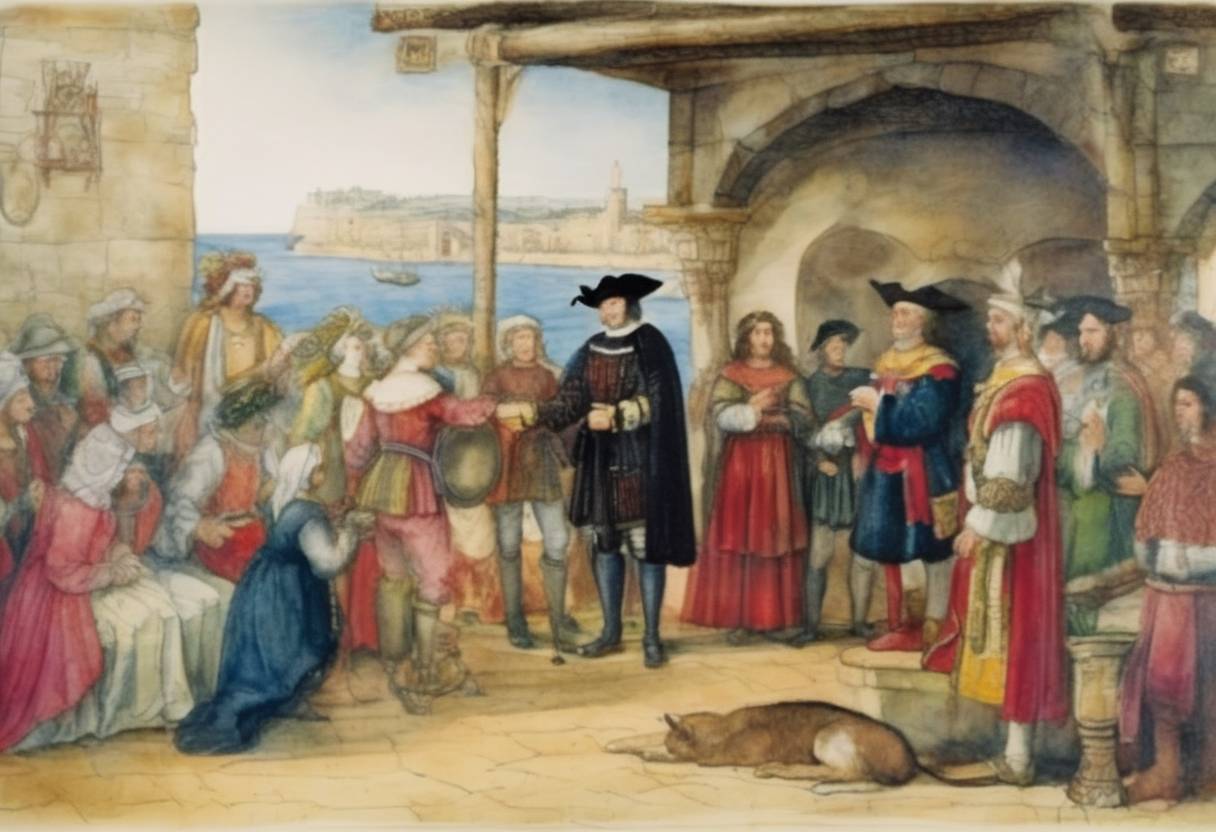
Christopher Columbus and the Commission of Exploration from Spain
On May 1, 1486, Christopher Columbus officially received his commission from the Spanish monarchs, King Ferdinand II of Aragon and Queen Isabella I of Castile, marking a pivotal moment in the history of exploration. This commission underlined the regal backing Columbus required for his ambitious plan to find a westward maritime route to the lucrative markets of Asia, marking the nascent stages of what would become his first voyage across the Atlantic Ocean.
Context and Background
Prior to receiving this commission, Columbus had already pitched the idea of a westward voyage to reach Asia to several European monarchs including those in Portugal, England, and Spain. Initial responses were largely unfavorable due to doubts about the practicality and cost of his plans, compounded by skepticism about his estimates regarding the distance to Asia by this route.
However, Columbus’s persistence and the eventual interest of key Spanish court figures, particularly after the conclusion of the Reconquista in January 1492, helped his cause. The experts and advisors at the Spanish court spent several years deliberating Columbus’s proposal before finally taking the decisive step in 1486 to officially engage with him, setting in motion a series of events that would eventually lead to the 1492 voyage.
The Commission
The commission granted to Columbus on this date in Madrid represented a burgeoning partnership between the explorer and the Spanish Crown. It was not immediately a royal contract for a voyage but was pivotal in putting formal backing behind Columbus’s ideas and allowing him to remain at court, receiving both the necessary logistical support and economic survival while negotiations continued.
Significance and Aftermath
While the official commission in 1486 did not directly result in Columbus setting sail, it was a crucial precursor to his eventual agreement in 1492, when the Capitulations of Santa Fe were signed. These documents outlined the terms of his voyage, granting Columbus titles and a share of the profits from lands he would claim for Spain.
The commission and the eventual voyages had profound historical implications, setting off the Age of Exploration. This era drastically altered global trade, geopolitics, and cultures, marking the beginning of European colonialism in the Americas and reshaping the world in numerous ways.
In summary, the granting of the commission on May 1, 1486, was a crucial step in Columbus’s journey towards realizing his vision of a westward route to Asia, securing the royal interest that would eventually facilitate his landmark 1492 voyage across the Atlantic.