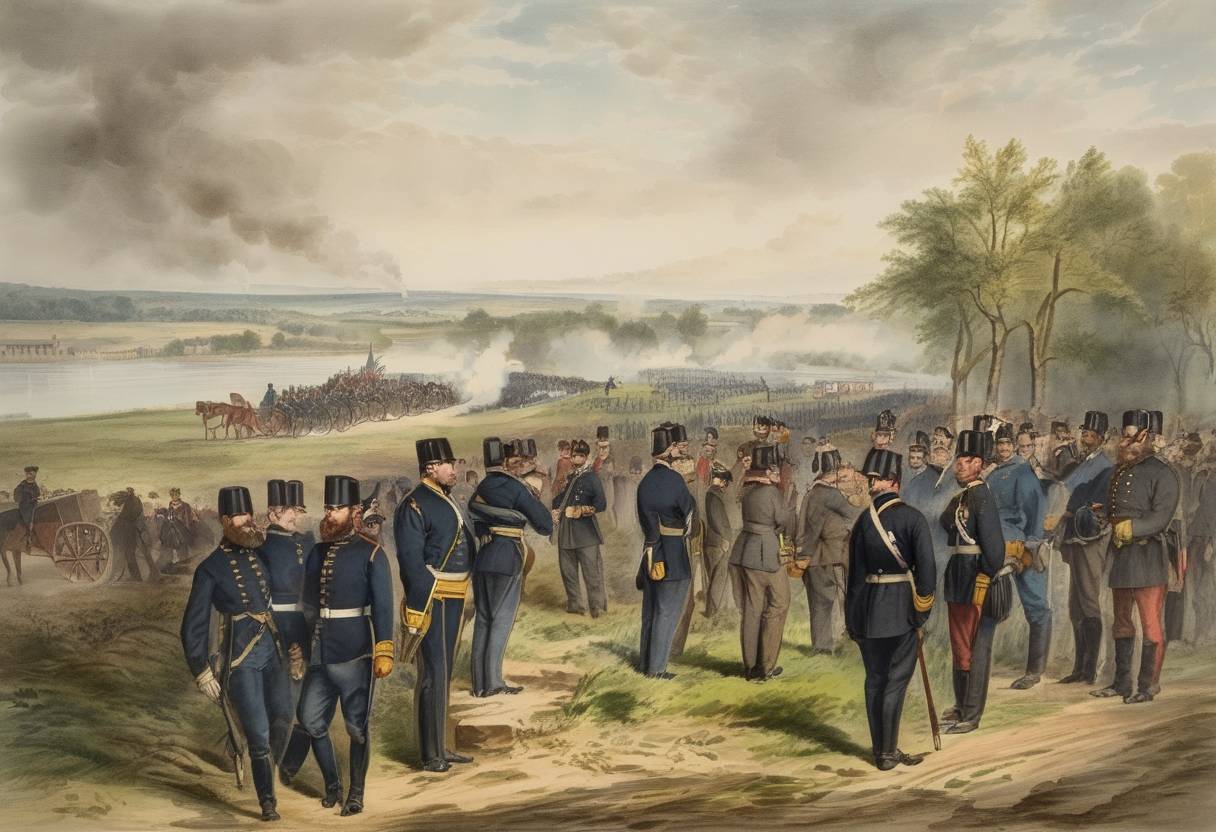
Disbanding of the Army of the Potomac
On June 28, 1865, the Army of the Potomac, one of the principal Union armies in the Eastern Theater of the American Civil War, was officially disbanded under the command of Major General George G. Meade. This event marked one of the final formal acts in the winding down of active Union military operations following the Confederate surrender.
Background
The Army of the Potomac was established in 1861, soon after the start of the Civil War, primarily operating in the Eastern United States. It played a crucial role in the Union’s military strategy, engaging in numerous significant battles such as Antietam, Fredericksburg, Chancellorsville, and the pivotal Battle of Gettysburg, where it delivered a critical defeat to Confederate forces in July 1863.
General George G. Meade took command of the Army of the Potomac just days before the Battle of Gettysburg. Although Ulysses S. Grant, as General-in-Chief of all Union armies, placed the army under his immediate oversight during the Overland Campaign of 1864, Meade maintained day-to-day tactical command until the cessation of hostilities.
Key Events Leading to Disbandment
The successful siege of Petersburg and the capture of Richmond in early April 1865 forced Confederate General Robert E. Lee to retreat, leading to his surrender at Appomattox Court House on April 9, 1865. This surrender signaled the effective end of the Confederacy and the conclusion of the Civil War.
As reconstruction and peace processes began, the need for large field armies diminished. The formal disbandment of the Army of the Potomac recognized the cessation of wartime functions and the transition to peace.
Historical Significance
The dissolution of the Army of the Potomac symbolizes the transition from war to peace and the Union’s victory in maintaining the United States as a unified nation. It also initiated the demobilization of soldiers and a return to civilian life for many who had served, impacting the socio-political landscape of post-war America.
General Meade himself continued to serve in the United States Army, participating in the Reconstruction era efforts and other military administrative roles until his death in 1872.
Aftermath
The disbandment reflects the broader demilitarization in the aftermath of the Civil War, as the United States shifted focus towards rebuilding and integration of the Southern states back into the Union.
At its peak, the Army of the Potomac had been instrumental in numerous engagements that shaped the course of the Civil War, and its legacy is integral to understanding the military history of the United States. The army’s veterans and their experiences significantly influenced post-war American society and the memorialization of Civil War history.