Battle of Maciejowice - October 10, 1794
1794 · Maciejowice, Poland
Russian General Alexander Suvorov leads his troops to victory in the battle against Polish forces at the Battle of Maciejowice during the Kościuszko Uprising.
June 28, 1651
The Battle of Beresteczko begins, marking a significant conflict during the Khmelnytsky Uprising, fought between Polish–Lithuanian Commonwealth forces and the alliance of Cossacks and Crimean Tatars.
Beresteczko, Poland | Polish–Lithuanian Commonwealth Army
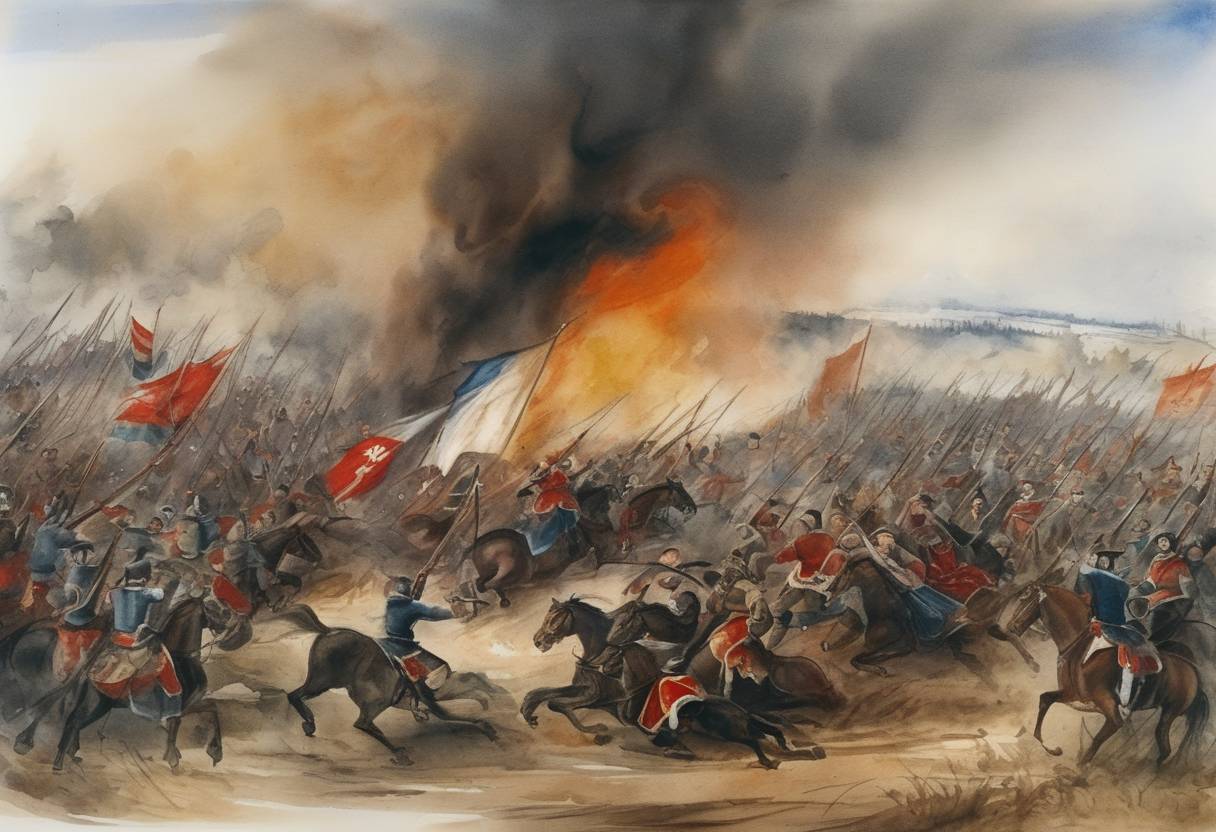
The Battle of Beresteczko marked a pivotal engagement during the Khmelnytsky Uprising, a rebellion against the Polish-Lithuanian Commonwealth led by the Cossack Hetman Bohdan Khmelnytsky. The uprising began in 1648, driven by Cossack grievances regarding political freedoms, religious rights, and social status. By 1651, tensions had escalated significantly, with numerous confrontations and shifting alliances shaping the conflict.
Polish-Lithuanian Commonwealth: Led by King John II Casimir Vasa, the Commonwealth forces comprised nobles, regular army troops, and mercenaries.
Cossack and Crimean Tatar Alliance: Commanded by Hetman Bohdan Khmelnytsky, this coalition sought greater autonomy and aimed to challenge the Commonwealth’s dominion over Ukrainian territories.
Date: The battle began on June 28, 1651, near the village of Beresteczko in present-day Ukraine.
Deployment and Tactics: The Polish-Lithuanian Commonwealth army was better equipped, with a well-developed cavalry and artillery. The Cossacks and Tatars relied on their mobility and the tactical acumen of their leaders.
As the battle commenced, the tactical advantage initially shifted back and forth. The Crimean Tatars, crucial to the Cossack coalition, played a significant role in the initial stages.
The Polish-Lithuanian forces, under the direct leadership of King John II Casimir, capitalized on superior firepower and disciplined formations. They maintained pressure on the Cossack lines, steadily pushing them back.
Outcome: The battle extended over several days but visibly tilted in favor of the Commonwealth shortly after it began, marking a strategic victory for them by the end of June.
Significance: This battle was one of the largest involving cavalry forces in Europe during the 17th century and demonstrated the military might and political importance of the Polish-Lithuanian Commonwealth in Eastern Europe.
Aftermath: The victory at Beresteczko significantly weakened the Cossack and Tatar alliance, although the uprising itself continued for several more years. The eventual Treaty of Bila Tserkva followed, imposing harsher terms on the Cossacks. However, the struggle for Ukrainian autonomy and freedom from Polish control persisted, resting at the heart of ongoing regional instability.
Source: en.wikipedia.org