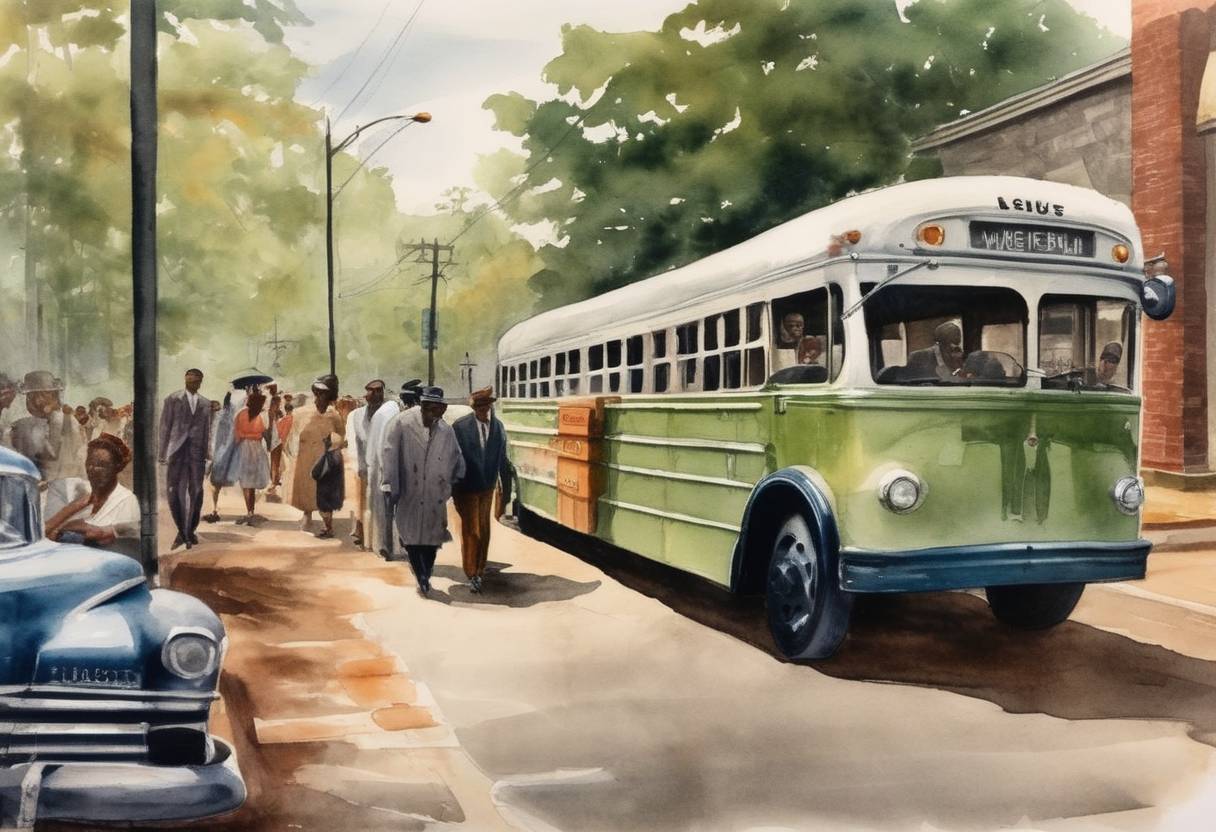
Montgomery Bus Boycott Ends - December 20, 1956
On December 20, 1956, the Montgomery Bus Boycott concluded after 381 days, catalyzed by a pivotal United States Supreme Court decision. The boycott emerged as a critical protest against racial segregation in public transportation in Montgomery, Alabama. It became a seminal event in the American Civil Rights Movement, leading to broader efforts for racial equality across the United States.
Background
The boycott was initiated on December 5, 1955, following the arrest of Rosa Parks on December 1, 1955. Parks, an African American woman, refused to relinquish her bus seat to a white passenger, in defiance of strict segregation laws prevalent at the time. Her arrest galvanized the African American community in Montgomery and led to the formation of the Montgomery Improvement Association (MIA), with Dr. Martin Luther King Jr. as its leader.
The Legal Battle and Supreme Court Ruling
The boycott resulted in a significant loss of revenue for the Montgomery City Lines and exerted immense pressure on the local government. Advocates for desegregation took the legal battle to the courts. In February 1956, a lawsuit known as Browder v. Gayle was filed by civil rights attorneys, including Fred Gray, representing several African American women who had experienced similar discrimination.
On June 5, 1956, a U.S. District Court ruled in Browder v. Gayle that bus segregation was unconstitutional, citing it as a violation of the 14th Amendment’s Equal Protection Clause. Appealed by the state and city, the case advanced to the Supreme Court. On November 13, 1956, the Supreme Court upheld the lower court’s decision, effectively outlawing racial segregation on public buses.
Conclusion of the Boycott
With this verdict becoming enforceable on December 20, the Montgomery Bus Boycott officially ended. The success of the boycott marked a significant victory for nonviolent protest and civil rights activism, demonstrating the potential of collective action and the legal system in achieving social change.
Thousands of African American residents returned to the buses, sitting wherever they chose, symbolizing a monumental step towards dismantling institutionalized racial segregation in the South. The victory propelled figures such as Dr. Martin Luther King Jr. into national prominence and laid groundwork for future civil rights initiatives, reinforcing the movement’s momentum during the late 1950s and 1960s.
Legacy
The end of the Montgomery Bus Boycott is regarded as a turning point in the civil rights era. It set a precedent that empowered other communities to challenge segregation and discrimination, fueling the broader fight for equality across various facets of American society.
The boycott exemplified the effectiveness of persistent, organized, and nonviolent protest, inspiring generations to pursue justice and civil rights through peaceful means.