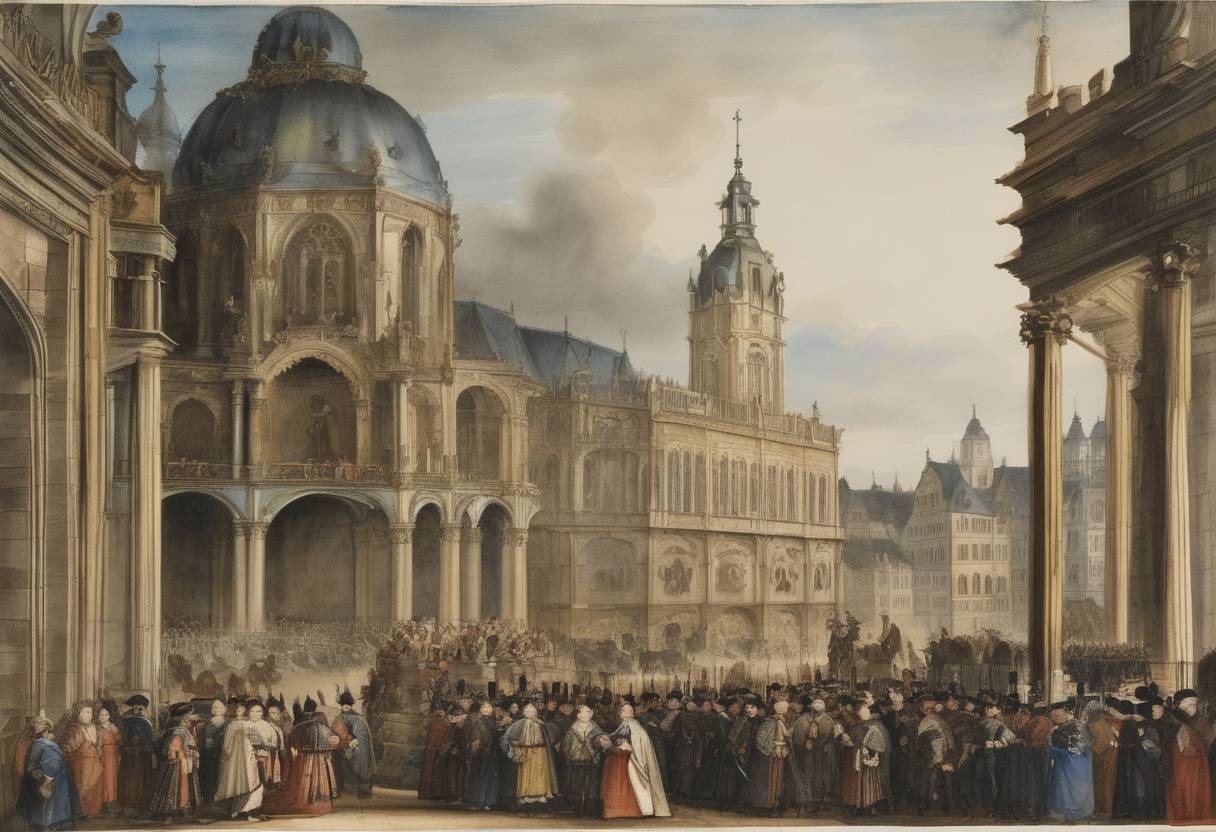
The Treaty of Westphalia Ratified: November 30, 1648
Overview
On November 30, 1648, the Treaty of Westphalia was formally ratified, marking the official conclusion of the Thirty Years’ War in the Holy Roman Empire. This series of treaties, including the Peace of Münster and the Peace of Osnabrück, was signed on October 24, 1648, but the ratification on November 30 finalized the diplomatic successes achieved through prolonged negotiations.
Background
- Thirty Years’ War (1618-1648): This conflict originally started as a struggle between Catholic and Protestant states in the fragmented Holy Roman Empire. It soon escalated into a broader European war involving major powers, including Sweden, France, Spain, and the Habsburg Monarchy.
- Impact on Europe: The war devastated large regions, particularly in the German states, leading to significant population loss, economic downturns, and a shift in political power across the continent.
The Treaties
The Treaty of Westphalia comprises several key stipulations:
- Religious Tolerance and Sovereignty: It acknowledged the legitimacy of Catholicism, Lutheranism, and Calvinism, granting rulers the right to determine the official religion of their territories (the principle of “cuius regio, eius religio”).
- Territorial Adjustments: The treaty included territorial adjustments that reshaped the map of Europe. Notably, France acquired Alsace and Sweden gained control over territories in the Holy Roman Empire.
- The Dutch Republic and Switzerland: The treaties recognized the independence of the Dutch Republic from Spain and Switzerland’s independence from the Holy Roman Empire.
- Impact on Political Structures: This treaty is credited with laying the groundwork for modern state sovereignty, diminishing the political power of the Holy Roman Emperor and enhancing the influence of individual states.
Aftermath and Historical Significance
- German Territorial Fragmentation: The peace agreements contributed to the prolonged fragmentation and political weakness of the German regions, a state that persisted until the unification of Germany in the 19th century.
- End of Large-Scale Religious Wars in Europe: The Thirty Years’ War was the last major religious war in Europe. The Treaty of Westphalia is often cited as a pivotal moment in ending the era of religiously motivated conflicts on such a large scale.
- Formation of a State System: It is commonly viewed as a foundational event in the development of a system of sovereign states, a central concept in modern international relations.
The Treaty of Westphalia remains a significant moment in European history, symbolizing the transition towards state sovereignty and paving the way for a new order in international politics and diplomacy.