The Battle of Inkerman: November 5, 1854
1854 · Inkerman, Crimea
The Battle of Inkerman took place during the Crimean War, resulting in a victory for the British and French forces against Russia.
September 9, 1855
Crimean War: The Siege of Sevastopol (1854–1855) ended as Russian forces abandoned the city after 11 months of siege by the Franco-British alliance.
Sevastopol, Russian Empire | Franco-British Alliance
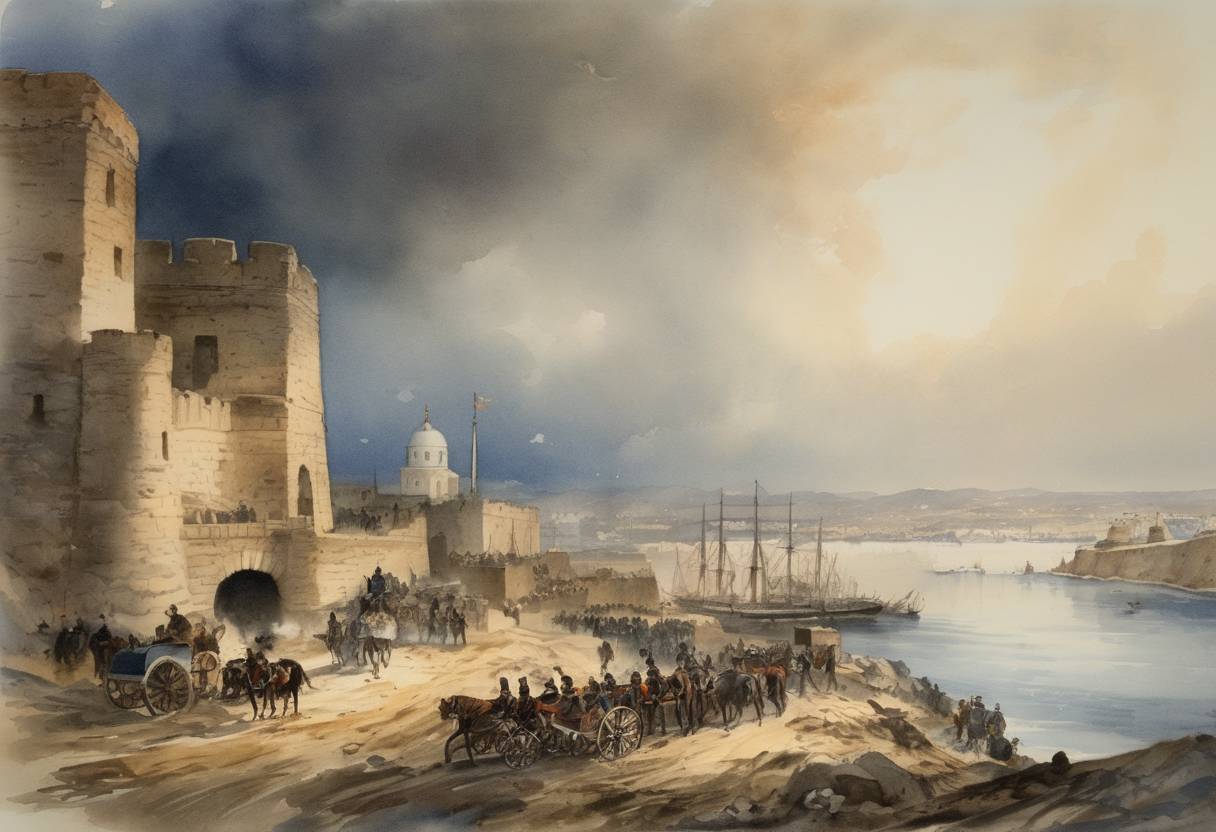
The Siege of Sevastopol played a pivotal role in the Crimean War, marking a significant turning point. On September 9, 1855, Russian forces decisively abandoned Sevastopol after enduring an arduous 11-month siege by the Franco-British alliance, consisting of British, French, and Ottoman troops.
The Crimean War, primarily a conflict over territorial and religious disputes, escalated into a confrontation involving Europe’s major powers. The Russian Empire sought to expand its influence over the Ottoman Empire, prompting opposition from France, Britain, and the Ottoman Empire. Sevastopol, located on the Crimean Peninsula, was the main naval base for Russia’s Black Sea Fleet, making it a strategic target for the allied forces.
The siege began in October 1854, shortly after the battles of Alma and Balaklava. The allies aimed to capture the vital port and cripple Russia’s naval capabilities. The siege involved continuous trench warfare, artillery bombardments, and assaults on both sides. The Russian defenders, led by commanders such as Admiral Pavel Nakhimov and General Eduard Totleben, defended the city valiantly, using the rugged terrain and extensive fortifications to their advantage.
Despite fierce resistance, the superior numbers and resources of the allied forces gradually gained ground. The defenses were systematically reduced through persistent assaults and a combination of French and British engineering and tactical innovations.
The breakthrough came with the fall of the Malakhov Kurgan on September 8, 1855. The French forces succeeded in capturing this critical stronghold, compromising the city’s defenses and leading to the inevitable fall of Sevastopol. Recognizing their untenable position, the Russian defenders evacuated the city the following day, on September 9, 1855. They crossed the harbor to the north side, leaving behind a heavily damaged city.
The fall of Sevastopol marked a significant victory for the allied coalition and underscored the weakened state of the Russian Empire. This defeat, among others, eventually led to Russia seeking peace negotiations. The eventual Treaty of Paris in 1856 formally ended the war, leading Russia to concede to several conditions that limited its influence in the region.
The Siege of Sevastopol is heralded as a precursor to modern warfare by illustrating the impact of technology and industrial might on military outcomes. The conflict also exposed the need for military reform within the participating nations and highlighted the horrors and human cost of war, influencing future military and diplomatic strategies.
Source: www.britannica.com