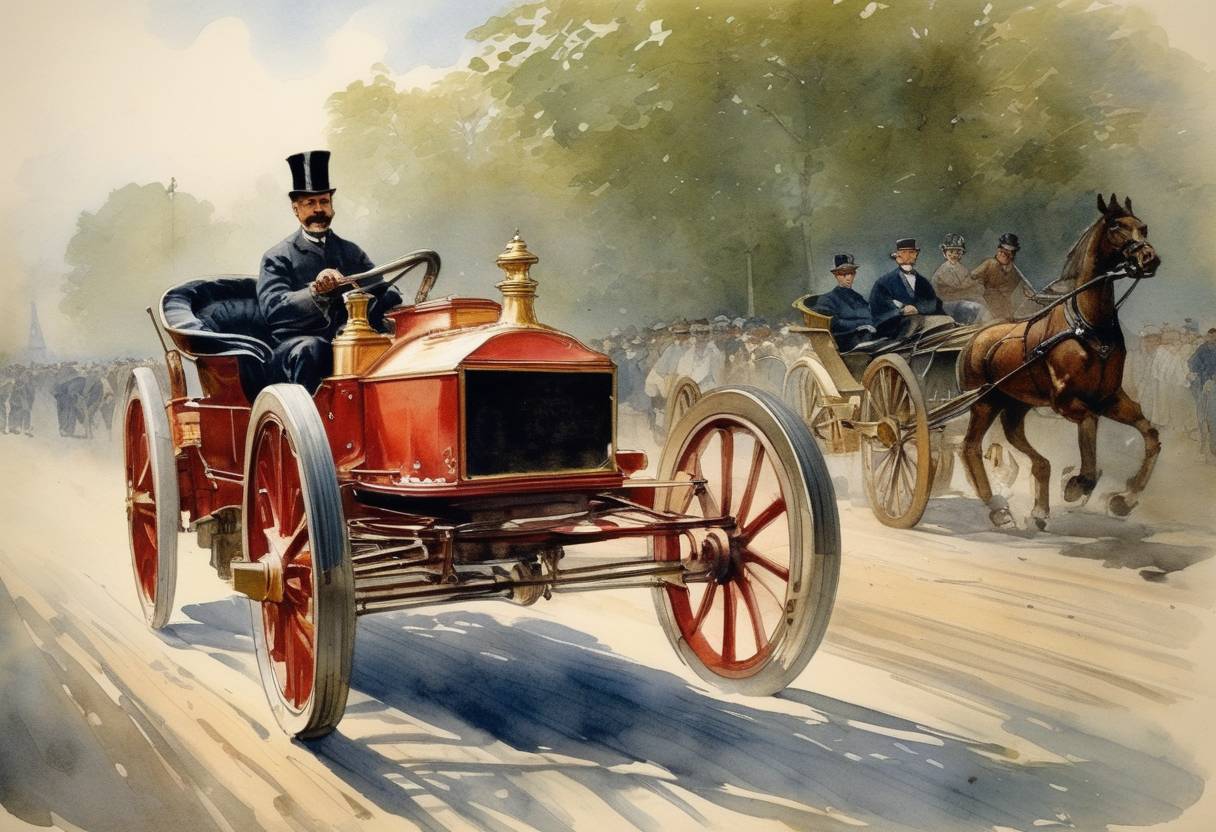
World’s First Gasoline-Powered Automobile Race - September 9, 1893
On September 9, 1893, the world witnessed the first gasoline-powered automobile race held near Paris, France. This event marked a significant milestone in automotive history, setting the stage for the future of motor racing and the development of automobile technology.
Context and Background
In the late 19th century, the automobile industry was in its nascent stages, with inventors experimenting with various propulsion methods including steam, electricity, and gasoline. By the early 1890s, gasoline-powered engines, developed by inventors like Karl Benz and Gottlieb Daimler, had begun to demonstrate their viability as a power source for transportation.
The Race
The race took place on a route from Paris to the nearby town of Rouen. It covered a distance of approximately 50 kilometers (about 31 miles). Designed not purely as a contest of speed but rather a demonstration of the reliability and performance of these new machines, the race attracted significant public attention and was seen as a showcase of innovation.
Count Jules-Albert de Dion, a pioneering French automobile manufacturer, played a crucial role in organizing the race. The event featured several gasoline-powered vehicles, each showcasing different designs and technological solutions. Among the notable participants was Georges Bouton, a key figure in early automobile design, who competed in a steam-powered vehicle built through collaboration with de Dion.
Outcomes and Impact
Although the competition did not declare an outright winner in the traditional sense due to its exhibition nature, it underscored the potential of the gasoline engine, highlighting the technological advances made possible through internal combustion. This event helped stimulate interest and investment in automotive technology, influencing future races and automotive advancements.
Broader Historical Significance
The 1893 Paris automobile race served as a precursor to more formalized competitive events in the automotive world, eventually giving rise to legendary races such as the Paris-Rouen race of 1894 and the inaugural Grand Prix of 1906. It laid the groundwork for the evolution of motorsport and signaled a shift towards a society increasingly reliant on motorized transportation, reshaping urban landscapes and economies worldwide.
This pivotal event in automotive history exemplifies the spirit of innovation and competition that continues to drive advancements in motor vehicles to this day.