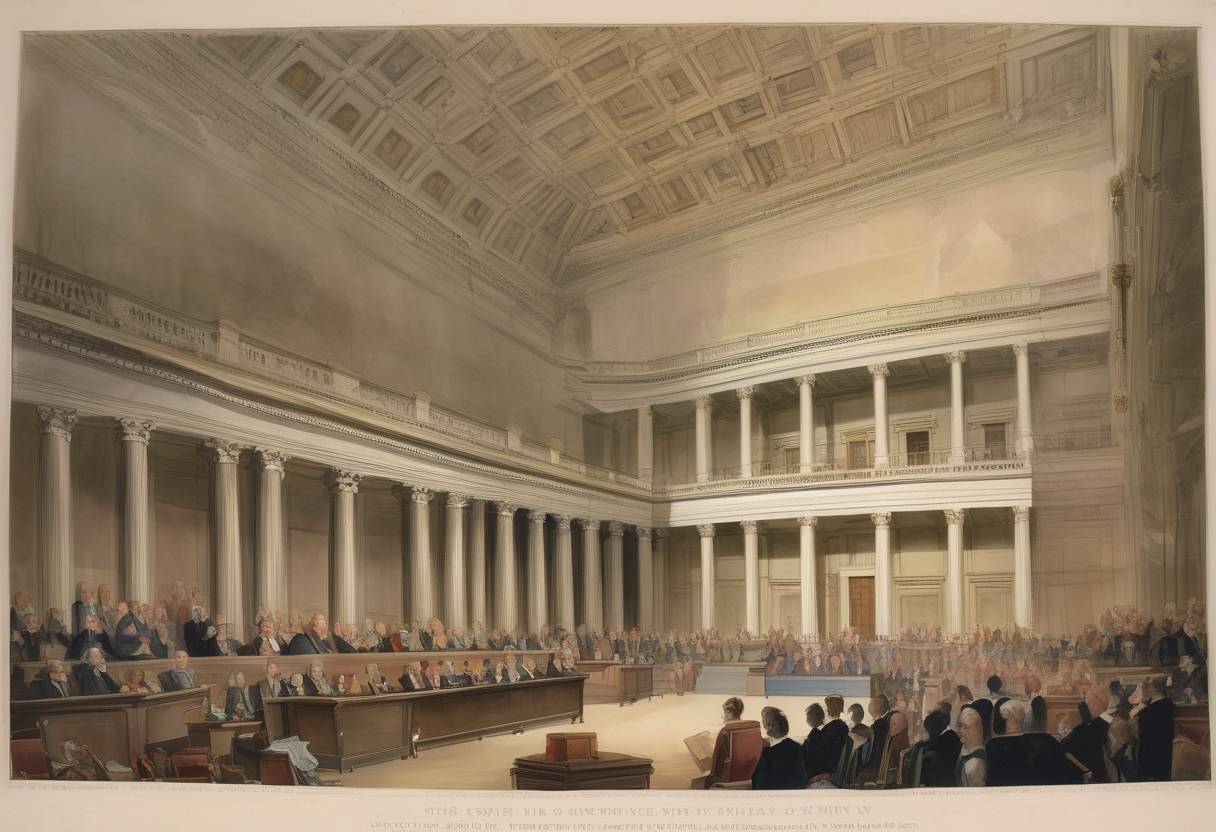
Marbury v. Madison: Establishing Judicial Review
On February 24, 1803, the Supreme Court of the United States delivered its decision in the landmark case of Marbury v. Madison, establishing the principle of judicial review. This pivotal case laid the foundation for the Supreme Court’s authority to interpret the Constitution and to invalidate laws that it finds in conflict with the Constitution.
Background
The case originated from the final days of President John Adams’ administration. In an effort to maintain Federalist influence, Adams appointed several judges to the federal courts, known as the “midnight judges,” under the Judiciary Act of 1801. William Marbury was one of these appointees, designated as a justice of the peace in the District of Columbia.
However, when Thomas Jefferson assumed the presidency, his Secretary of State, James Madison, refused to deliver Marbury’s commission. Marbury petitioned the Supreme Court for a writ of mandamus, compelling Madison to deliver the commission.
The Decision
Chief Justice John Marshall delivered the unanimous opinion of the Court. The decision addressed three key questions:
Did Marbury have a right to his commission?
The Court found that Marbury had been lawfully appointed and therefore had a right to his commission.
Was there a legal remedy for Marbury?
The Court determined that Marbury was entitled to a remedy under the law.
Could the Supreme Court issue the writ of mandamus?
Here, the Court concluded that it could not issue the writ. The Judiciary Act of 1789, which Marbury had invoked, extended the Court’s original jurisdiction beyond what was constitutionally permitted. Thus, the relevant section of the Act was deemed unconstitutional.
Establishing Judicial Review
The most significant outcome of Marbury v. Madison was the establishment of the principle of judicial review. Chief Justice Marshall asserted that it is “emphatically the province and duty of the judicial department to say what the law is.” This decision empowered the Supreme Court to nullify laws that it interprets as unconstitutional, thereby reinforcing the system of checks and balances integral to the U.S. government.
Historical Significance
Marbury v. Madison is a cornerstone of American constitutional law. It affirmed the judiciary’s role as a co-equal branch of government and set a precedent for the Court’s ability to limit Congressional power. This case has been cited in numerous subsequent decisions and remains a fundamental aspect of the Court’s authority.
The decision underscored the importance of an independent judiciary and has had a lasting impact on the interpretation and application of the U.S. Constitution, shaping the legal landscape of the United States for over two centuries.