The Execution of Captain Jack and Modoc Warriors
1873 · Fort Klamath, United States
Captain Jack and three other Modoc warriors were hanged for the murder of General Edward Canby during the Modoc War.
August 4, 1873
American Indian Wars: The Modoc War ends with the surrender of Captain Jack and his band to the U.S. Army, marking the conclusion of the conflict in California and Oregon.
California and Oregon, United States | United States Army
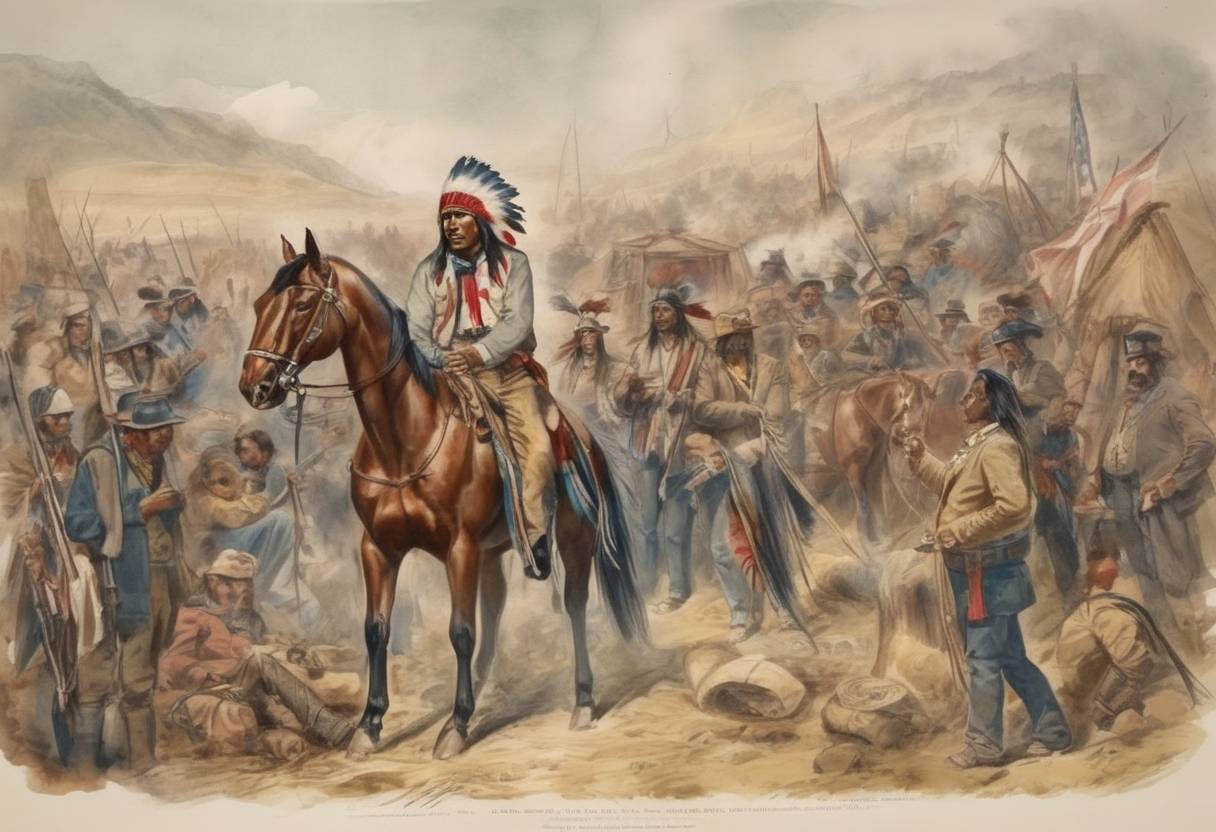
The Modoc War, a pivotal conflict in the series of confrontations known as the American Indian Wars, officially concluded on August 4, 1873, with the surrender of Captain Jack (Kintpuash) and his band to the U.S. Army. This marked the end of hostilities between the Modoc people and the United States in the regions of California and Oregon.
The Modoc War was rooted in longstanding tensions over land and sovereignty. The Modoc people traditionally inhabited areas around the California-Oregon border. However, increasing pressure from settlers and the U.S. government led to their forced relocation to the Klamath Reservation in Oregon, which they shared with the Klamath and Yahooskin tribes. The conditions on the reservation were poor, and conflicts with the Klamath tribe exacerbated the Modocs’ dissatisfaction.
In 1872, under the leadership of Captain Jack, a group of Modocs left the reservation and returned to their ancestral lands near Tule Lake. The U.S. government demanded their return to the reservation, but the Modocs resisted, leading to the outbreak of the Modoc War in November 1872.
The war was characterized by several significant battles and skirmishes, most notably the Battle of the Lava Beds, where the Modocs utilized the rugged terrain to their advantage. Despite being heavily outnumbered, they managed to hold off U.S. forces for several months.
A turning point in the conflict occurred in April 1873, when a peace commission meeting ended in violence. During the negotiations, Captain Jack, under pressure from his followers, killed General Edward Canby, the only U.S. Army general killed during the Indian Wars. This act intensified military efforts against the Modocs.
By June 1873, the Modocs were weakened by continuous military pressure and internal divisions. Captain Jack and his remaining followers were eventually captured by the U.S. Army. On August 4, 1873, Captain Jack formally surrendered, marking the end of the Modoc War.
Following their surrender, Captain Jack and several other Modoc leaders were tried and executed for the murder of General Canby. The remaining Modoc people were relocated to the Quapaw Agency in Oklahoma, far from their homeland.
The Modoc War highlighted the broader issues of Native American displacement and resistance during the westward expansion of the United States. It underscored the challenges faced by indigenous peoples in maintaining their land and way of life in the face of U.S. expansionist policies.
The conflict remains a significant chapter in the history of Native American resistance and the American Indian Wars, illustrating the complexities and tragedies of this era.
Source: en.wikipedia.org