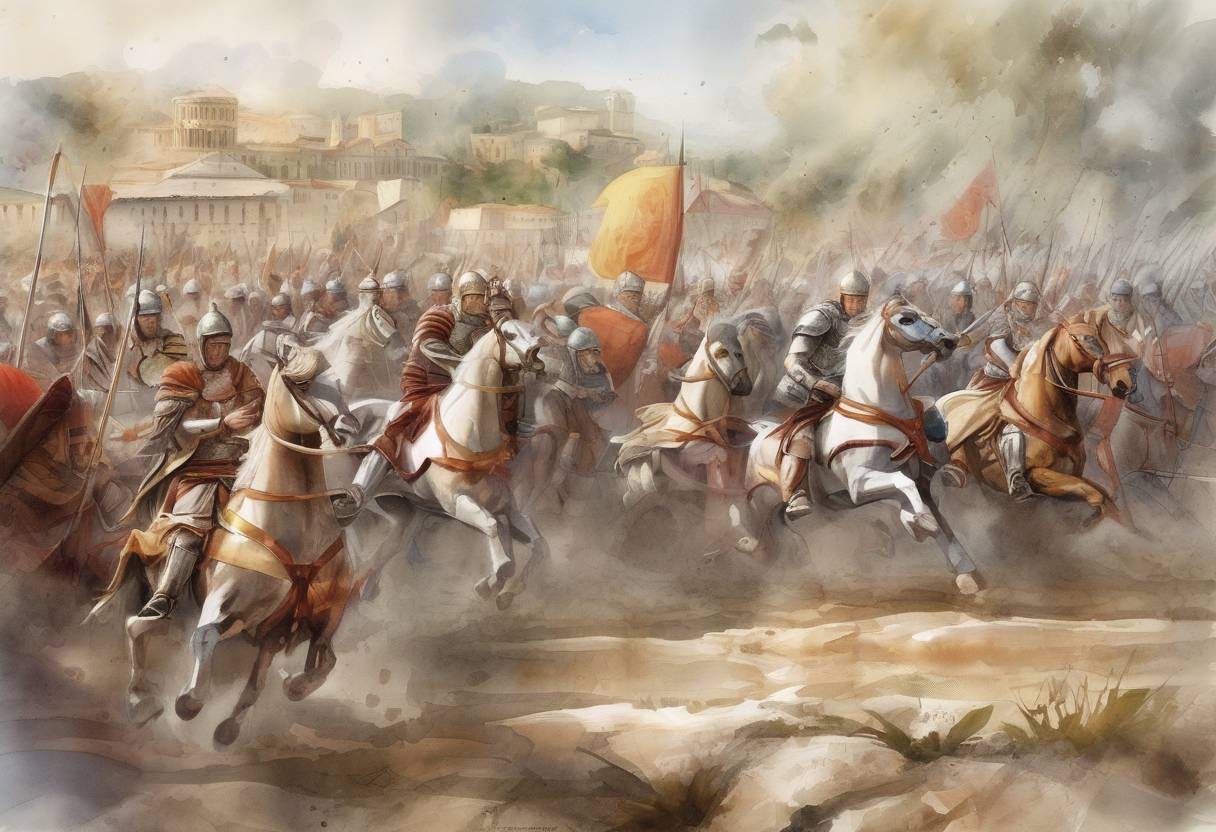
The Battle of the Frigidus: September 5-6, 394
The Battle of the Frigidus, fought on September 5-6, 394, was a pivotal conflict in the late Roman Empire, marking the consolidation of power by the Eastern Roman Emperor Theodosius I over the entire Roman Empire. This battle was significant not only for its immediate military and political outcomes but also for its long-term implications on the Roman Empire’s religious and administrative landscape.
Background
In the late 4th century, the Roman Empire was divided into Eastern and Western regions, each ruled by its own emperor. Theodosius I, a staunch supporter of Nicene Christianity, ruled the Eastern Roman Empire. The Western Roman Empire, however, was under the control of Eugenius, a usurper who had gained power with the backing of the Roman general Arbogast after the death of Emperor Valentinian II in 392.
Eugenius, although a Christian, was more tolerant of pagan practices, which garnered him support from the traditional Roman aristocracy and military factions that were resistant to Theodosius’s religious policies. This division set the stage for a confrontation between the two emperors.
The Battle
The battle took place near the Frigidus River, in the Julian Alps, in present-day Slovenia. Theodosius’s forces were composed of Eastern Roman troops, bolstered by Gothic auxiliaries led by Alaric, who would later become famous for his sack of Rome in 410. Eugenius’s army was primarily composed of Western Roman legions and Frankish mercenaries.
Key Events
Day 1 (September 5): The battle began with an aggressive assault by Theodosius’s forces. However, Eugenius’s troops, fortified by their strong defensive position, managed to hold their ground, inflicting heavy casualties on the Eastern forces.
Day 2 (September 6): A sudden and fierce bora wind, a natural phenomenon in the region, blew against Eugenius’s army, disrupting their formations and turning the tide in favor of Theodosius. This unexpected weather event was interpreted by Theodosius’s supporters as divine intervention.
Theodosius’s forces capitalized on this advantage, breaking through Eugenius’s lines. Eugenius was captured and executed, while Arbogast committed suicide.
Aftermath and Significance
The victory at the Battle of the Frigidus allowed Theodosius I to reunite the Roman Empire under a single ruler for the last time in its history. His triumph also reinforced the dominance of Nicene Christianity within the empire, as Theodosius continued to promote Christian orthodoxy and suppress pagan practices.
The battle’s outcome had significant implications for the Roman military and political structure. The reliance on Gothic auxiliaries foreshadowed the increasing influence of barbarian groups within the Roman military, a factor that would contribute to the eventual decline of the Western Roman Empire.
Theodosius’s death in 395 led to the permanent division of the Roman Empire into Eastern and Western halves, with his sons Arcadius and Honorius inheriting the respective regions. This division would persist until the fall of the Western Roman Empire in the 5th century.
In summary, the Battle of the Frigidus was a decisive moment in Roman history, symbolizing the triumph of Theodosius’s religious and political vision and setting the stage for the future trajectory of the Roman Empire.