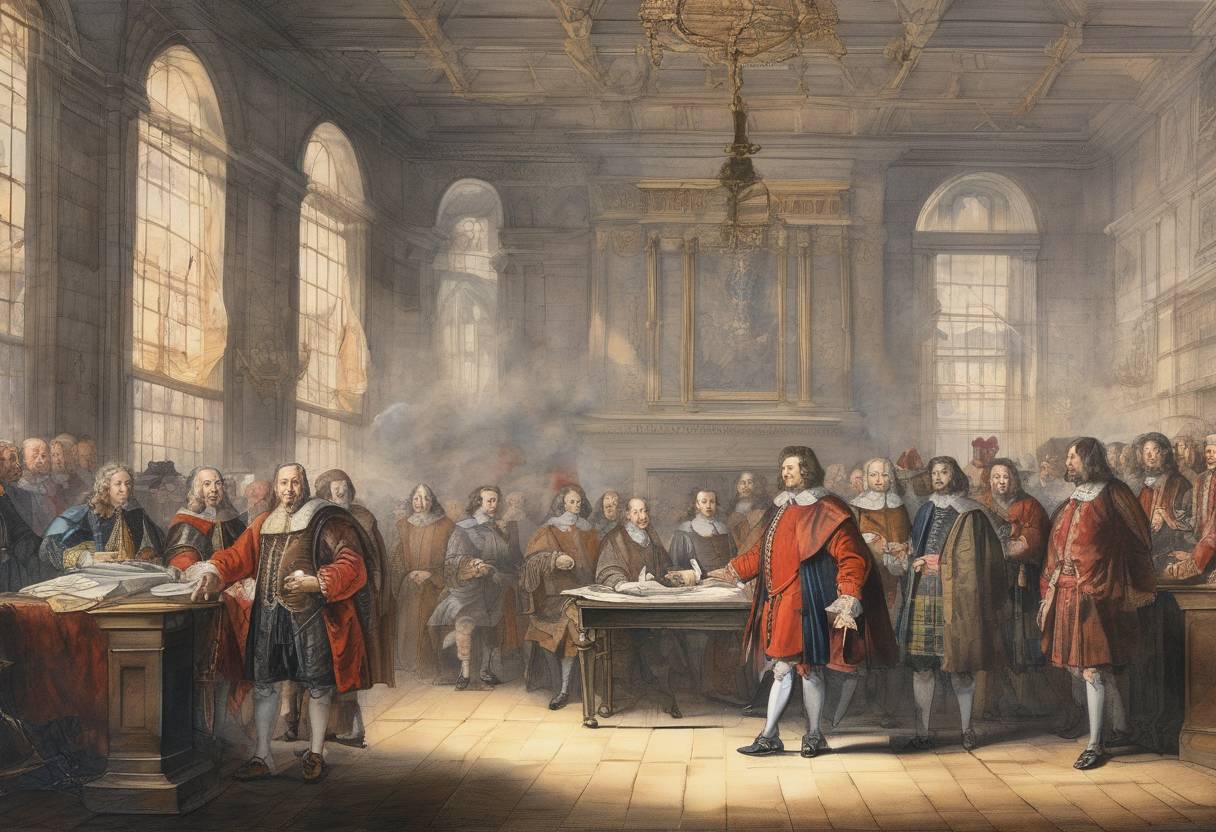
The Treaty of London: Ending the Bishops’ Wars
On November 3, 1641, the Treaty of London was signed, marking the end of the Bishops’ Wars between England and Scotland. This treaty was a significant milestone in the series of conflicts that eventually culminated in the English Civil War.
Background
The Bishops’ Wars were a pair of conflicts that took place in 1639 and 1640, primarily over religious disagreements. King Charles I of England attempted to impose Anglican practices on the Scottish Church, which was predominantly Presbyterian. This imposition was met with fierce resistance from the Scots, who saw it as an infringement on their religious freedoms.
The conflict began with the signing of the National Covenant in 1638 by Scottish Presbyterians, who pledged to resist any changes to their religious practices. Tensions escalated, leading to the First Bishops’ War in 1639. The war ended inconclusively with the Pacification of Berwick, but unresolved issues led to the Second Bishops’ War in 1640.
The Treaty of London
The Treaty of London was negotiated to bring an end to the Second Bishops’ War. Key terms of the treaty included:
- Withdrawal of English Forces: English troops were to be withdrawn from Scotland, acknowledging the failure of military efforts to enforce religious conformity.
- Restoration of Scottish Autonomy: The treaty recognized the autonomy of the Scottish Church and Parliament, effectively nullifying Charles I’s attempts to impose Anglican practices.
- Financial Compensation: The English government agreed to pay the Scottish army a substantial sum to cover their expenses during the conflict.
Consequences and Significance
The Treaty of London had several important consequences:
Financial Strain on England: The cost of the wars and the financial compensation to Scotland exacerbated the financial difficulties of Charles I, contributing to his reliance on Parliament for funds.
Political Tensions: The treaty highlighted the growing tensions between Charles I and the English Parliament. Many in Parliament were dissatisfied with the king’s handling of the wars and his attempts to govern without parliamentary consent.
Prelude to the English Civil War: The unresolved issues of governance, religion, and royal authority that were highlighted by the Bishops’ Wars and the Treaty of London set the stage for the English Civil War. The conflict between the monarchy and Parliament would soon escalate into a full-scale civil war, fundamentally altering the political landscape of England.
In summary, the Treaty of London was a pivotal moment in the lead-up to the English Civil War, illustrating the deep-seated conflicts over religious and political authority that would soon engulf the British Isles.