Christopher Columbus' Second Voyage: September 9, 1493
1493 · Cadiz, Spain
Christopher Columbus set sail on his second voyage to the New World, with a fleet of 17 ships carrying supplies and settlers.
January 4, 1493
Christopher Columbus began his return to Spain from his first voyage to the Americas.
Isabela, Dominican Republic | Spanish Crown
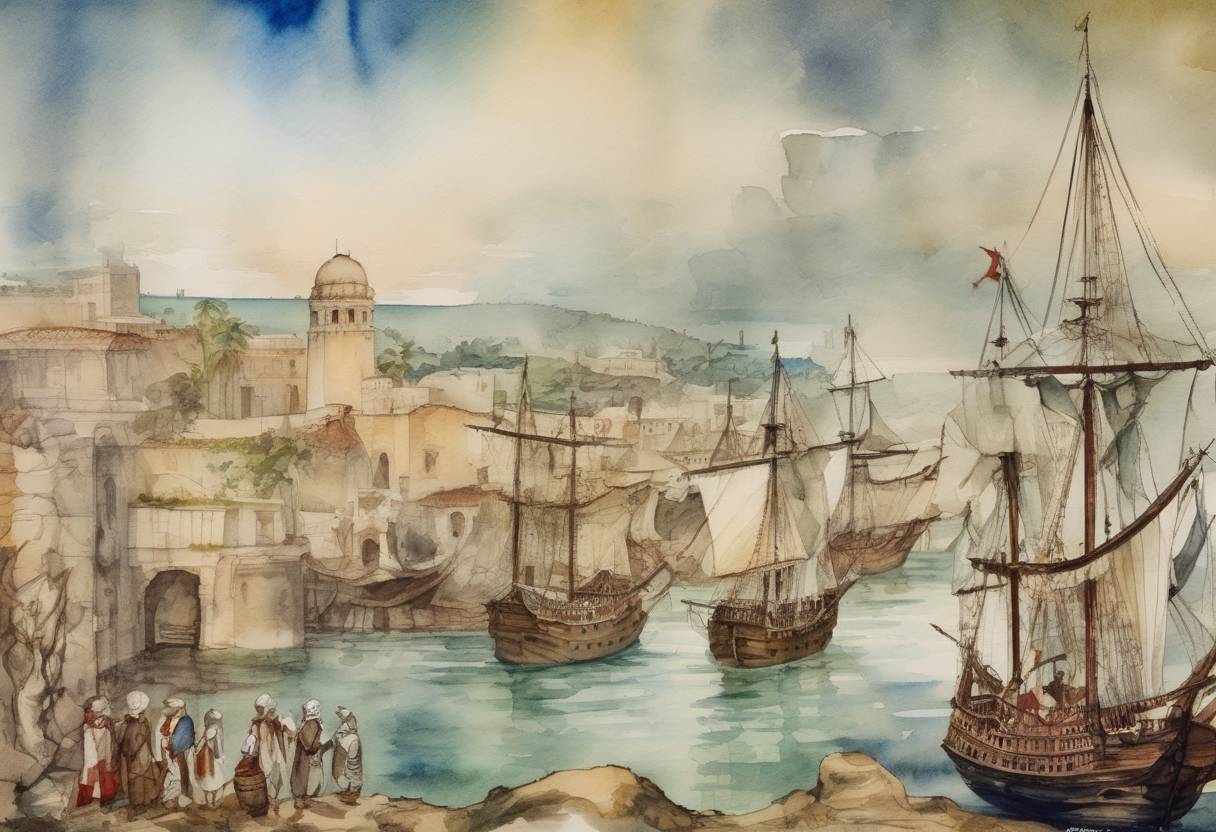
On January 4, 1493, Christopher Columbus embarked on his return journey to Spain after completing his first voyage to the Americas. This marked a significant moment in history, as Columbus’s expedition had opened the way for the widespread European exploration and eventual colonization of the Americas.
Christopher Columbus, an Italian navigator sailing under the Spanish flag, set out on his first voyage on August 3, 1492, with the aim of finding a westward sea passage to the East Indies. Sponsored by the Catholic Monarchs, Queen Isabella I and King Ferdinand II of Spain, Columbus commanded three ships: the Santa María, the Pinta, and the Niña.
On October 12, 1492, Columbus made landfall in what is now known as the Bahamas, believing he had reached islands off the Asian continent. Over the next few months, he explored parts of the Caribbean, including present-day Cuba and Hispaniola (now divided between Haiti and the Dominican Republic).
Settlement and Shipwreck: During his exploration, Columbus established a small settlement named La Navidad on Hispaniola after the Santa María was wrecked on a reef on December 25, 1492. He left some of his crew there to maintain the settlement.
Decision to Return: With the remaining ships, the Niña and the Pinta, Columbus decided to return to Spain to report his findings. His return was motivated by the need to inform the Spanish monarchs of his discoveries and to secure further support for future expeditions.
Departure: Columbus set sail from Hispaniola on January 4, 1493. The journey back to Spain was fraught with challenges, including severe storms that separated the Niña and the Pinta for a time.
Arrival in Spain: Despite the difficulties, Columbus successfully reached the port of Palos de la Frontera in Spain on March 15, 1493. His return was met with great enthusiasm and curiosity, as he brought with him news of the new lands and their potential riches.
Impact on Europe: Columbus’s successful return and the reports of his discoveries sparked a wave of interest and competition among European powers to explore and colonize the New World. This led to the Age of Exploration, fundamentally altering global trade, culture, and geopolitics.
Subsequent Voyages: Columbus would go on to make three more voyages to the Americas, although he never realized he had discovered a new continent, believing instead that he had reached the outskirts of Asia.
Legacy: While Columbus is often credited with “discovering” the Americas, it is important to acknowledge the complex legacy of his voyages, which included the beginning of European colonization and its profound impacts on indigenous populations.
Columbus’s return to Spain on January 4, 1493, thus marks a pivotal moment in world history, setting the stage for centuries of exploration and interaction between the Old and New Worlds.
Source: www.history.com