John Brown's Raid on Harpers Ferry - October 16, 1859
1859 · Harpers Ferry, United States
John Brown leads a raid on the federal armory at Harpers Ferry, intending to start an armed slave revolt.
December 2, 1859
Militant abolitionist John Brown was executed for his role in the raid on Harpers Ferry.
Charles Town, United States | State of Virginia
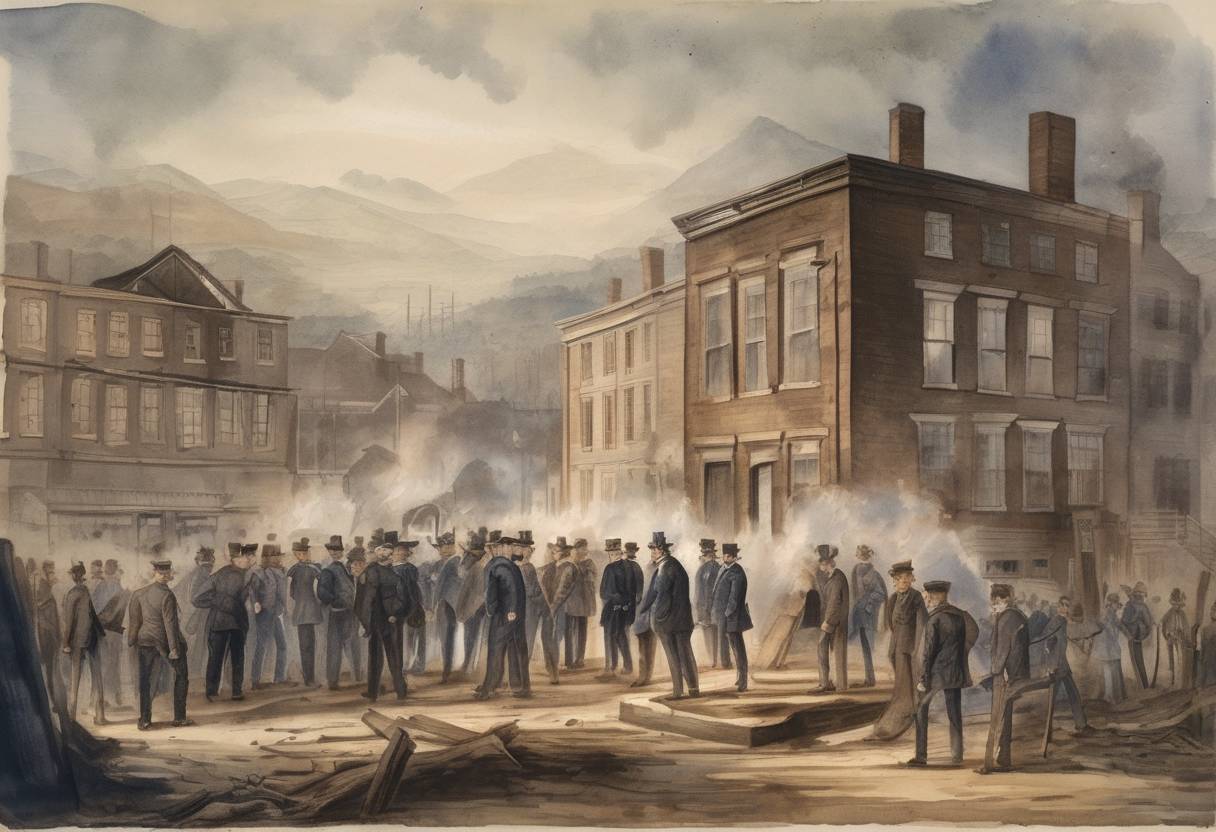
On December 2, 1859, John Brown, a militant abolitionist, was executed by hanging in Charles Town, Virginia (now West Virginia), following his conviction for treason against the Commonwealth of Virginia, murder, and inciting a slave insurrection. His execution was a pivotal moment in the lead-up to the American Civil War, highlighting the deepening national divide over the issue of slavery.
John Brown was a fervent abolitionist who believed in the use of armed insurrection to overthrow the institution of slavery in the United States. He had previously been involved in violent conflicts in Kansas, known as “Bleeding Kansas,” where pro-slavery and anti-slavery forces clashed violently.
On October 16, 1859, Brown led a group of 21 men, including five African Americans, in a raid on the federal armory at Harpers Ferry, Virginia. His objective was to seize weapons and initiate a slave uprising across the South. The raid, however, was poorly planned and executed. Local militia and U.S. Marines, led by then-Colonel Robert E. Lee, quickly suppressed the insurrection. Brown and his followers were captured after a two-day standoff.
John Brown was swiftly tried and found guilty of treason, murder, and inciting a slave rebellion. His trial was highly publicized, and Brown used the platform to advocate against slavery, gaining sympathy from abolitionists in the North. Despite pleas for clemency, he was sentenced to death.
On the morning of December 2, 1859, Brown was executed. His composed demeanor and dignified conduct during his trial and execution won him admiration and martyrdom status among abolitionists. His final note, written on the day of his execution, prophetically stated that the crimes of the nation would only be purged with blood.
Brown’s raid and subsequent execution intensified the sectional tensions between the North and South. In the North, he was hailed as a martyr for the abolitionist cause, while in the South, he was vilified as a terrorist. The event exacerbated fears of slave insurrections and contributed to the Southern states’ secessionist sentiments, which eventually led to the outbreak of the Civil War in 1861.
John Brown’s legacy is complex; he is remembered both as a radical who resorted to violence and as a courageous figure who stood unwaveringly against the moral atrocity of slavery. His actions and execution underscored the irreconcilable differences between the North and South, setting the stage for the conflict that would determine the future of slavery in America.
Source: en.wikipedia.org