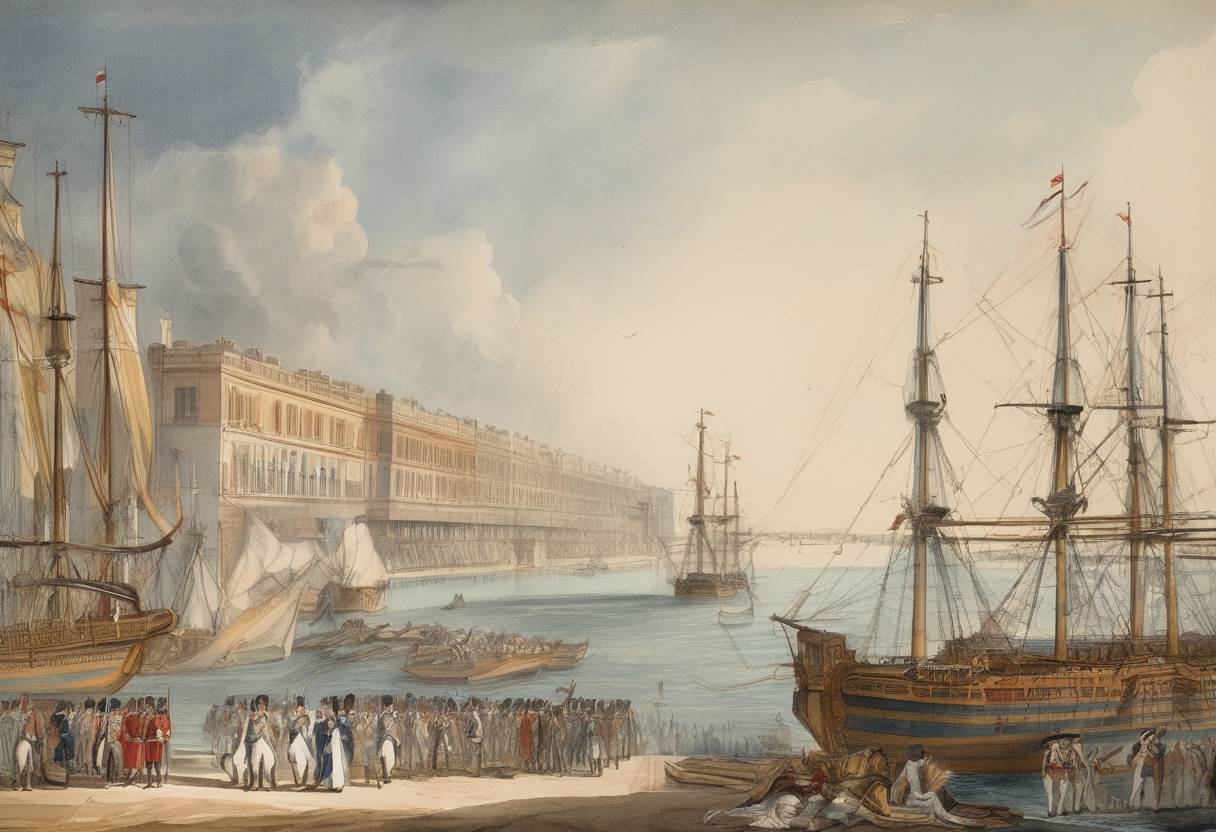
Napoleon Bonaparte’s Departure from Egypt - August 23, 1799
On August 23, 1799, Napoleon Bonaparte made the pivotal decision to leave Egypt and return to France, effectively marking the end of the French campaign in Egypt and Syria. This campaign, which began in 1798, was part of Napoleon’s broader strategy to undermine British interests by threatening their trade routes to India and expanding French influence in the Middle East.
Context and Background
The Egyptian Campaign (1798-1799): Napoleon’s expedition to Egypt was initially successful. He achieved a significant victory at the Battle of the Pyramids in July 1798, which allowed him to capture Cairo. However, the campaign faced numerous challenges, including resistance from local populations, logistical difficulties, and the British naval blockade led by Admiral Horatio Nelson, who destroyed the French fleet at the Battle of the Nile in August 1798.
Strategic Challenges: The destruction of the French fleet left Napoleon’s forces isolated in Egypt, unable to receive reinforcements or supplies from France. Additionally, the campaign in Syria, which included the siege of Acre, ended in failure, further complicating the French position in the region.
Napoleon’s Decision to Leave
Political Instability in France: By 1799, France was experiencing political instability, with the Directory government facing internal dissent and external threats from the Second Coalition. Napoleon, aware of the precarious situation, saw an opportunity to return and potentially seize power.
Secret Departure: Napoleon’s departure from Egypt was conducted in secrecy. He left behind a significant portion of his army under the command of General Jean-Baptiste Kléber, who was tasked with maintaining French control in Egypt. Napoleon’s decision was controversial, as it left his troops in a vulnerable position.
Aftermath and Consequences
Return to France: Napoleon arrived in France in October 1799. His return was met with enthusiasm by the French public, and he quickly capitalized on the political turmoil. By November 1799, he orchestrated a coup d’état, known as the Coup of 18 Brumaire, which led to the establishment of the Consulate and his rise as First Consul, effectively ending the French Revolution.
End of the Campaign: The French forces in Egypt continued to face difficulties. General Kléber was assassinated in 1800, and his successor, General Jacques-François Menou, eventually surrendered to British and Ottoman forces in 1801, formally ending the French presence in Egypt.
Historical Significance
Napoleon’s Egyptian campaign, despite its ultimate failure, had lasting impacts. It sparked European interest in Egyptology and contributed to the discovery of the Rosetta Stone, which was crucial in deciphering Egyptian hieroglyphs. Politically, Napoleon’s return to France set the stage for his eventual rise to Emperor, reshaping the course of European history in the early 19th century.