1715 · Various, Various
A total solar eclipse occurred, known as the 'Eclipse of Thales.' Although not widely documented in that year, eclipses were points of significant interest providing impetus for scientific inquiry.
May 28, 0585
A solar eclipse occurred, which was predicted by the Greek philosopher and scientist Thales of Miletus. This event reportedly took place during the Battle of Halys between the Medes and the Lydians, leading to a truce.
Halys, modern-day Turkey
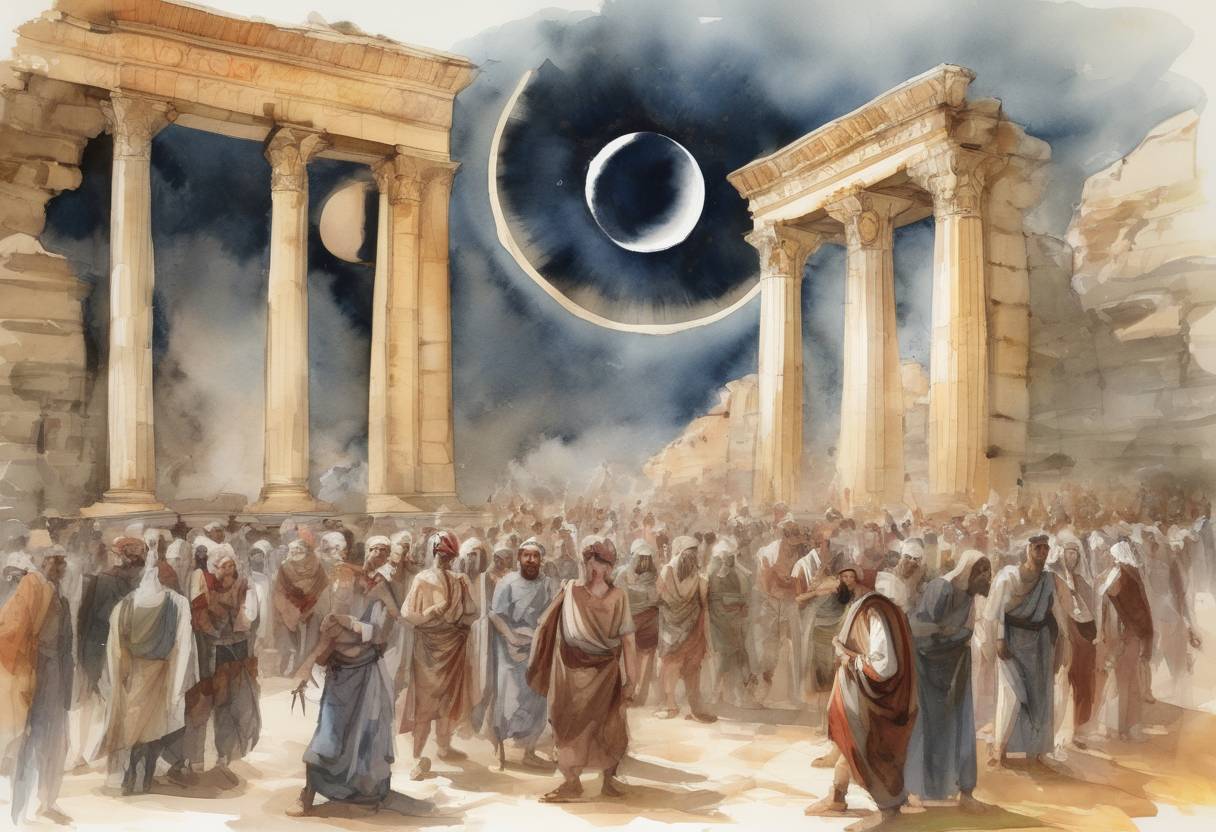
On May 28, 585 BCE, a remarkable astronomical event occurred that had significant historical implications: a solar eclipse predicted by the Greek philosopher and scientist Thales of Miletus. This eclipse is famously associated with the Battle of Halys, fought between the Medes and the Lydians.
Thales of Miletus: Thales was one of the pre-Socratic philosophers and is often regarded as the first individual in Western history to engage in scientific philosophy. He is credited with various contributions to mathematics and astronomy, including the prediction of this solar eclipse.
The Battle of Halys: This battle was part of a protracted conflict between the Medes, led by King Cyaxares, and the Lydians, under King Alyattes. The two kingdoms were powerful entities in the region, with the Medes controlling much of what is now Iran and the Lydians ruling over parts of western Anatolia (modern-day Turkey).
The Eclipse: The solar eclipse on May 28, 585 BCE, was a total eclipse, meaning the moon completely obscured the sun for a brief period. This dramatic celestial event was visible over the battlefield, casting an eerie shadow over the combatants.
Thales’ Prediction: Thales’ prediction of the eclipse is considered one of the earliest recorded instances of scientific forecasting. While the exact method he used remains unknown, it is believed that he might have relied on Babylonian astronomical records or cycles.
The Truce: The sudden darkening of the sky during the battle was interpreted as an omen by both sides. The unexpected event led to a cessation of hostilities, as both the Medes and the Lydians took it as a sign from the gods. Consequently, they agreed to a truce, ending the six-year war. The Halys River was established as the boundary between the two kingdoms.
Scientific Achievement: Thales’ successful prediction marked a significant milestone in the history of science, demonstrating the potential for human understanding and prediction of natural phenomena.
Cultural Impact: The eclipse and its role in halting the battle highlight the profound influence of celestial events on human affairs, particularly in ancient times when such occurrences were often seen as divine interventions.
Diplomatic Resolution: The truce brokered under the shadow of the eclipse exemplifies how natural events can influence political and military decisions, leading to peaceful resolutions.
In summary, the solar eclipse of May 28, 585 BCE, stands as a fascinating intersection of science, history, and culture, illustrating the profound impact of astronomical phenomena on human events and the early strides in scientific thought by figures like Thales of Miletus.
Source: en.wikipedia.org