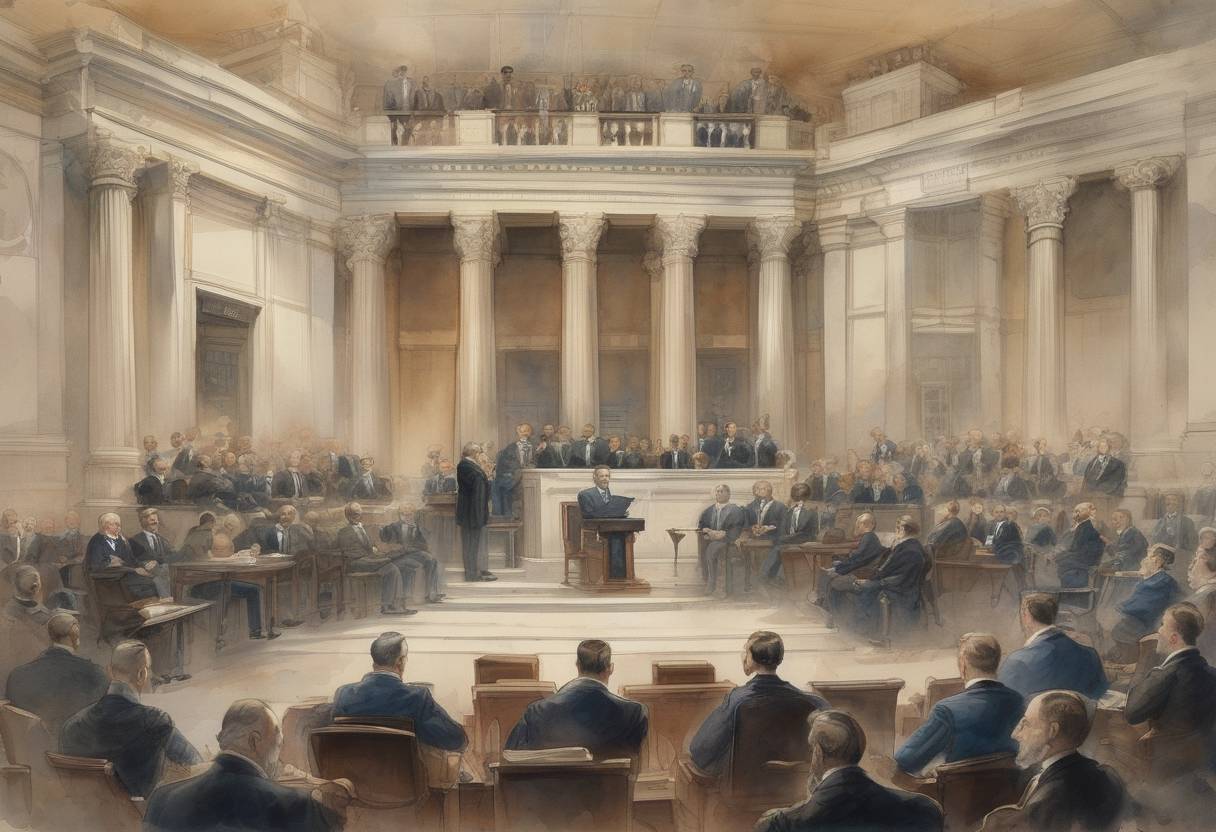
Plessy v. Ferguson: The Supreme Court Decision of May 18, 1896
On May 18, 1896, the United States Supreme Court delivered its landmark decision in the case of Plessy v. Ferguson. This ruling upheld the constitutionality of racial segregation under the “separate but equal” doctrine, a pivotal moment in the history of civil rights in the United States.
Background
The case originated in Louisiana, where the state had enacted the Separate Car Act in 1890, requiring separate railway cars for Black and White passengers. Homer Plessy, a man of mixed race, challenged this law by refusing to leave a Whites-only car. Plessy was arrested, and his case eventually made its way to the Supreme Court.
The Supreme Court’s Decision
The Supreme Court, in a 7-1 decision, ruled against Plessy. The majority opinion, written by Justice Henry Billings Brown, held that the Louisiana law did not violate the Equal Protection Clause of the 14th Amendment. The Court argued that as long as the separate facilities for the races were equal, their segregation did not imply the inferiority of African Americans.
Key Points of the Decision:
- “Separate but Equal” Doctrine: The Court established the doctrine that would justify segregation for decades, asserting that racial segregation was constitutional as long as the facilities provided to each race were equal.
- Impact on Civil Rights: This decision effectively sanctioned laws that institutionalized racial discrimination and segregation across the United States, particularly in the South.
Dissenting Opinion
Justice John Marshall Harlan was the sole dissenter in the case. He famously argued that the Constitution is “color-blind” and does not tolerate classes among citizens. Harlan’s dissent would later be seen as a prescient critique of the majority’s decision.
Aftermath and Historical Significance
The Plessy v. Ferguson decision had profound implications:
- Legalized Segregation: It provided a legal foundation for the Jim Crow laws that enforced racial segregation in public facilities, schools, and transportation.
- Civil Rights Movement: The decision was a significant setback for civil rights but also galvanized future generations to fight for equality, eventually leading to the Civil Rights Movement of the 1950s and 1960s.
- Overturning by Brown v. Board of Education: The “separate but equal” doctrine remained in place until it was overturned by the Supreme Court in 1954 with the Brown v. Board of Education decision, which declared that separate educational facilities are inherently unequal.
The Plessy v. Ferguson case remains a critical example of how legal interpretations can profoundly affect societal norms and individual rights. Its legacy is a reminder of the ongoing struggle for equality and justice in American history.