Restoration of Emperor Louis the Pious - March 1, 834
834 · Aachen, Carolingian Empire
Emperor Louis the Pious is restored to power after being deposed by his sons, marking a significant event in the Carolingian Empire.
January 28, 0814
Charlemagne, King of the Franks and Lombards and Emperor of the Carolingian Empire, dies in Aachen, present-day Germany. His death marks the end of a significant era in European history, as Charlemagne was instrumental in uniting much of Western Europe during the early Middle Ages.
Aachen, Frankish Empire (present-day Germany) | Carolingian Empire
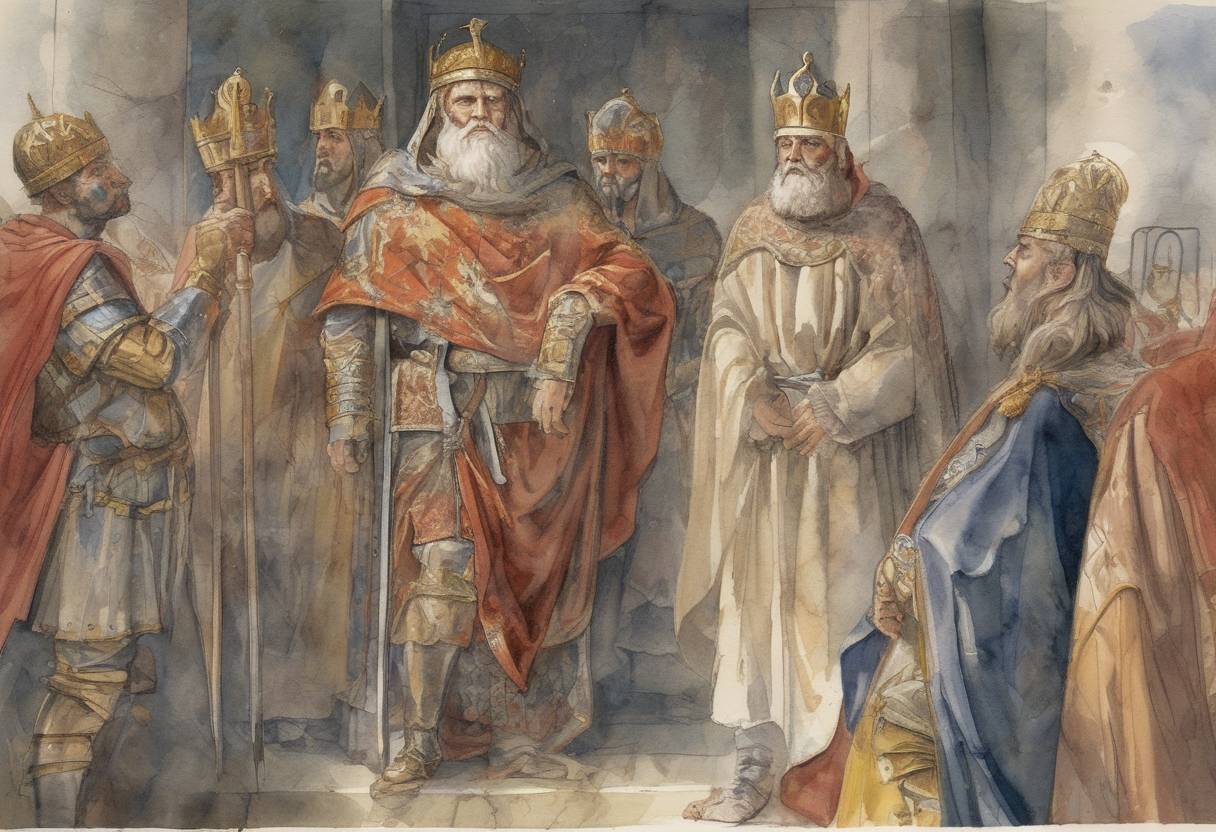
On January 28, 814, Charlemagne, one of the most influential figures in European history, passed away in Aachen, present-day Germany. His death marked the end of a significant era in the early Middle Ages, as he was instrumental in uniting much of Western Europe under his rule.
Charlemagne, also known as Charles the Great, was born on April 2, 747. He was the son of Pepin the Short, the first Carolingian king, and Bertrada of Laon. Upon Pepin’s death in 768, Charlemagne and his brother Carloman inherited the Frankish kingdom. After Carloman’s death in 771, Charlemagne became the sole ruler.
Charlemagne’s reign was marked by a series of military campaigns that expanded his empire and consolidated his power:
In 800, Charlemagne was crowned “Emperor of the Romans” by Pope Leo III, reviving the title in the West and laying the foundation for what would become the Holy Roman Empire.
Charlemagne’s reign is often associated with the Carolingian Renaissance, a revival of art, culture, and learning based on classical models. He established a more efficient administrative system, with counts and local officials overseeing various regions of his empire. He also promoted education and literacy, encouraging the establishment of schools and the preservation of classical texts.
Charlemagne died on January 28, 814, after a reign of over four decades. He was buried in the cathedral at Aachen, a city that served as his capital and a center of his empire.
His death marked the end of an era, but his legacy endured. The empire he built laid the groundwork for the development of modern European states. His efforts to unify Western Europe and promote Christianity had lasting impacts on the continent’s cultural and political landscape.
Charlemagne’s empire was divided among his grandsons following the Treaty of Verdun in 843, leading to the formation of distinct political entities that would evolve into modern European nations. His influence is still recognized today, and he is often regarded as the “Father of Europe” for his role in shaping the continent’s history.
Source: en.wikipedia.org