The Battle of Leuctra: A Turning Point in Greek History
371 · Leuctra, Greece
The Battle of Leuctra took place, where the Theban army, led by Epaminondas, defeated the Spartans, marking a significant shift in Greek power dynamics.
August 2, 0338
The Battle of Chaeronea occurred, where Philip II of Macedon defeated the combined forces of Athens and Thebes, marking the rise of Macedonian power in Greece.
Chaeronea, Ancient Greece | Macedonian Army
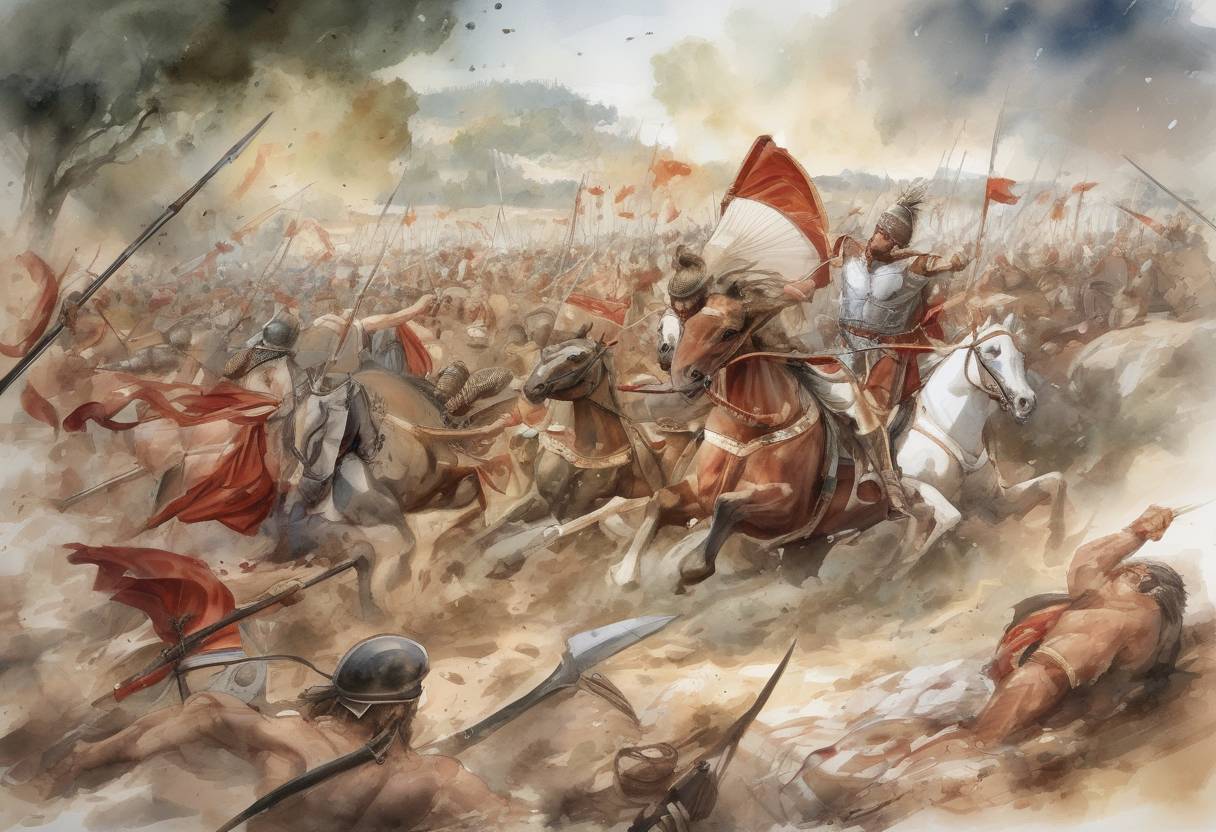
The Battle of Chaeronea, fought on August 2, 338 BCE, was a pivotal conflict in ancient Greek history that marked the ascendancy of Macedonian power under Philip II. This battle took place near the town of Chaeronea in Boeotia, central Greece, and involved a decisive confrontation between the forces of Philip II of Macedon and a coalition of Greek city-states, primarily Athens and Thebes.
Rise of Macedon: By the mid-4th century BCE, Philip II had transformed Macedon from a relatively weak kingdom into a formidable military power. His strategic marriages, diplomatic maneuvers, and military reforms, including the development of the Macedonian phalanx, strengthened his position in the region.
Greek Resistance: The growing power of Macedon alarmed many Greek city-states. Athens and Thebes, traditionally powerful and influential, viewed Philip’s expansionist policies as a direct threat to their autonomy and influence.
Formation of the Alliance: In response to Philip’s advances, Athens and Thebes, along with several other smaller states, formed an alliance to counter Macedonian aggression. This coalition was an attempt to preserve the independence of the Greek city-states and prevent Macedonian dominance.
Forces and Strategy: Philip II commanded a well-trained and disciplined army, including his elite Companion Cavalry and the innovative Macedonian phalanx. The Greek coalition, though numerically comparable, was less cohesive, with differing military traditions and strategies.
Tactics and Execution: The battle commenced with both sides deploying their forces strategically. Philip positioned his troops to exploit the weaknesses in the Greek lines. A key moment in the battle was the tactical maneuver by Philip’s son, Alexander the Great, then only 18 years old, who led a decisive cavalry charge that broke through the Theban lines.
Outcome: The Macedonian forces achieved a resounding victory. The Theban Sacred Band, an elite unit, was annihilated, and the Athenian forces were routed. The defeat effectively ended the independence of the Greek city-states, as they fell under Macedonian hegemony.
Macedonian Hegemony: The victory at Chaeronea established Macedonian dominance over Greece. Philip II formed the Corinthian League, a federation of Greek states under Macedonian leadership, ostensibly to unite Greece against the Persian Empire.
Rise of Alexander the Great: The battle also marked the emergence of Alexander as a formidable military leader, setting the stage for his future conquests.
End of Classical Greece: The battle is often seen as the end of the classical era of Greek history, as the traditional city-state model gave way to larger territorial states.
The Battle of Chaeronea was a turning point that reshaped the political landscape of Greece and set the stage for the subsequent expansion of the Macedonian Empire under Alexander the Great.
Source: en.wikipedia.org