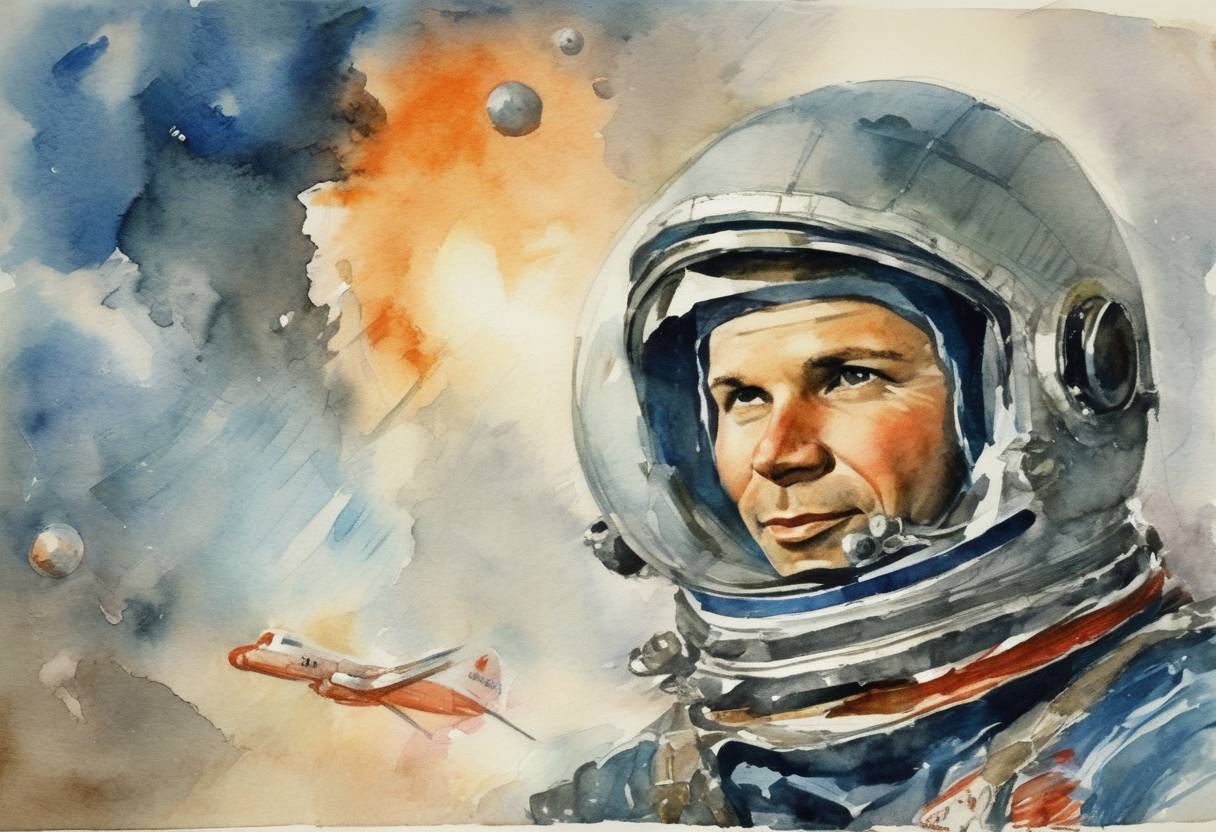
Yuri Gagarin’s Historic Spaceflight: Vostok 1
On April 12, 1961, Soviet cosmonaut Yuri Gagarin made history as the first human to travel into space and orbit the Earth aboard the spacecraft Vostok 1. This monumental event marked a significant milestone in the Space Race between the United States and the Soviet Union during the Cold War era.
Background
The Space Race was a period of intense competition between the United States and the Soviet Union, aiming to achieve superior space exploration capabilities. The Soviet Union had already achieved a major victory by launching Sputnik 1, the first artificial satellite, in 1957. The successful launch of Vostok 1 further solidified the Soviet Union’s lead in space exploration.
The Mission
- Launch Date: April 12, 1961
- Launch Site: Baikonur Cosmodrome, Kazakhstan
- Spacecraft: Vostok 1
- Duration: Approximately 108 minutes
- Orbit: One complete orbit around the Earth
Key Events
Launch: Vostok 1 was launched at 06:07 UTC. The spacecraft was propelled by a Vostok-K rocket, designed to carry a single cosmonaut into space.
Orbit: Gagarin reached an altitude of about 327 kilometers (203 miles) at the highest point of his orbit. The spacecraft traveled at a speed of approximately 27,400 kilometers per hour (17,000 miles per hour).
Re-entry and Landing: After completing one orbit, Vostok 1 re-entered the Earth’s atmosphere. Gagarin ejected from the spacecraft at an altitude of about 7 kilometers (4.3 miles) and parachuted safely to the ground near the town of Engels in the Saratov region of the Soviet Union.
Significance
Pioneering Achievement: Yuri Gagarin’s successful mission made him an international hero and a symbol of Soviet space prowess. It demonstrated the feasibility of human spaceflight and paved the way for future manned missions.
Impact on the Space Race: The mission intensified the Space Race, prompting the United States to accelerate its own space program, leading to President John F. Kennedy’s commitment to landing a man on the Moon by the end of the 1960s.
Cultural Influence: Gagarin’s flight had a profound impact on popular culture and inspired generations of scientists, engineers, and explorers worldwide. April 12 is celebrated annually as Yuri’s Night, commemorating human space exploration.
Aftermath
Following his historic flight, Yuri Gagarin became a global ambassador for the Soviet Union, traveling extensively to promote the achievements of Soviet space exploration. Tragically, Gagarin died in a plane crash on March 27, 1968, but his legacy as a pioneer of space exploration endures.
Gagarin’s journey aboard Vostok 1 remains a testament to human ingenuity and the spirit of exploration, marking a pivotal moment in the history of space travel.