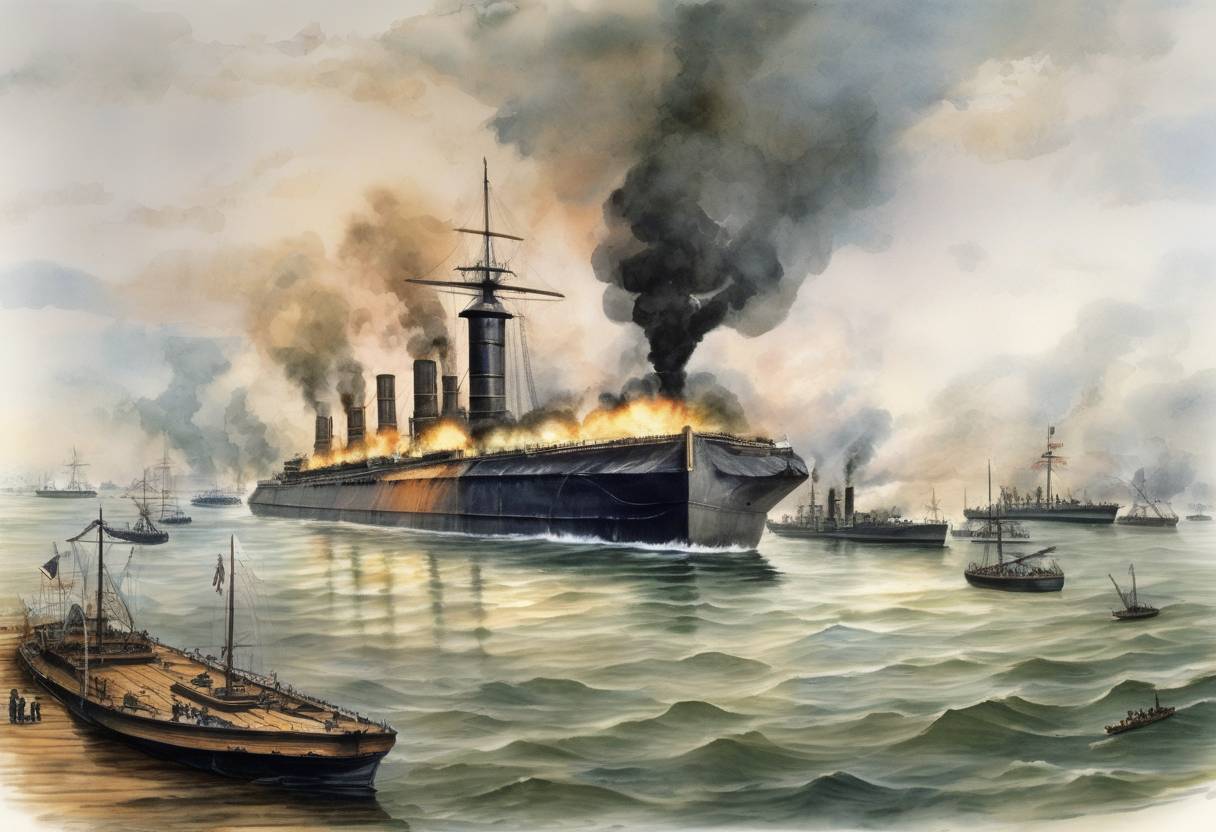
The Battle of Hampton Roads: The Clash of Ironclads
Context
The Battle of Hampton Roads, fought on March 8-9, 1862, during the American Civil War, marked a pivotal moment in naval warfare history. This battle witnessed the first meeting in combat of ironclad warships, the USS Monitor and the CSS Virginia, signaling a revolutionary shift from wooden ships to armored vessels.
Background
The CSS Virginia
- Originally the USS Merrimack, a wooden frigate, it was scuttled by Union forces to prevent capture.
- The Confederacy salvaged and transformed it into the ironclad CSS Virginia.
- Armed with ten guns and an iron ram, it aimed to break the Union blockade of Southern ports.
The USS Monitor
- Designed by Swedish engineer John Ericsson, the Monitor was a novel design featuring a revolving turret.
- It was hastily constructed in response to the threat posed by the Virginia.
- The Monitor carried two large guns and was characterized by its low profile and innovative design.
The Battle
March 8, 1862
- The CSS Virginia, commanded by Captain Franklin Buchanan, attacked Union ships at Hampton Roads.
- It destroyed the USS Cumberland with its iron ram and set the USS Congress ablaze.
- The Virginia’s dominance seemed assured as it faced little resistance from the wooden Union fleet.
March 9, 1862
- The USS Monitor, under Lieutenant John L. Worden, arrived overnight to challenge the Virginia.
- The two ironclads engaged in a historic duel, exchanging fire for hours.
- Despite the intense battle, neither ship could claim a decisive victory.
- The Monitor’s turret allowed it to fire in all directions, while the Virginia’s armor withstood the Monitor’s shots.
Aftermath and Significance
- The battle ended in a stalemate, but it had profound implications for naval warfare.
- It demonstrated the obsolescence of wooden warships and heralded the era of ironclad vessels.
- Both the Union and Confederate navies accelerated their ironclad programs.
- The engagement captured public imagination and influenced naval strategies worldwide.
Broader Historical Impact
- The battle underscored the importance of technological innovation in warfare.
- It highlighted the strategic significance of naval power in the Civil War.
- The Monitor and Virginia’s clash set a precedent for future naval engagements and ship design.
The Battle of Hampton Roads remains a landmark event in military history, symbolizing the transition from traditional naval warfare to modern, mechanized combat.