Assassination of Roman Emperor Pertinax and the Auction of the Imperial Throne
193 · Rome, Roman Empire
The Roman Emperor Pertinax is assassinated by the Praetorian Guard, leading to the auction of the imperial throne.
January 1, 0193
The Roman Emperor Commodus was assassinated, leading to the Year of the Five Emperors, a period of civil war in the Roman Empire.
Rome, Roman Empire | Roman government
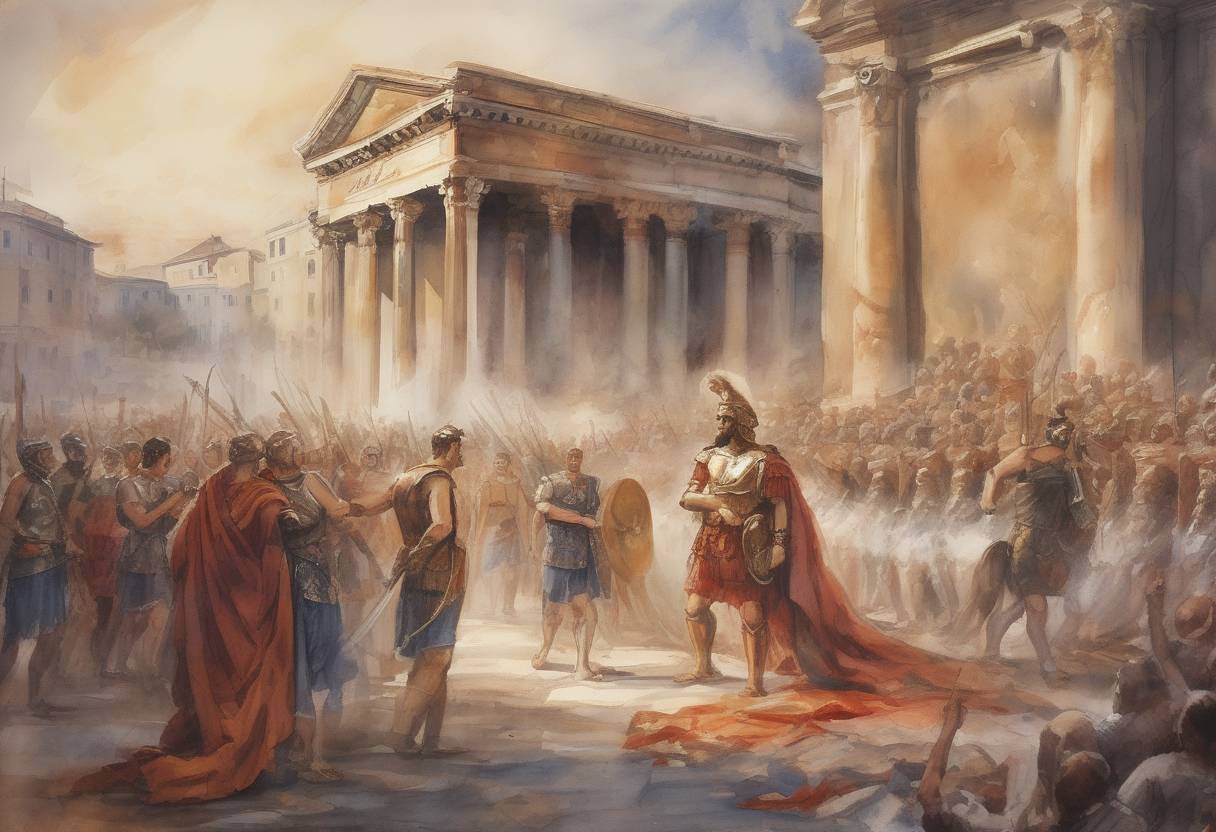
On January 1, 193 AD, the Roman Emperor Commodus was assassinated, marking a pivotal moment in Roman history that led to a period of civil unrest known as the Year of the Five Emperors. This event not only ended the reign of a controversial emperor but also plunged the Roman Empire into a chaotic succession crisis.
Commodus, born in 161 AD, was the son of the esteemed Emperor Marcus Aurelius. He ascended to the throne in 180 AD, marking the end of the Pax Romana, a long period of relative peace and stability across the Roman Empire. Unlike his father, Commodus was known for his erratic behavior and self-indulgence. His reign was characterized by political instability, economic difficulties, and a growing disconnect between the emperor and the Roman Senate.
Commodus increasingly alienated the Senate and the Roman elite by indulging in extravagant displays of power, including participating in gladiatorial games and declaring himself a living god. His administration was marked by corruption and mismanagement, leading to widespread dissatisfaction.
The assassination of Commodus was orchestrated by a conspiracy involving several of his closest associates, including his chamberlain, Eclectus, his mistress, Marcia, and the Praetorian Prefect, Quintus Aemilius Laetus. Fearing for their own safety and the stability of the empire, they plotted to remove Commodus from power.
On the night of December 31, 192 AD, Commodus was poisoned, but when the poison failed to kill him, the conspirators resorted to more direct means. A wrestler named Narcissus was enlisted to strangle Commodus in his bath, successfully ending his life.
The death of Commodus set off a rapid succession of claimants to the imperial throne, leading to what is known as the Year of the Five Emperors. This period saw the rise and fall of several emperors in quick succession:
Pertinax: Immediately following Commodus’s death, Pertinax, a respected senator and former governor, was declared emperor. However, his attempts to reform the empire and curb the excesses of Commodus’s reign led to his assassination by the Praetorian Guard after just 86 days.
Didius Julianus: In a shocking turn of events, the imperial throne was auctioned off by the Praetorian Guard, and Didius Julianus became emperor by offering the highest bid. His reign was short-lived, as he failed to gain the support of the Roman legions.
Pescennius Niger: A governor in the eastern provinces, Niger was declared emperor by his troops. His claim led to a civil war as he vied for control of the empire.
Clodius Albinus: Initially an ally of Septimius Severus, Albinus was declared emperor by his legions in Britain. He later turned against Severus, leading to further conflict.
Septimius Severus: Ultimately, it was Septimius Severus who emerged victorious. A seasoned military commander, Severus marched on Rome, defeated his rivals, and established the Severan dynasty, bringing an end to the immediate chaos.
The Year of the Five Emperors highlighted the fragility of the Roman imperial system and the significant power wielded by the military. The events of 193 AD underscored the importance of securing the loyalty of the legions and the Praetorian Guard for any would-be emperor.
Septimius Severus’s rise to power marked the beginning of a new era in Roman history. His reign focused on strengthening the military and consolidating power, setting the stage for the Severan dynasty, which would rule the empire for several decades.
The assassination of Commodus and the subsequent power struggles had lasting implications for the Roman Empire, illustrating the challenges of maintaining stability in a vast and diverse empire.
Source: en.wikipedia.org