The Establishment of the Yuan Dynasty: December 18, 1271
1271 · Beijing, China
Kublai Khan renames his empire 'Yuan', marking the beginning of the Yuan Dynasty in China.
May 5, 1260
Kublai Khan becomes ruler of the Mongol Empire.
Karakorum, Mongol Empire | Mongol Empire
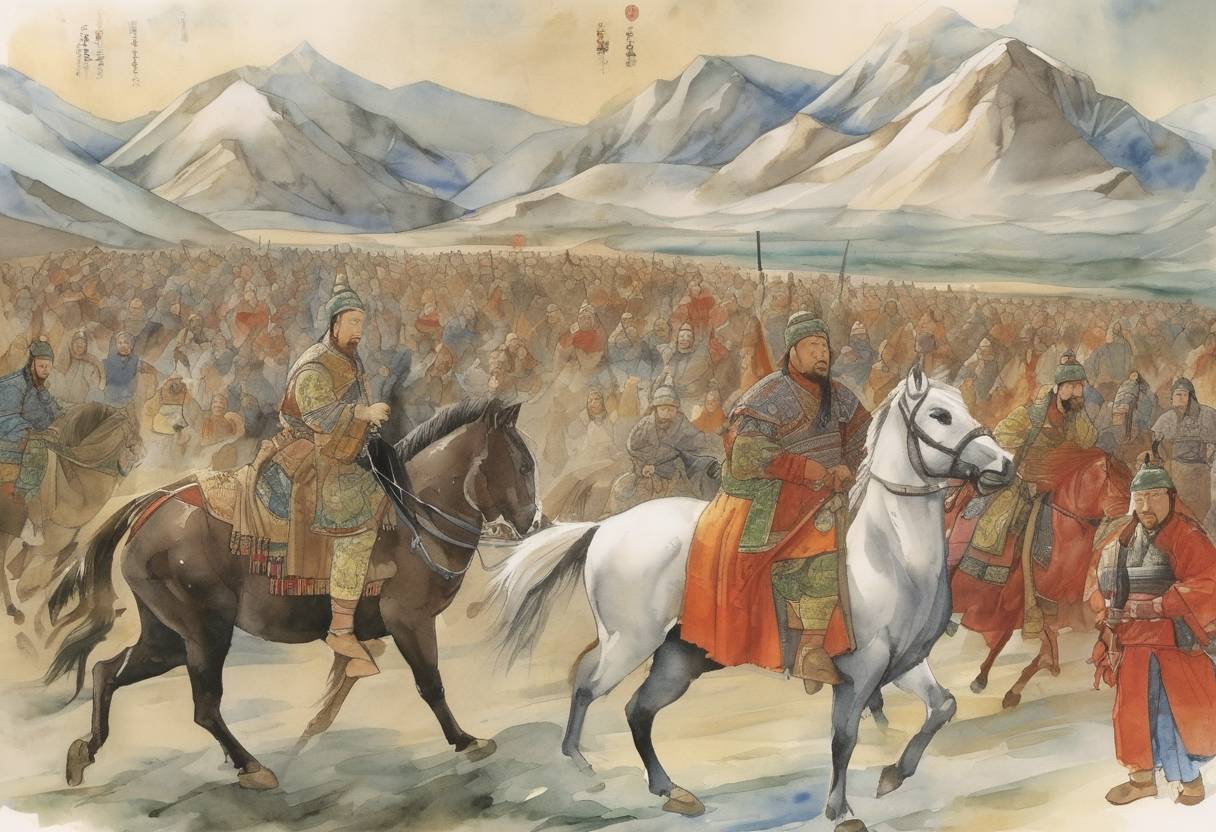
On May 5, 1260, Kublai Khan was declared the ruler of the Mongol Empire, marking a significant turning point in the history of the empire and its expansion. This event was pivotal in shaping the future of the Mongol Empire and its influence across Asia and beyond.
Kublai Khan was the grandson of Genghis Khan, the founder of the Mongol Empire. Born in 1215, Kublai was the fourth son of Tolui and Sorghaghtani Beki. He was raised in the Mongolian steppes and was deeply influenced by his mother, who was a Nestorian Christian and a skilled political strategist. Kublai was known for his interest in Chinese culture and administration, which later played a crucial role in his governance style.
The death of Kublai’s brother, Möngke Khan, in 1259 led to a succession crisis within the Mongol Empire. Möngke’s death left a power vacuum, and the empire was divided between different factions supporting various claimants to the throne. Kublai’s main rival was his younger brother, Ariq Böke, who was also vying for control.
Kublai was declared the Great Khan on May 5, 1260, at a kurultai (a traditional Mongol council) held in the city of Kaiping, which he later renamed Shangdu. However, his ascension was contested by Ariq Böke, who held his own kurultai in Karakorum, the traditional Mongol capital, and declared himself the Great Khan.
The ensuing civil war between Kublai and Ariq Böke lasted for four years, from 1260 to 1264. Kublai’s strategic alliances and superior resources eventually led to his victory. Ariq Böke was captured and forced to surrender in 1264, solidifying Kublai’s position as the undisputed ruler of the Mongol Empire.
Kublai Khan’s reign marked a significant transformation in the Mongol Empire. He moved the capital from Karakorum to Khanbaliq (modern-day Beijing), reflecting his focus on consolidating power in China. Kublai established the Yuan Dynasty in 1271, becoming the first non-Han emperor to rule over China. His reign was characterized by efforts to integrate Mongol and Chinese cultures, promote trade, and expand the empire’s influence.
Kublai Khan’s rule also saw the flourishing of the Silk Road, facilitating cultural and economic exchanges between the East and West. His court became a hub for scholars, artists, and traders from various parts of the world, including the famous Venetian traveler Marco Polo.
Kublai Khan’s ascension to power on May 5, 1260, was a defining moment in the history of the Mongol Empire. His leadership not only expanded the empire’s territories but also left a lasting legacy on the cultural and political landscape of Asia. His reign exemplified the complexities of Mongol governance and the challenges of ruling a vast and diverse empire.
Source: en.wikipedia.org