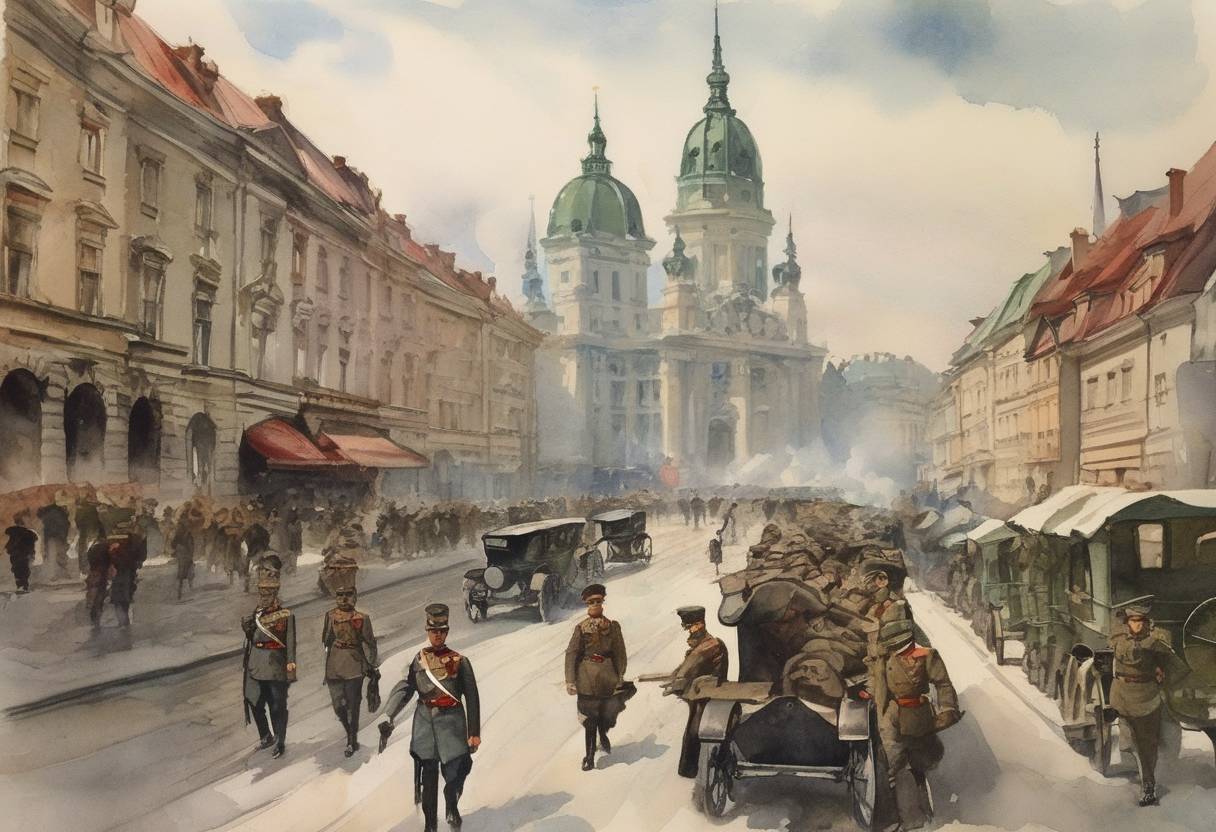
The Outbreak of World War I: Austria-Hungary Declares War on Serbia
On July 28, 1914, a pivotal moment in world history unfolded as Austria-Hungary declared war on Serbia, marking the beginning of World War I. This declaration was the culmination of a series of events that followed the assassination of Archduke Franz Ferdinand, heir to the Austro-Hungarian throne, and his wife, Sophie, in Sarajevo on June 28, 1914.
Context and Prelude to War
The Assassination
- Archduke Franz Ferdinand: The heir presumptive to the Austro-Hungarian Empire, his assassination was carried out by Gavrilo Princip, a Bosnian Serb member of the nationalist group known as the Black Hand.
- Motivation: The assassination was driven by nationalist tensions within the Balkans, where Slavic groups sought independence from Austro-Hungarian rule.
Diplomatic Tensions
- Austria-Hungary’s Response: The assassination was perceived as a direct attack on the empire’s authority, prompting a demand for retribution against Serbia, which was believed to have supported the assassins.
- The Ultimatum: On July 23, 1914, Austria-Hungary issued an ultimatum to Serbia with stringent demands, including the suppression of anti-Austrian propaganda and the involvement of Austro-Hungarian officials in the investigation of the assassination.
The Role of Alliances
- Serbia’s Partial Compliance: Serbia accepted most of the demands but rejected those that infringed on its sovereignty, leading to a breakdown in negotiations.
- Entangled Alliances: The complex web of alliances in Europe meant that a conflict between Austria-Hungary and Serbia could escalate. Russia, an ally of Serbia, began mobilizing its forces, while Germany, allied with Austria-Hungary, prepared to support its partner.
The Declaration of War
- July 28, 1914: Austria-Hungary officially declared war on Serbia, initiating military action. This declaration set off a chain reaction among the major European powers due to their interlocking alliances.
Broader Historical Significance
Escalation to World War
- Mobilization and Declarations: Following Austria-Hungary’s declaration, Russia mobilized against Austria-Hungary, prompting Germany to declare war on Russia on August 1, 1914. Germany’s subsequent invasion of Belgium brought Britain into the war on August 4, 1914.
- Global Conflict: What began as a regional conflict quickly expanded into a global war involving multiple continents and empires, fundamentally altering the geopolitical landscape.
Consequences
- Casualties and Destruction: World War I resulted in unprecedented casualties and destruction, with millions of soldiers and civilians losing their lives.
- Political Changes: The war led to the collapse of empires, including the Austro-Hungarian, Ottoman, Russian, and German empires, and set the stage for significant political changes and the eventual rise of totalitarian regimes.
The declaration of war by Austria-Hungary on Serbia on July 28, 1914, was a critical juncture that triggered one of the deadliest conflicts in human history, reshaping the world in profound ways.