The Naval Battle of Guadalcanal: A Decisive Allied Victory
1942 · Guadalcanal, Solomon Islands
The Naval Battle of Guadalcanal ends in a decisive Allied victory during World War II, marking a turning point in the Pacific Theater.
August 21, 1942
The Guadalcanal Campaign, a significant battle in the Pacific Theater of World War II, begins as the Battle of the Tenaru takes place.
Guadalcanal, Solomon Islands | Allied Forces
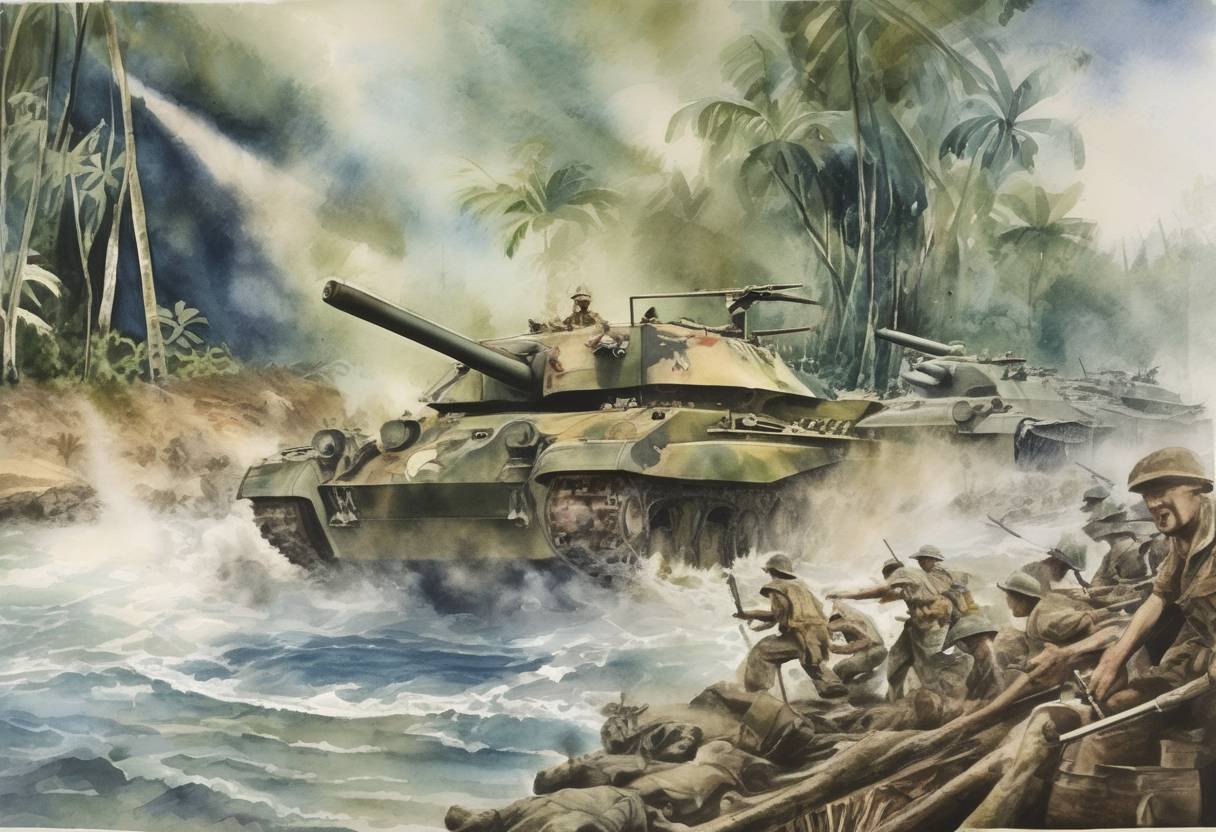
The Guadalcanal Campaign, also known as the Battle of Guadalcanal, was a pivotal series of battles in the Pacific Theater of World War II. It marked the first major offensive by Allied forces against the Empire of Japan. The campaign began on August 7, 1942, when U.S. Marines landed on the islands of Guadalcanal, Tulagi, and Florida in the Solomon Islands, aiming to deny the Japanese the ability to threaten supply and communication routes between the United States, Australia, and New Zealand.
The Battle of the Tenaru, also known as the Battle of Alligator Creek, was one of the first significant engagements of the Guadalcanal Campaign. It took place on August 21, 1942, along the Ilu River, which was mistakenly referred to as the Tenaru River by the Americans.
Japanese Assault: The battle began when a Japanese force, primarily composed of the Ichiki Detachment led by Colonel Kiyonao Ichiki, launched a night assault against the U.S. Marine positions near the Ilu River. The Japanese aimed to recapture the strategically important Henderson Field, an airfield that the Allies had seized and were using to support their operations.
American Defense: The U.S. Marines, under the command of Colonel Clifton B. Cates, were well-prepared for the assault. They had established strong defensive positions, including barbed wire and machine-gun nests, which proved crucial in repelling the Japanese attack.
Outcome: The battle was a decisive victory for the U.S. Marines. The Japanese forces, underestimating the strength and preparedness of the American defenses, suffered heavy casualties. Colonel Ichiki’s detachment was virtually annihilated, with over 800 Japanese soldiers killed, while the Marines sustained relatively few casualties.
Strategic Impact: The Battle of the Tenaru demonstrated the effectiveness of American defensive tactics and marked the first major defeat of Japanese ground forces in the Pacific. It boosted the morale of Allied forces and underscored the importance of the Guadalcanal Campaign in the broader strategy to halt Japanese expansion in the Pacific.
Continued Campaign: The Guadalcanal Campaign continued for several months, involving numerous land, sea, and air battles. It ultimately resulted in a strategic victory for the Allies, significantly weakening Japanese forces and contributing to the shift in momentum in the Pacific War.
Legacy: The campaign highlighted the importance of air superiority, logistics, and the tenacity of ground forces in jungle warfare. It set the stage for subsequent Allied offensives in the Pacific, leading to the eventual defeat of Japan in 1945.
The Battle of the Tenaru remains a testament to the bravery and resilience of the U.S. Marines and a critical moment in the Pacific Theater of World War II.
Source: en.wikipedia.org