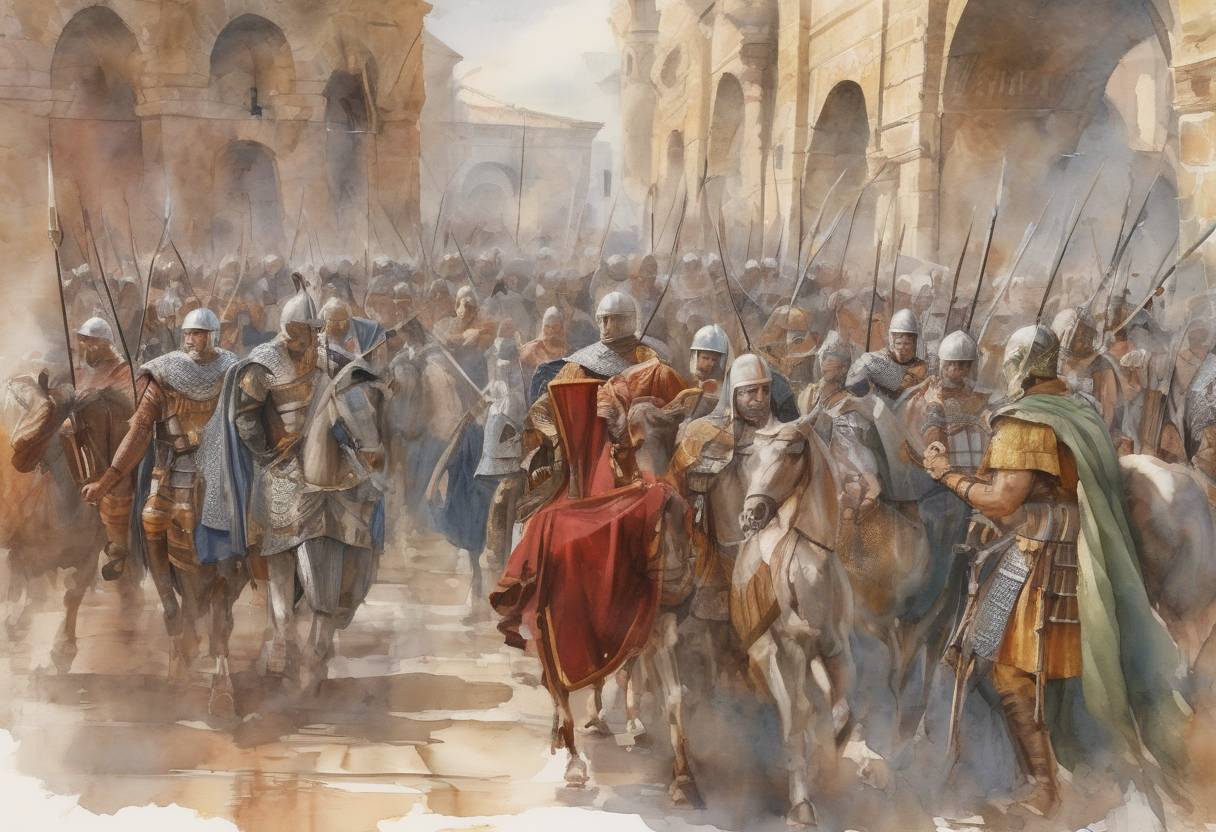
The Permanent Division of the Roman Empire: January 17, 395
On January 17, 395, the Roman Empire underwent a significant transformation with the death of Emperor Theodosius I, leading to its permanent division into the Western Roman Empire and the Eastern Roman Empire, which would later be known as the Byzantine Empire. This division marked a pivotal moment in the history of the Roman Empire, setting the stage for the distinct paths these two regions would follow.
Context and Background
The Roman Empire had been experiencing internal and external pressures for centuries, including political instability, economic troubles, and invasions by various barbarian groups. To manage these challenges, the empire had previously been divided temporarily on several occasions. The most notable division before Theodosius was under Emperor Diocletian in 285, who established the Tetrarchy, a system of rule by four emperors to better govern the vast empire.
Theodosius I, also known as Theodosius the Great, was the last emperor to rule over both the eastern and western halves of the Roman Empire. His reign was marked by efforts to strengthen the empire and promote Christianity as the state religion, culminating in the Edict of Thessalonica in 380, which made Nicene Christianity the official religion of the empire.
The Division
Upon Theodosius’s death on January 17, 395, the empire was divided between his two sons:
Honorius: He became the ruler of the Western Roman Empire, which included territories such as Italy, Gaul, Spain, Britain, and parts of North Africa. Honorius was only ten years old at the time, and his reign was largely influenced by his powerful general, Stilicho.
Arcadius: He inherited the Eastern Roman Empire, encompassing regions like the Balkans, Greece, Asia Minor, the Levant, and Egypt. Arcadius, although older than Honorius, was also a relatively weak ruler, with much of the power held by his ministers and court officials.
Consequences and Significance
The division of the Roman Empire had profound and lasting impacts:
Political and Administrative Divergence: The two halves of the empire developed distinct political and administrative systems. The Eastern Roman Empire, with its capital at Constantinople, became more centralized and bureaucratic, while the Western Roman Empire struggled with internal divisions and external threats.
Cultural and Religious Differences: Over time, cultural and religious differences between the two regions became more pronounced. The Eastern Empire, heavily influenced by Greek culture, maintained a strong Christian identity, while the Western Empire faced increasing pressure from pagan and barbarian influences.
Survival and Fall: The Eastern Roman Empire, or Byzantine Empire, managed to survive for nearly a thousand years after the fall of the Western Roman Empire in 476 AD. The Western Empire, weakened by internal strife and barbarian invasions, ultimately collapsed, marking the end of ancient Rome and the beginning of the Middle Ages in Europe.
The permanent division of the Roman Empire in 395 was a crucial turning point that shaped the course of European and Mediterranean history, influencing the political, cultural, and religious landscape for centuries to come.