The Hijra: Muhammad's Migration from Mecca to Medina
622 · Medina, present-day Saudi Arabia
The Prophet Muhammad completed his Hijra (migration) from Mecca to Medina, marking the beginning of the Islamic calendar (1 AH).
June 16, 0632
The Islamic prophet Muhammad is buried in Medina, following his death on June 8, 632. His burial marks a significant moment in Islamic history, as it leads to the succession crisis and the eventual division between Sunni and Shia Islam.
Medina, present-day Saudi Arabia | Islamic community
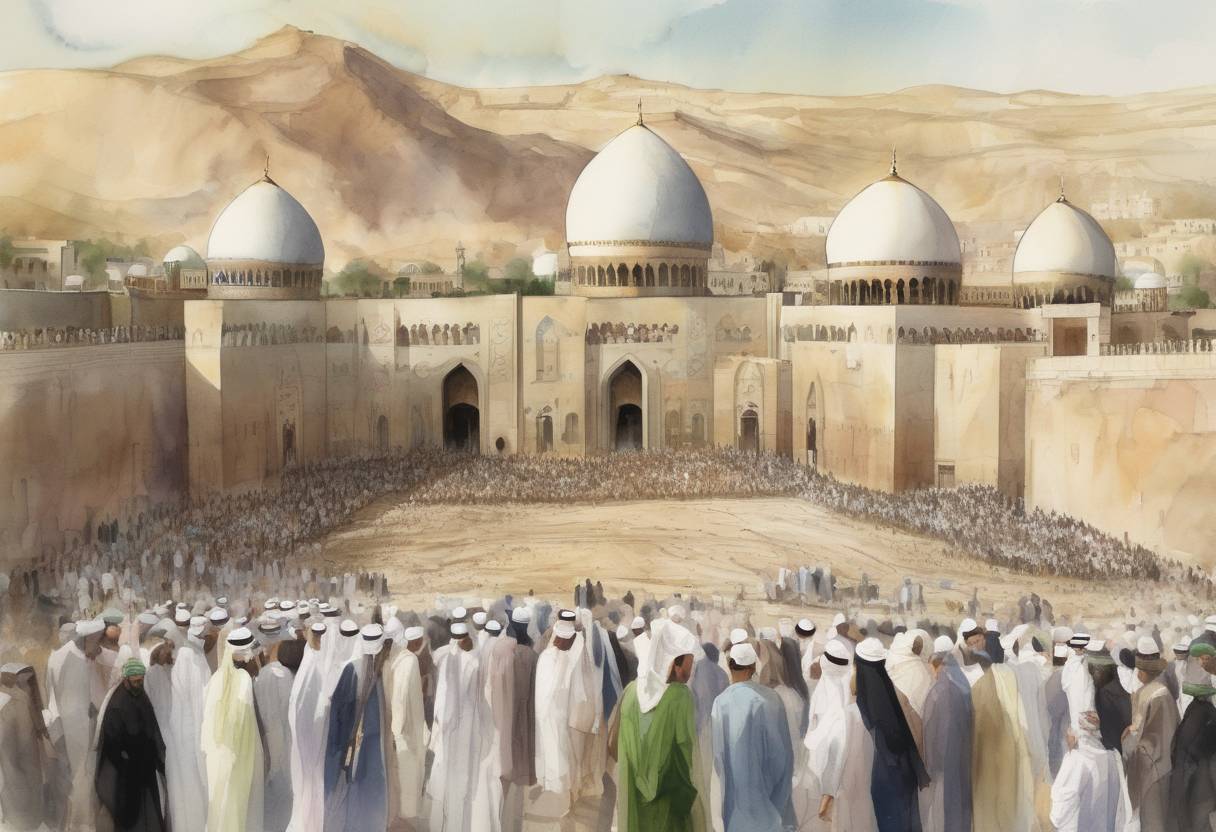
On June 8, 632, the Islamic prophet Muhammad passed away in Medina, a city in present-day Saudi Arabia. His death marked a pivotal moment in Islamic history, leading to significant developments that shaped the future of the Muslim community.
Muhammad was buried on June 16, 632, in the chamber of his wife Aisha, adjacent to the mosque he had established in Medina. This location is now part of the Prophet’s Mosque, one of the holiest sites in Islam. His burial was a moment of profound grief for his followers, who had looked to him not only as a spiritual leader but also as a political and social guide.
Muhammad’s death led to an immediate and pressing question: who would lead the Muslim community? Muhammad had not appointed a successor, which resulted in a crisis of leadership. This uncertainty gave rise to significant discussions and debates among his closest companions and followers.
Shortly after Muhammad’s death, a group of his companions gathered at Saqifah, a meeting place in Medina, to discuss the leadership issue. After deliberations, Abu Bakr, a close companion and father-in-law of Muhammad, was elected as the first Caliph (successor). His election was not without controversy, as some believed that Ali, Muhammad’s cousin and son-in-law, had been designated by Muhammad as his rightful successor.
The question of rightful leadership eventually led to the division between Sunni and Shia Islam, a split that remains to this day:
Sunni Islam: Followers who accepted Abu Bakr’s leadership and the subsequent caliphs are known as Sunnis. They emphasize the community’s consensus in choosing a leader.
Shia Islam: Those who believed that Ali was the rightful successor to Muhammad are known as Shias. They hold that leadership should remain within the Prophet’s family, specifically through Ali and his descendants.
The events following Muhammad’s death set the stage for the rapid expansion of Islam beyond the Arabian Peninsula. Under the leadership of the early caliphs, the Islamic empire expanded into the Byzantine and Sassanian territories, spreading Islamic culture and influence.
The succession crisis and the resulting Sunni-Shia division have had profound implications for Islamic theology, law, and politics. These events have shaped the religious, cultural, and geopolitical landscapes of the Muslim world throughout history.
In summary, the burial of Prophet Muhammad on June 16, 632, was not just a moment of mourning but also a turning point that led to significant developments in Islamic history, influencing the faith’s trajectory and the lives of its followers for centuries to come.
Source: www.britannica.com