Execution of Five People During the Salem Witch Trials on August 19, 1692
1692 · Salem, United States
Five people, including a clergyman, are executed for witchcraft in Salem, Massachusetts, during the Salem witch trials.
June 2, 1692
The first official execution of the Salem witch trials takes place as Bridget Bishop is hanged in Salem, Massachusetts.
Salem, United States | Salem witch trials
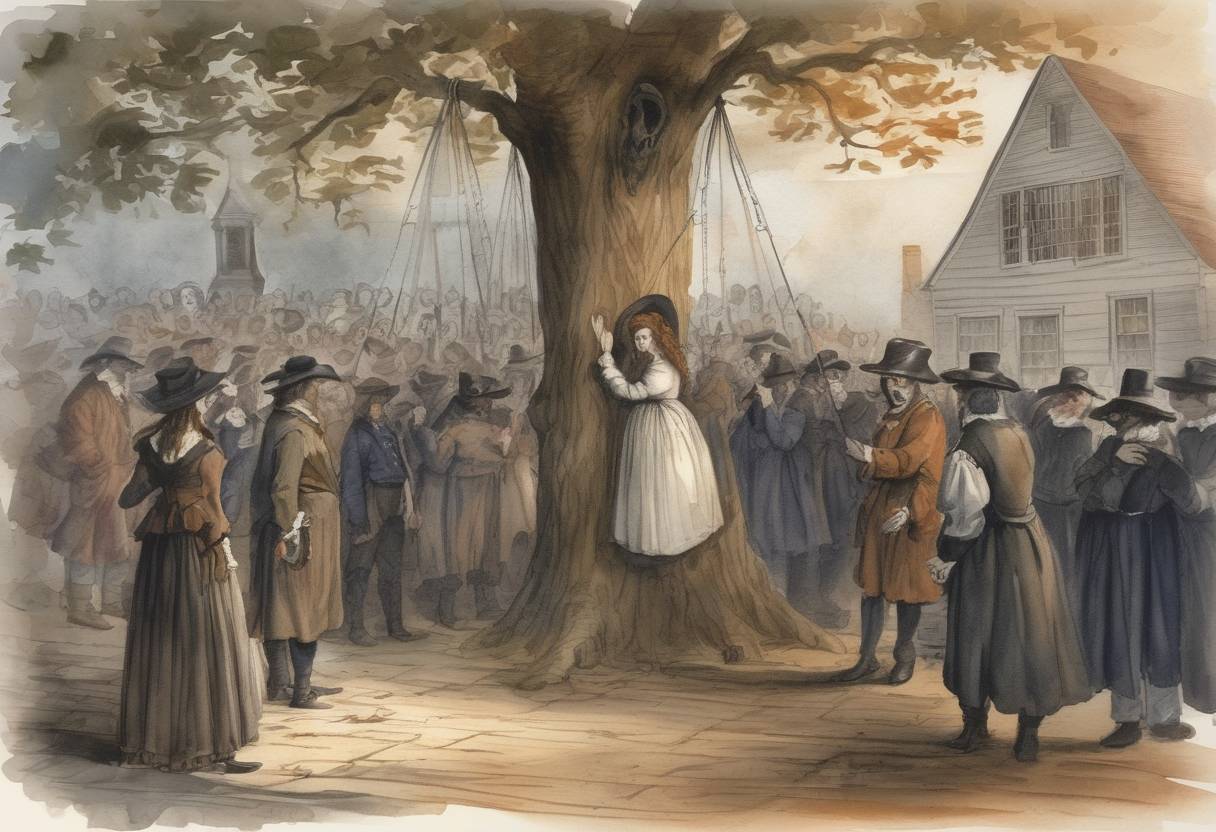
The Salem witch trials were a series of hearings and prosecutions of people accused of witchcraft in colonial Massachusetts between February 1692 and May 1693. The trials are infamous for the mass hysteria they incited and the severe miscarriages of justice that occurred. The Puritanical society of the time was deeply religious and superstitious, which contributed to the fervor and fear surrounding the accusations of witchcraft.
On June 10, 1692, Bridget Bishop became the first person to be executed during the Salem witch trials. She was hanged at Gallows Hill in Salem, Massachusetts. Bridget Bishop was a local woman known for her outspoken nature and unconventional lifestyle, which included running a tavern and wearing ostentatious clothing, both of which were frowned upon by the Puritan community.
Accusations: Bridget Bishop was accused of witchcraft by several individuals, including young girls who claimed to be afflicted by her supposed sorcery. These accusations were based on spectral evidence, which involved claims of seeing the accused’s spirit or specter committing witchcraft.
Trial: Bishop’s trial was held before the Court of Oyer and Terminer, a special court established to handle the witchcraft cases. The court relied heavily on spectral evidence and the testimonies of the afflicted girls. Despite the lack of concrete evidence, Bishop was found guilty of witchcraft.
Date and Location: Bridget Bishop was executed on June 10, 1692, at Gallows Hill, a site used for public executions.
Significance: Her execution marked the beginning of a tragic period in American colonial history, where fear and superstition led to the deaths of 19 people by hanging and the imprisonment of many others.
The execution of Bridget Bishop set a precedent for the subsequent trials and executions that followed. The Salem witch trials eventually led to widespread criticism and reflection on the use of spectral evidence and the judicial processes of the time. By the end of 1692, the fervor had begun to wane, and the trials were eventually deemed unlawful. In 1693, the remaining accused were released, and the court was disbanded.
The Salem witch trials remain a poignant example of the dangers of mass hysteria, the importance of due process, and the need for evidence-based judicial proceedings. They serve as a reminder of the consequences of fear-driven justice and the importance of safeguarding individual rights.
Source: en.wikipedia.org