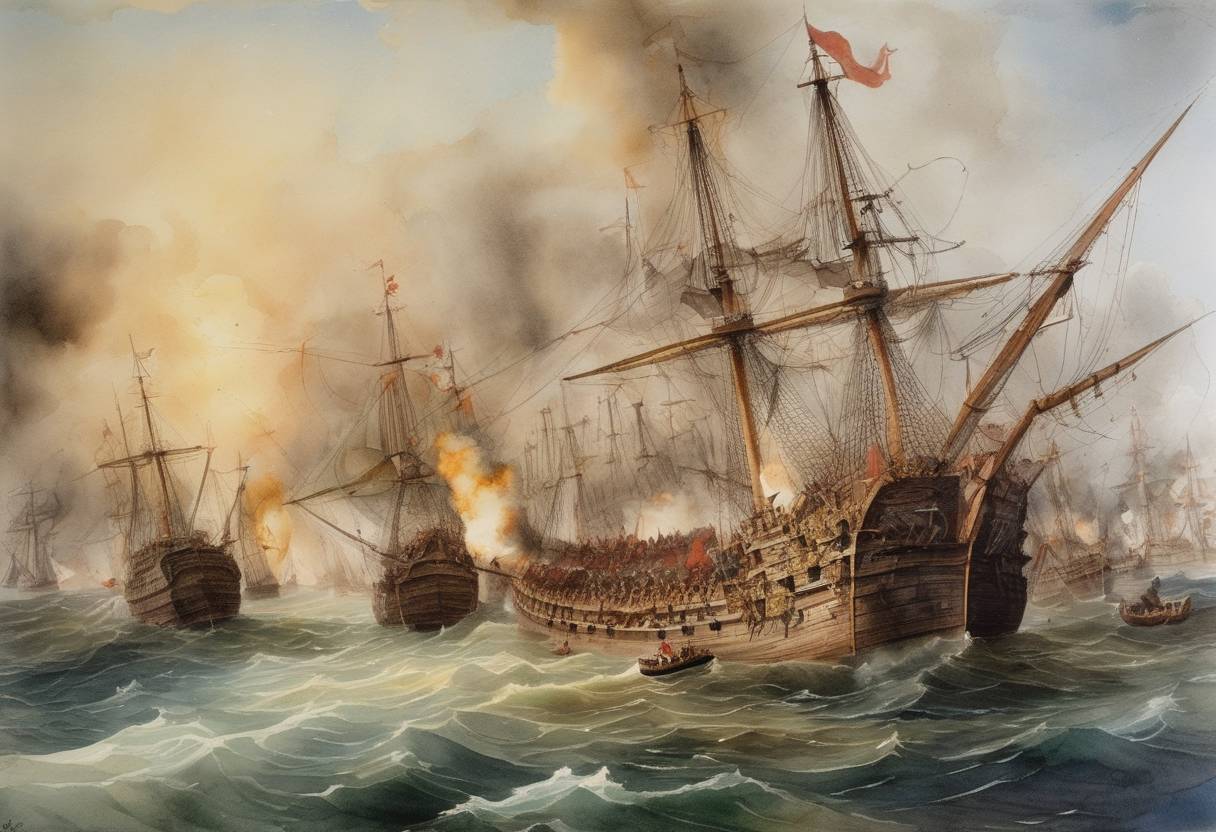
The Battle of Meloria - August 6, 1284
The Battle of Meloria, a significant naval engagement, occurred on August 6, 1284, off the coast of Meloria, near Livorno, Italy. This confrontation was pivotal in the ongoing rivalry between two prominent Italian maritime republics: Pisa and Genoa.
Background
In the late 13th century, Pisa and Genoa were two of the most powerful maritime republics in Italy, both vying for dominance over the trade routes of the western Mediterranean. Their rivalry was fueled by competition for control over Sardinia, Corsica, and access to lucrative markets in the East. Prior to the battle, Genoa had been gaining strength and seeking to undermine Pisa’s naval supremacy.
The Battle
The fleets met off the coast of Meloria on August 6, 1284. The Genoese fleet, commanded by Oberto Doria and Benedetto Zaccaria, fielded around 93 galleys, compared to the approximately 72 galleys under the Pisan command led by Alberto Morosini. The Genoese employed superior naval tactics, including the use of a reserve fleet that caught the Pisans off-guard, and effectively surrounded and decimated the Pisan navy.
Outcome
The battle concluded with a decisive Genoese victory. The Pisan fleet was devastated, suffering significant losses in ships and manpower. Thousands of Pisan sailors were captured, many of whom spent years imprisoned in Genoa.
Aftermath and Significance
This battle drastically weakened Pisa’s naval capabilities and marked the beginning of its decline as a dominant maritime power. Consequently, Genoa consolidated its control over crucial trade routes, enhancing its influence in the Mediterranean.
The defeat also impacted Pisa politically and economically, diminishing its ability to project power and pursue its interests in the region. The loss of Meloria exacerbated internal strife and contributed to Pisa’s eventual subjugation by Florence in the early 15th century.
The Battle of Meloria was thus a turning point that redefined the balance of power among the Italian maritime republics, signifying a shift toward Genoese dominance during a critical period of Mediterranean trade and politics.