The Outbreak of the Korean War: June 25, 1950
1950 · Seoul, Korea
The Korean War began when North Korean forces crossed the 38th parallel into South Korea.
August 11, 1945
Allied control of Korea began with the establishment of the 38th parallel as a temporary division between Soviet and American forces.
Seoul, Korea | Allied Powers
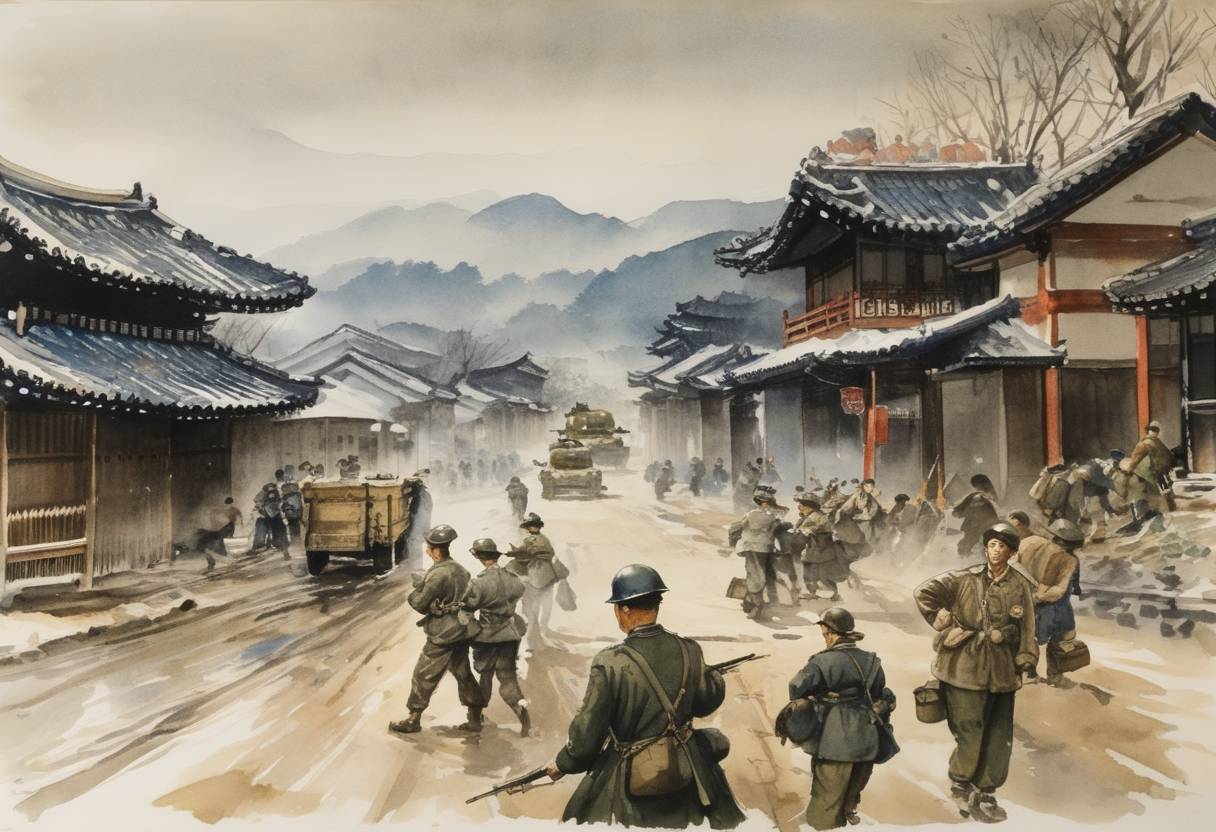
On August 11, 1945, as part of the broader Allied occupation efforts in the closing days of World War II, the 38th parallel was established as the dividing line between Soviet and American military interests on the Korean Peninsula. This demarcation was intended as a temporary measure to facilitate the surrender and disarmament of Japanese forces occupying Korea, following Japan’s impending defeat.
Background: Korea had been under Japanese colonial rule since 1910. With the defeat of Nazi Germany in Europe and the Pacific War concluding, attention turned to the post-war administration of countries liberated from Axis powers.
Yalta Conference Decisions: Earlier in February 1945, world leaders at the Yalta Conference, including the United States and the Soviet Union, discussed post-war reorganization, which included plans for Korea.
Potsdam Conference: In July-August 1945, further plans were discussed at the Potsdam Conference, leading up to Japan’s unconditional surrender.
Decision: The decision to use the 38th parallel as a division line was made quickly by U.S. Army strategists. This line was chosen, in part, because it seemed to conveniently split the peninsula, allowing for manageable administration between Soviet and American forces.
Implementation: Soviet forces began occupying the Korean Peninsula from the north on August 9, 1945. The formal establishment of the 38th parallel as the dividing line followed shortly after, on August 11, when U.S. planners proposed it as a tactical boundary for occupation forces.
Military Occupation: Soviet troops accepted the surrender of Japanese forces north of the 38th parallel, while American forces did so to the south. This division laid initial frameworks for the separate control zones.
Political Implications: This demarcation laid the groundwork for the eventual formation of two distinct governments. Northern Korea developed under Soviet influence, while the south came under American guidance.
Rising Tensions: Though initially intended as a temporary administrative measure, the division grew into a permanent political and ideological boundary, leading to rising tensions during the early Cold War era.
Korean Peninsula: These events foreshadowed the division of Korea into two states: the Democratic People’s Republic of Korea (North Korea) and the Republic of Korea (South Korea).
Cold War Dynamics: The establishment of the 38th parallel contributed to the geopolitical rift that characterized much of the Cold War, influencing U.S.-Soviet (and subsequently U.S.-China) dynamics for decades to follow.
The establishment of the 38th parallel thus marked the beginning of a division that was intended to be provisional but became one of the most enduring legacies of the post-war geopolitical restructuring, with significant ramifications throughout the latter half of the 20th century and beyond.
Source: www.britannica.com