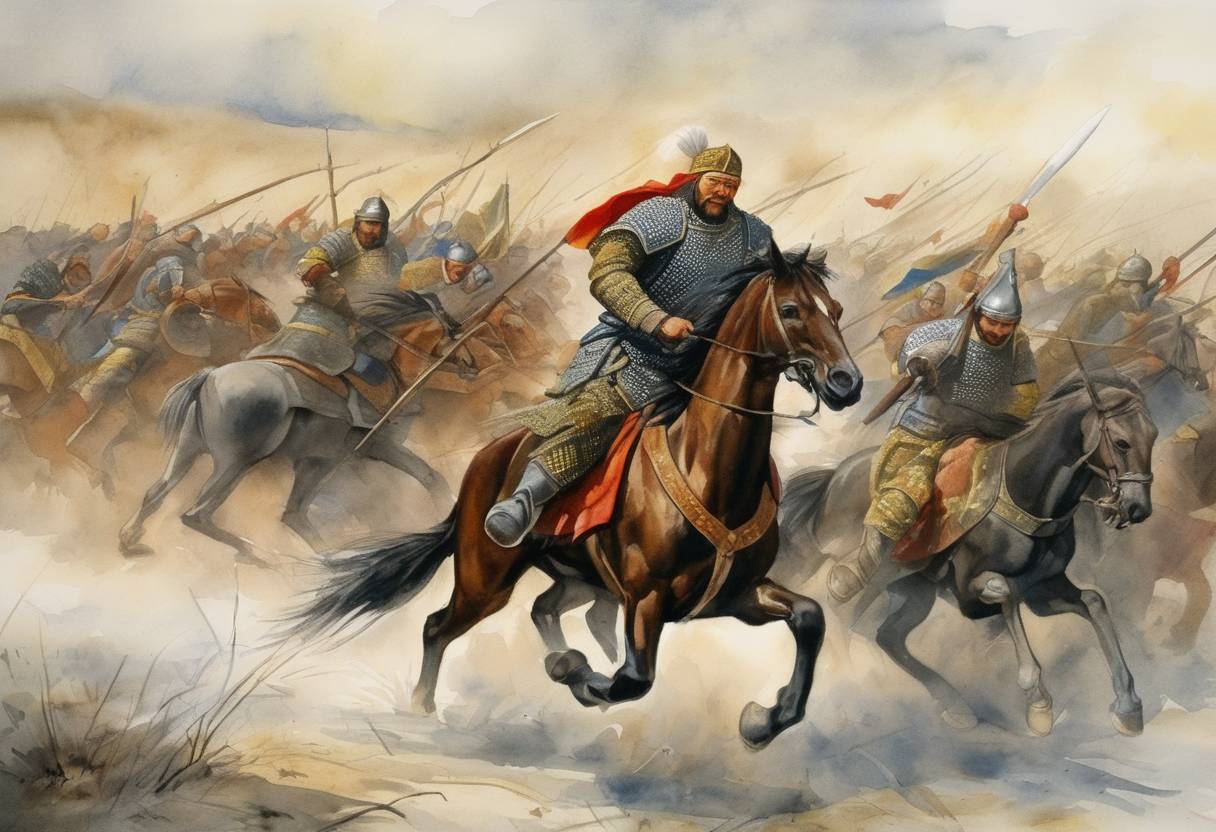
Battle of the Kalka River: 31 May 1223
The Battle of the Kalka River, fought on 31 May 1223, was a pivotal confrontation between the Mongol forces led by Subutai and Jebe, and a coalition of several Rus’ principalities along with their Cuman allies. The battle was a significant engagement during the early Mongol incursions into Eastern Europe and marked a decisive Mongol victory, demonstrating their superior military tactics and strategic acumen.
Background
The Mongol invasion into the lands of the Kievan Rus’ and neighboring territories was part of a broader reconnaissance in force, intended to assess the military strength of the regions west of the Mongol Empire. After defeating the Cumans—nomadic warrior tribes allied with several Rus’ principalities—Mongol generals Subutai and Jebe aimed to dismantle any further support structures by targeting the Rus’ forces directly.
The Coalition
In response to the Mongol forays, a coalition of Rus’ principalities was formed under the leadership of Mstislav the Bold of Galich, Mstislav III of Kiev, and Mstislav of Chernigov. This alliance was joined by the Cumans, who were eager to avenge their defeat at the hands of the Mongols. Despite their combined strength, the coalition forces lacked the cohesion and discipline demonstrated by the Mongol army.
The Battle
The battle took place near the Kalka River, which was strategically important due to its location and terrain. Using feigned retreats—a favored Mongol tactic—Subutai and Jebe lured the Rus’ coalition into a vulnerable position. This tactic involved enticing the enemy into overextending their lines, believing they were routing the Mongol forces. Once the coalition was disorganized, the Mongols counterattacked with devastating effectiveness.
The Mongol cavalry executed rapid maneuvers, encircling and annihilating the Rus’ forces. The lack of central command among the Rus’ and their allies, coupled with the superior coordination and speed of the Mongol cavalry, contributed significantly to the Mongol victory. Key Rus’ leaders, including Mstislav of Kiev, suffered heavy losses, and many were captured or killed.
Aftermath
The aftermath of the Battle of the Kalka River had profound implications:
Rus’ Disarray: The defeat shattered the unity of the Rus’ principalities, leading to a weakened collective defense that would have consequences during subsequent Mongol campaigns.
Mongol Prestige: The success at Kalka River served as a display of Mongol military prowess, underscoring their capability to defeat larger, less coordinated forces through strategic innovation.
Future Invasions: Though the Mongols did not immediately advance further into Rus’ territories due to their limited invasion objective, the battle laid groundwork for future full-scale invasions, culminating in the eventual Mongol domination of the Kievan Rus’.
The Battle of the Kalka River remains a notable example of the early Mongol campaigns in Europe, illustrating the initial phases of their expansion and their impact on the geopolitical landscape of the 13th century.