The Death of Charles the Bold and the Battle of Nancy
1477 · Nancy, France
Charles the Bold, Duke of Burgundy, was killed at the Battle of Nancy, leading to the end of the Burgundian Wars and significant territorial changes in Europe.
October 29, 1467
The Battle of Brustem took place during the Liège Wars, resulting in a victory for Charles the Bold, Duke of Burgundy, over the Prince-Bishopric of Liège.
Brustem, present-day Belgium | Burgundian State
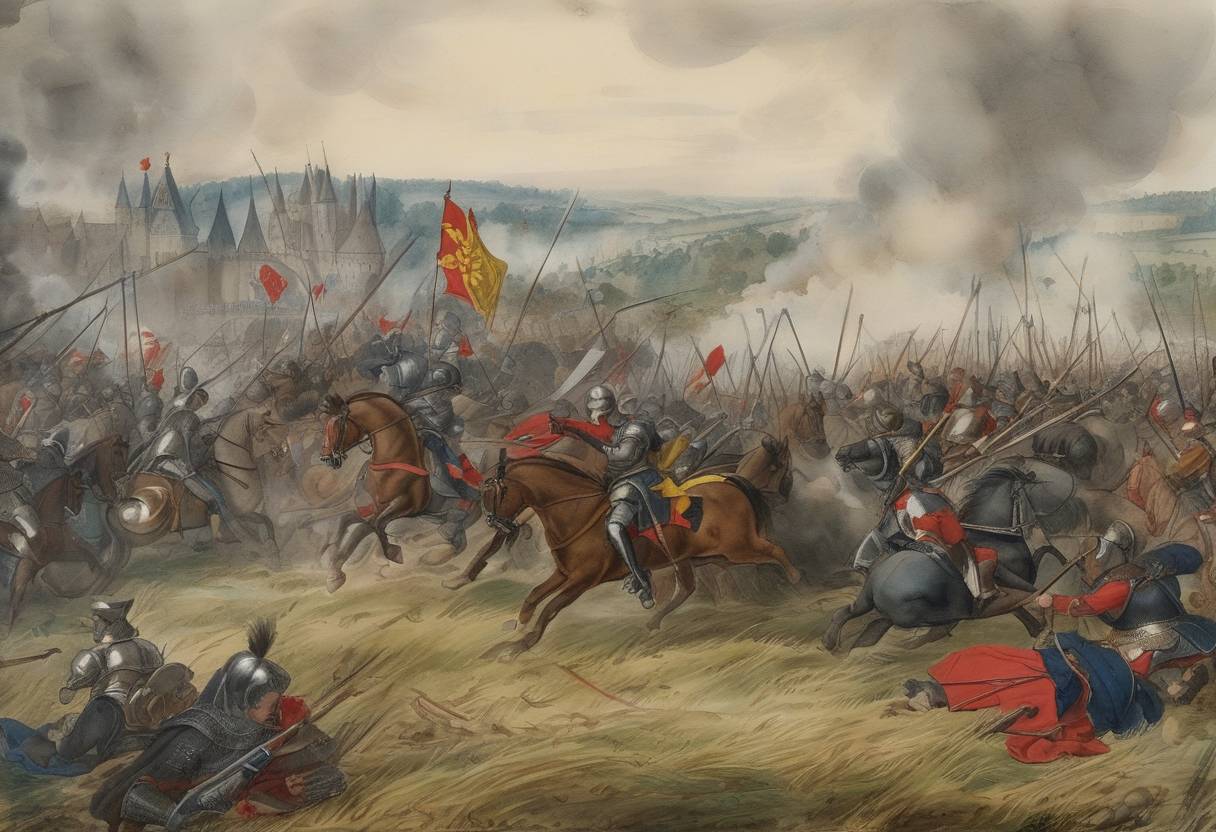
On October 29, 1467, the Battle of Brustem became a significant conflict during the Liège Wars, marking a decisive victory for Charles the Bold, Duke of Burgundy, over the forces of the Prince-Bishopric of Liège.
The Liège Wars were a series of conflicts in the 15th century involving the city of Liège and its prince-bishopric against the powerful Duchy of Burgundy. The roots of the conflict lay in Liège’s efforts to maintain independence and resist Burgundian influence, growing under the rule of Charles’s predecessors.
Tensions intensified when Charles the Bold, later Duke of Burgundy, became involved in the power struggles within the region. After succeeding his father, Philip the Good, in 1467, Charles sought to assert control over the rebel territories, including Liège.
The battle occurred near Brustem, a village in what is now modern-day Belgium. The forces of the Prince-Bishopric of Liège, led by Prince-Bishop Louis de Bourbon, faced the economically and militarily superior Burgundian army under Charles’s command.
Troop Composition:
Battle Events:
The outcome of the Battle of Brustem was significant for several reasons:
The battle effectively ended the ongoing Liège Wars, allowing Charles to focus on other ambitions and challenges within his expansive domain. The consolidation of power following this victory reinforced the strategic and political importance of the Burgundian Netherlands during the late medieval period.
In the wake of the Battle of Brustem, Charles the Bold continued to consolidate his control over the region. The resistance in Liège was weakened, and the political landscape began to stabilize under Burgundian rule.
Significantly, this battle exemplified the era’s transition to more organized and technologically advanced warfare, as evidenced by the effective use of artillery, setting a precedent for future military engagements in the region.
Source: en.wikipedia.org