1924 · Santo Domingo, Dominican Republic
American soldiers leave the Dominican Republic after eight years of occupation that began in 1916. The occupation was initially aimed at ensuring political stability and safeguarding foreign interests.
April 28, 1965
The U.S. Marines landed in the Dominican Republic to protect U.S. citizens during the Dominican Civil War.
Santo Domingo, Dominican Republic | United States Marine Corps
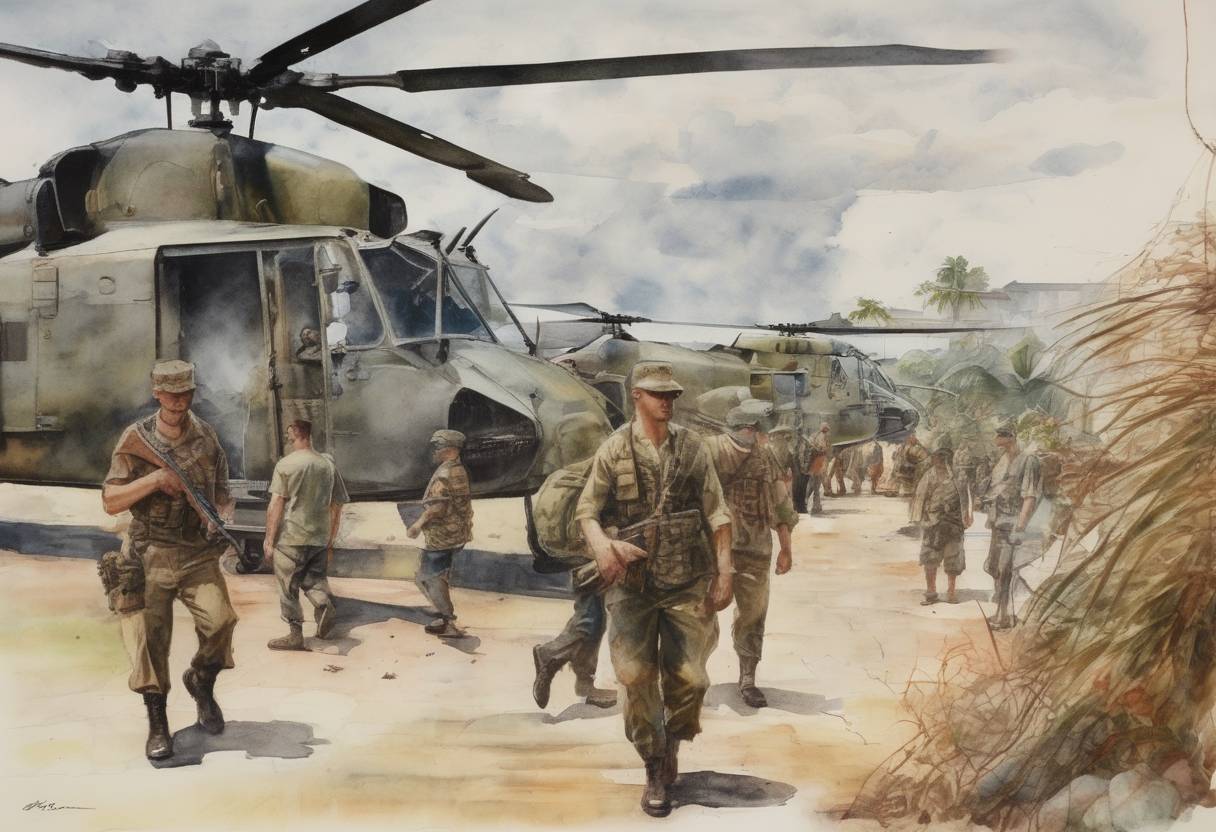
On April 28, 1965, U.S. Marines landed in the Dominican Republic as part of “Operation Power Pack,” a military intervention aimed at protecting American citizens and preventing the spread of communism during the Dominican Civil War. This intervention was a significant event in the context of Cold War geopolitics and U.S. foreign policy in Latin America.
The Dominican Civil War erupted in April 1965, following a coup d’état in 1963 that ousted the democratically elected president, Juan Bosch. Bosch’s government was seen as progressive and reformist, which alarmed conservative elements within the Dominican military and business sectors. The coup led to a period of political instability and unrest.
In April 1965, a group of military officers and civilians, known as the “Constitutionalists,” attempted to restore Bosch to power. This led to intense fighting in the capital, Santo Domingo, between the Constitutionalists and the opposing “Loyalist” forces, who were supported by the military junta that had replaced Bosch.
Amidst the escalating violence, the U.S. government, led by President Lyndon B. Johnson, grew concerned about the safety of American citizens and the potential for a communist takeover, reminiscent of the Cuban Revolution. The Johnson administration feared that the instability could lead to the establishment of a government aligned with the Soviet Union or Cuba.
On April 28, 1965, President Johnson ordered the deployment of U.S. Marines to the Dominican Republic. The initial force consisted of approximately 400 Marines, with the mission to secure the U.S. Embassy and ensure the safety of American citizens. Over the following days, the number of U.S. troops increased significantly, eventually reaching around 23,000.
The U.S. intervention played a crucial role in stabilizing the situation, but it also drew criticism both domestically and internationally. Critics argued that the intervention was an overreach of American power and an infringement on Dominican sovereignty. The intervention was perceived by some as an example of U.S. imperialism in Latin America.
The presence of U.S. forces helped facilitate a ceasefire and led to negotiations that eventually resulted in the establishment of a provisional government. In 1966, elections were held, and Joaquín Balaguer, a former ally of the ousted dictator Rafael Trujillo, was elected president.
The intervention in the Dominican Republic highlighted the complexities of U.S. foreign policy during the Cold War, particularly in the Western Hemisphere. It underscored the U.S. commitment to containing communism but also raised questions about the balance between intervention and respect for national sovereignty.
The 1965 intervention in the Dominican Republic is a notable example of Cold War-era U.S. military involvement in Latin America. It reflects the broader strategy of the United States to prevent the spread of communism in its sphere of influence, often prioritizing geopolitical concerns over democratic principles. The event remains a point of discussion in analyses of U.S.-Latin American relations and the legacy of Cold War interventions.
Source: en.wikipedia.org