Coronation of Władysław II Jagiełło as King of Poland
1386 · Kraków, Poland
Władysław II Jagiełło was crowned King of Poland.
October 16, 1384
Jadwiga is crowned King of Poland, a title she holds despite being female, marking a significant moment in Polish history.
Kraków, Poland | Kingdom of Poland
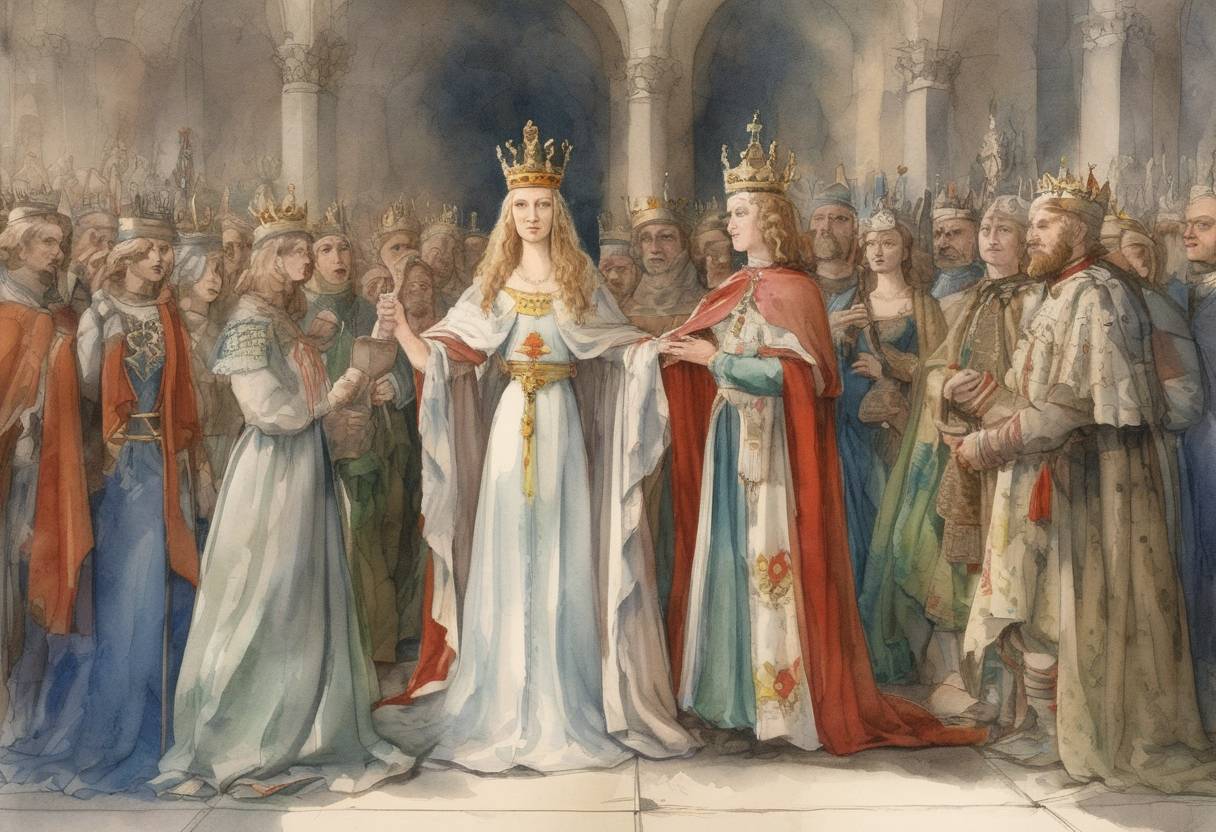
On October 16, 1384, a significant event unfolded in Polish history when Jadwiga of Anjou was crowned “King” of Poland. This momentous occasion marked not only a pivotal point in the history of Poland but also a unique instance of a female monarch assuming a traditionally male title.
Jadwiga was born in 1373 or 1374 into the powerful Anjou dynasty, the daughter of Louis I of Hungary and Elizabeth of Bosnia. Her father, Louis I, was also King of Poland, having inherited the throne through his mother, Elizabeth of Poland. Upon his death in 1382, a succession crisis ensued, as Louis left no male heirs. The Polish nobility, seeking to maintain their influence and autonomy, decided to invite Jadwiga to assume the throne.
Jadwiga’s coronation took place in Kraków, the capital of Poland at the time. Despite being female, she was crowned as “rex” (king) rather than “regina” (queen), a decision that underscored her role as a sovereign ruler in her own right, rather than merely a consort. This title was significant as it emphasized her authority and the legitimacy of her rule in a male-dominated society.
Jadwiga’s reign is notable for several reasons:
Political Alliance: Her marriage to Jogaila, the Grand Duke of Lithuania, in 1386, was a strategic alliance that led to the Union of Krewo. This union effectively merged Poland and Lithuania, creating a powerful political entity in Eastern Europe.
Cultural and Religious Influence: Jadwiga was a devout Catholic and played a crucial role in the Christianization of Lithuania. Her efforts in promoting education and religion were instrumental in the cultural development of the region.
Legacy: Jadwiga’s reign laid the groundwork for the future Polish-Lithuanian Commonwealth, a significant political and cultural force in Europe for centuries. Her legacy is celebrated in Poland, and she was canonized as a saint by the Roman Catholic Church in 1997.
Jadwiga ruled until her untimely death in 1399. Her reign, though relatively short, was marked by her diplomatic acumen and commitment to her kingdom’s prosperity. Her marriage to Jogaila not only secured the Polish-Lithuanian alliance but also set the stage for the Jagiellonian dynasty, which would rule Poland for nearly two centuries.
In summary, Jadwiga’s coronation as King of Poland on October 16, 1384, was a landmark event that had profound implications for the political landscape of Eastern Europe. Her reign is remembered for its strategic alliances, cultural contributions, and the unique position she held as a female monarch in a patriarchal society.
Source: en.wikipedia.org