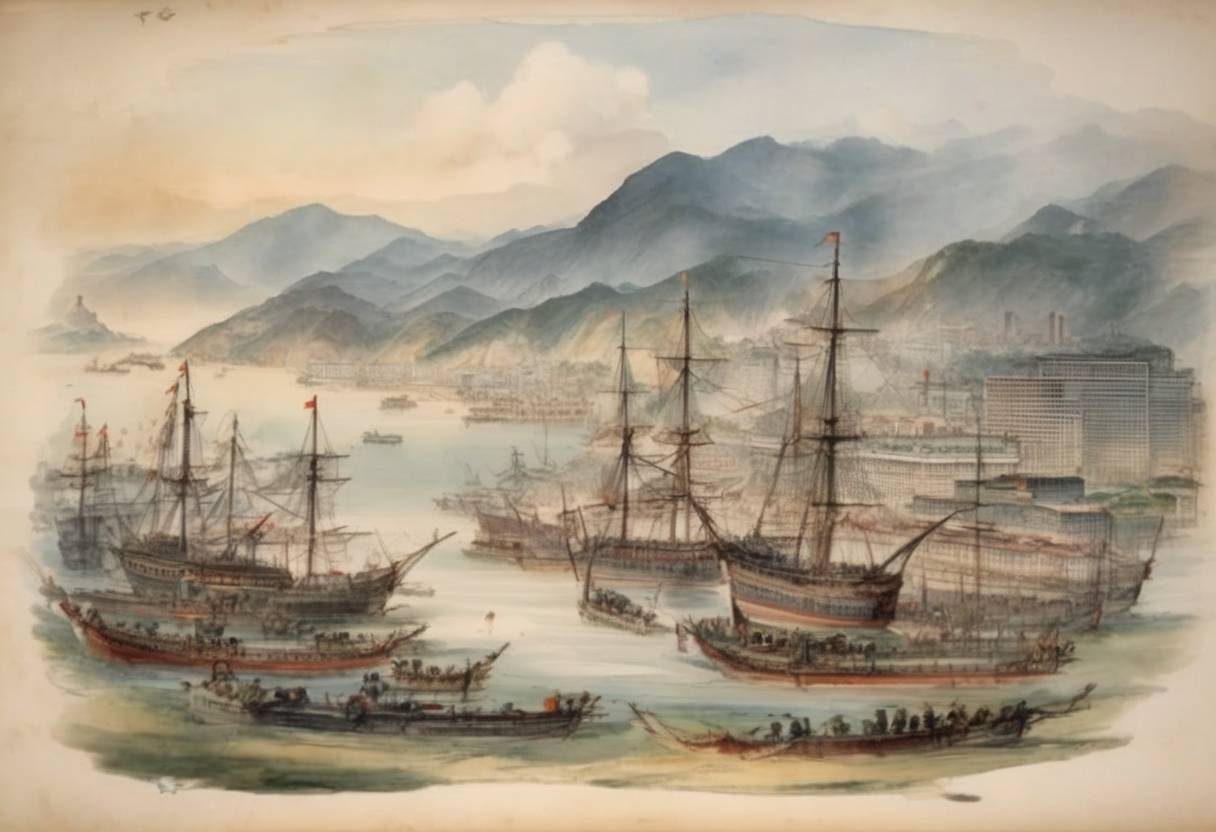
The Capture of Hong Kong by the United Kingdom on August 23, 1839
Context and Background
The capture of Hong Kong by the United Kingdom on August 23, 1839, was a pivotal moment in the lead-up to the First Opium War between Britain and Qing China. The roots of this conflict lay in the trade imbalances and diplomatic tensions that had been escalating over the preceding decades.
Trade Imbalance and Opium Trade
- Trade Imbalance: By the early 19th century, Britain faced a significant trade deficit with China. The British demand for Chinese tea, silk, and porcelain was high, but China had little interest in British goods.
- Opium as a Solution: To counteract this imbalance, the British East India Company began exporting opium from India to China. The addictive nature of opium led to widespread addiction in China, causing social and economic problems.
Chinese Crackdown and British Response
- Chinese Crackdown: In response to the growing opium crisis, the Qing government, under the leadership of Commissioner Lin Zexu, took strong measures to halt the opium trade. This included the confiscation and destruction of opium stocks in Canton (Guangzhou) in 1839.
- British Reaction: The destruction of British-owned opium was seen as an affront to British trade interests and national pride. This incident, coupled with the refusal of the Qing government to compensate for the destroyed opium, escalated tensions.
The Capture of Hong Kong
- Strategic Importance: Hong Kong, a sparsely populated island at the time, was identified by the British as a strategically valuable location. Its deep-water harbor made it an ideal base for naval operations.
- Occupation: On August 23, 1839, British forces occupied Hong Kong, establishing it as a base of operations as they prepared for military engagement with China.
Aftermath and Significance
- First Opium War: The occupation of Hong Kong was a precursor to the First Opium War, which officially began in 1839 and lasted until 1842. The war was characterized by several naval battles and the eventual defeat of the Qing forces.
- Treaty of Nanking: The war concluded with the Treaty of Nanking in 1842, which ceded Hong Kong Island to Britain in perpetuity, marking the beginning of British colonial rule in Hong Kong.
- Long-term Impact: The capture and subsequent cession of Hong Kong had long-lasting implications. It marked the start of a series of “Unequal Treaties” that eroded Qing sovereignty and opened China to foreign influence and trade under unfavorable terms.
Conclusion
The capture of Hong Kong by the United Kingdom on August 23, 1839, was a significant event that set the stage for the First Opium War. It highlighted the growing tensions between Western powers and Qing China, driven by trade disputes and differing worldviews. The consequences of this event were profound, leading to changes in China’s interactions with the West and the establishment of Hong Kong as a major global city under British rule.