Roald Amundsen's Historic Journey to the South Pole
1911 · South Pole, Antarctica
Norwegian explorer Roald Amundsen became the first person to reach the South Pole, marking a significant achievement in the Heroic Age of Antarctic Exploration.
November 29, 1929
U.S. Admiral Richard E. Byrd became the first person to fly over the South Pole, marking a significant achievement in polar exploration.
South Pole, Antarctica | United States Navy
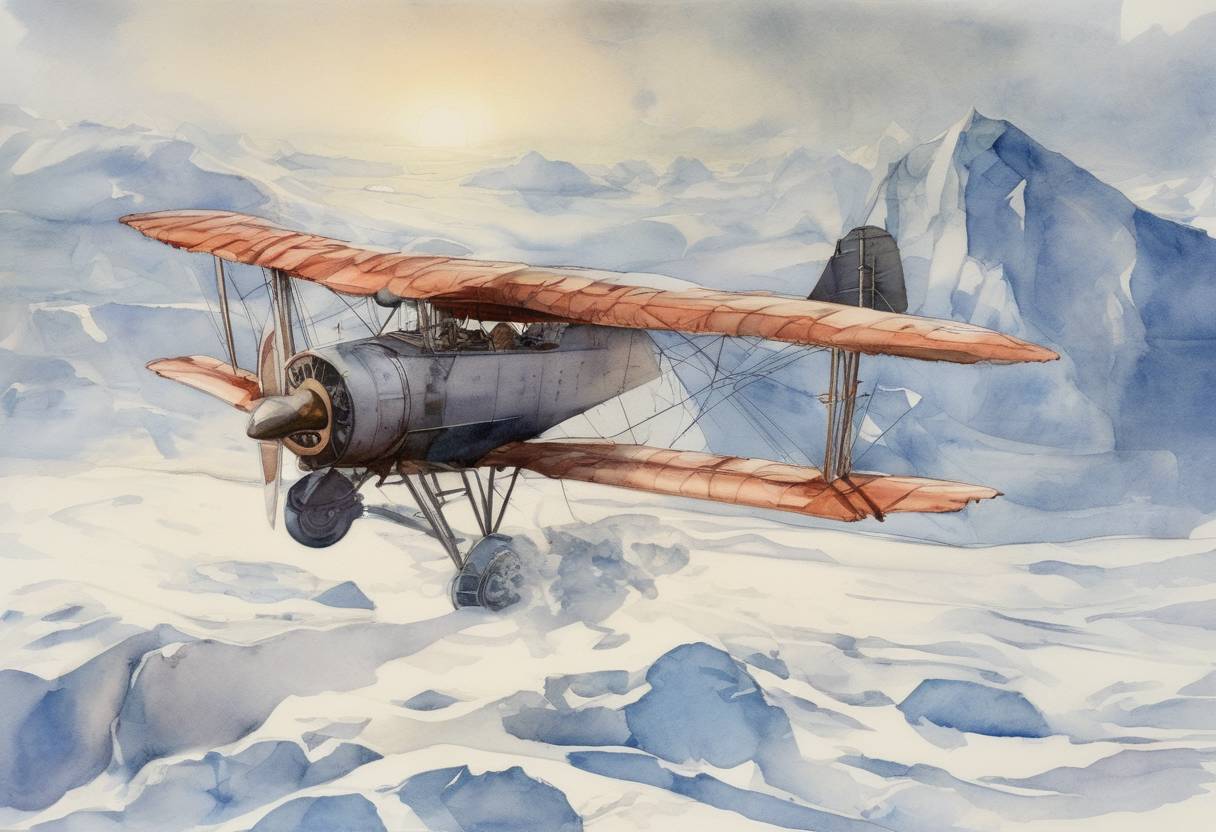
On November 29, 1929, U.S. Admiral Richard E. Byrd achieved a significant milestone in the annals of polar exploration by becoming the first person to fly over the South Pole. This daring feat was part of Byrd’s larger Antarctic expedition, which aimed to advance scientific knowledge and demonstrate the potential of aviation in exploration.
Richard Evelyn Byrd was a pioneering American naval officer and aviator, renowned for his contributions to exploration. Prior to his Antarctic ventures, Byrd had already gained fame for his transatlantic flight attempts and his 1926 flight over the North Pole, although the latter’s legitimacy has been subject to debate.
Byrd’s Antarctic expedition, known as the Byrd Antarctic Expedition, was meticulously planned and well-funded, involving a combination of private and public support. The expedition’s objectives included geographical exploration, scientific research, and the demonstration of aviation’s capabilities in extreme environments.
The historic flight over the South Pole was conducted in a Ford Trimotor aircraft named the “Floyd Bennett,” after Byrd’s late friend and fellow aviator. The aircraft was specially equipped for the harsh Antarctic conditions, featuring modifications to handle the extreme cold and high altitudes.
Byrd, accompanied by co-pilot Bernt Balchen, radio operator Harold June, and photographer Ashley McKinley, took off from the expedition’s base, Little America, located on the Ross Ice Shelf. The flight covered approximately 1,600 miles round trip and lasted about 18 hours.
During the flight, Byrd and his team faced numerous challenges, including severe cold, navigational difficulties, and the risk of mechanical failure. Despite these obstacles, they successfully reached the South Pole, marking the first time humans had flown over this remote and inhospitable part of the world.
Byrd’s successful flight over the South Pole was a landmark achievement in the history of exploration. It demonstrated the potential of aviation in expanding human reach to the most inaccessible parts of the planet. The expedition also contributed valuable scientific data and geographical information about Antarctica.
The success of the flight bolstered Byrd’s reputation as a leading figure in exploration and aviation. He continued to lead further expeditions to Antarctica, contributing to the establishment of permanent research stations and advancing scientific understanding of the continent.
Byrd’s achievements inspired future generations of explorers and underscored the importance of technological innovation in overcoming the challenges of exploration. His legacy is remembered as a testament to human curiosity and the relentless pursuit of knowledge.
Source: www.history.com